
Effectiveness of Monetary Policy
Monetary policy is used by the central bank to influence:
- Aggregate demand (AD)
- Inflation
- Economic growth
- Unemployment
- Financial stability
The effectiveness of monetary policy depends on:
- Economic conditions
- Consumer and business behaviour
- Banking system responses
- Confidence levels
- Global economic factors
Monetary policy can be highly effective in some situations, but it also faces important constraints and limitations.
Constraints on Monetary Policy
There are several factors that may reduce the effectiveness of monetary policy.
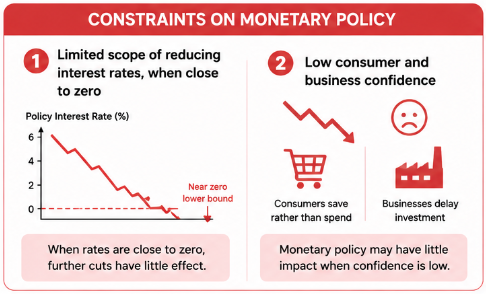
1. Limited Scope of Reducing Interest Rates When Close to Zero
During severe recessions, central banks may lower interest rates repeatedly to stimulate aggregate demand.
However, interest rates cannot usually fall much below:
\( \mathrm{0\%} \)
This creates a major limitation for expansionary monetary policy.
Zero Lower Bound
The zero lower bound refers to the situation where nominal interest rates are near zero and cannot easily be reduced further.
When interest rates are already extremely low:
- The central bank loses much of its ability to stimulate borrowing and spending through further rate cuts.
Liquidity Trap
A liquidity trap may occur when:
- Interest rates are extremely low
- People prefer holding cash instead of spending or investing
In this situation:
- Increasing money supply may not significantly increase aggregate demand.
Why Monetary Policy Becomes Less Effective
Even with very low interest rates:
- Consumers may avoid spending.
- Firms may avoid investment.
- Banks may lend cautiously.
This weakens the transmission mechanism of monetary policy.
Example
After major financial crises, some economies experienced near-zero interest rates but weak economic recovery because confidence remained low.
2. Low Consumer and Business Confidence
The effectiveness of monetary policy depends heavily on confidence levels in the economy.
Low Consumer Confidence
If consumers are pessimistic about the future:
- They may reduce spending.
- They may increase savings.
- They may avoid borrowing even when interest rates are low.
Low Business Confidence
If firms expect weak future demand:
- They may postpone investment projects.
- They may avoid hiring workers.
- They may reduce production.
Effect on Expansionary Monetary Policy
Even if the central bank lowers interest rates:
- Consumption may not increase significantly.
- Investment may remain weak.
As a result, aggregate demand may not rise sufficiently.
Confidence and Recession
During deep recessions or financial crises:
- Fear and uncertainty may reduce the effectiveness of monetary policy.
Strengths of Monetary Policy
Despite limitations, monetary policy has several important strengths.
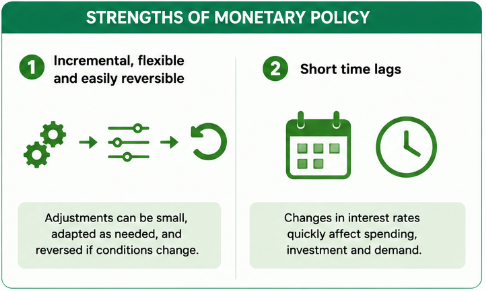
1. Incremental, Flexible and Easily Reversible
Monetary policy can be adjusted gradually according to changing economic conditions.
Incremental Changes
Central banks can:
- Raise interest rates slowly
- Lower interest rates gradually
- Adjust liquidity step by step
This allows policymakers to respond carefully to economic developments.
Flexibility
Monetary policy is flexible because the central bank can react quickly to:
- Inflation changes
- Economic slowdowns
- Financial instability
- External shocks
Easily Reversible
If policy changes produce unwanted effects:
- The central bank can reverse policy relatively quickly.
Examples:
- Interest rates can be raised after earlier cuts.
- Open market operations can be reversed.
Advantage Compared with Fiscal Policy
Fiscal policy changes may require:
- Government approval
- Political processes
- Long implementation periods
Monetary policy is often faster and more flexible.
2. Short Time Lags
Time lag refers to the delay between policy implementation and economic effects.
Shorter Implementation Lag
Monetary policy usually has shorter implementation lags because:
- Central banks can change interest rates quickly.
- No lengthy legislative approval is usually required.
Fast Financial Market Response
Financial markets often respond immediately to:
- Interest rate announcements
- Central bank guidance
- Monetary policy expectations
Recognition and Operational Advantages
Central banks continuously monitor economic indicators such as:
- Inflation
- GDP growth
- Unemployment
- Financial conditions
This allows quicker policy responses.
However, Effect Lag May Still Exist
Although implementation is quick:
- The full effects on output and inflation may still take months or years.
Strengths and Limitations in Promoting Growth, Low Unemployment, and Low and Stable Inflation
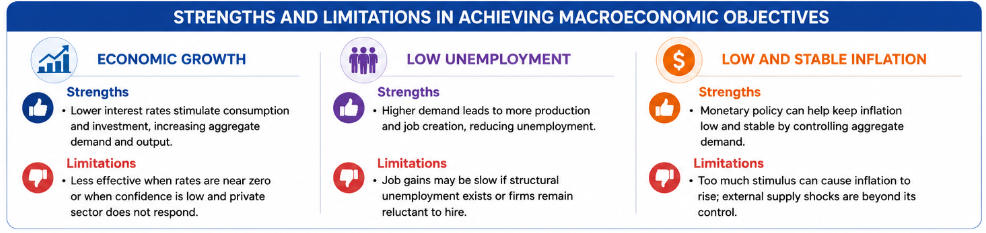
1. Promoting Economic Growth
Strengths
Expansionary monetary policy may promote economic growth by:
- Reducing borrowing costs
- Increasing investment
- Increasing consumption
- Stimulating aggregate demand
Interest rates ↓ → Consumption and investment ↑ → AD ↑ → Real GDP ↑
Limitations
- Growth effects may be weak during recessions if confidence is low.
- Firms may not invest despite low rates.
- Very low interest rates may create asset bubbles.
2. Promoting Low Unemployment
Strengths
Higher aggregate demand may increase:
- Output
- Labour demand
- Employment
This may reduce cyclical unemployment.
Limitations
- Monetary policy mainly affects cyclical unemployment.
- Structural unemployment may not respond to monetary policy.
- Automation and skill mismatches may persist.
3. Promoting Low and Stable Inflation
Strengths
Contractionary monetary policy may reduce inflation by:
- Reducing borrowing
- Reducing spending
- Lowering aggregate demand
This reduces inflationary pressure.
Inflation Targeting
Many central banks use inflation targeting to maintain price stability.
This improves:
- Policy credibility
- Consumer expectations
- Business confidence
Limitations
Monetary policy may be less effective against:
- Cost-push inflation
- Supply shocks
- Imported inflation
Higher interest rates may also:
- Reduce growth
- Increase unemployment
Trade-Offs in Monetary Policy
Central banks may face conflicts between objectives.
Examples:
- Reducing inflation may increase unemployment.
- Stimulating growth may increase inflation.
This creates policy trade-offs.
Monetary Policy During Different Economic Conditions
| Economic Condition | Likely Monetary Policy | Main Goal |
|---|---|---|
| Recession | Expansionary monetary policy | Increase growth and employment |
| High Inflation | Contractionary monetary policy | Reduce inflationary pressure |
| Financial Crisis | Very low rates and quantitative easing | Increase liquidity and confidence |
Example 1
Explain why expansionary monetary policy may become ineffective when interest rates are close to zero.
▶️ Answer / Explanation
When interest rates are already near zero, the central bank cannot reduce rates much further.
Consumers and firms may still avoid borrowing and spending because of low confidence.
As a result, aggregate demand may not increase significantly.
Example 2
Using an example, explain one strength of monetary policy in controlling inflation.
▶️ Answer / Explanation
If inflation rises rapidly, the central bank may increase interest rates.
Higher borrowing costs reduce consumption and investment.
Aggregate demand decreases, helping reduce inflationary pressure.