
Expansionary and Contractionary Fiscal Policies
Governments use fiscal policy to influence aggregate demand (AD) and stabilize the economy. Fiscal policy can be either expansionary or contractionary depending on economic conditions.
Expansionary policy → Increase AD
Contractionary policy → Decrease AD
1. Expansionary Fiscal Policy
Expansionary fiscal policy is used to increase aggregate demand during a deflationary/recessionary gap.
Recession → Low AD → Expansionary fiscal policy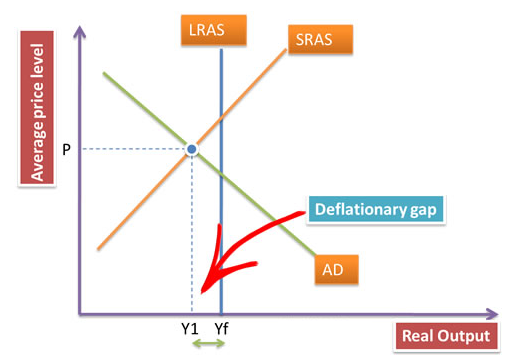
Deflationary/Recessionary Gap
A deflationary gap occurs when actual output is below full employment output.
- High unemployment exists.
- Aggregate demand is insufficient.
- Economic growth is slow or negative.
Policies Used:
- Increase government spending
- Reduce taxes
- Increase transfer payments
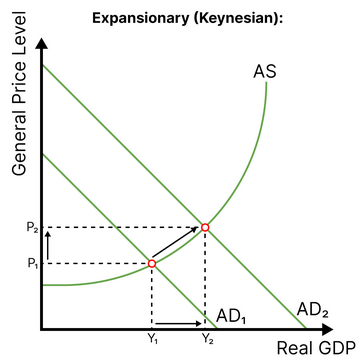
How It Works:
- Higher government spending directly increases AD.
- Lower taxes increase disposable income and consumption.
- Through the multiplier effect, GDP increases further.
Higher AD → Higher output → Lower unemployment
Economic Significance:
- Stimulates economic growth.
- Reduces unemployment.
- Improves business confidence.
Evaluation:
- May increase budget deficits and public debt.
- Can cause inflation if AD rises too much.
- Time lags may reduce effectiveness.
2. Contractionary Fiscal Policy
Contractionary fiscal policy is used to reduce aggregate demand during an inflationary gap.
Inflationary pressure → Excess AD → Contractionary fiscal policy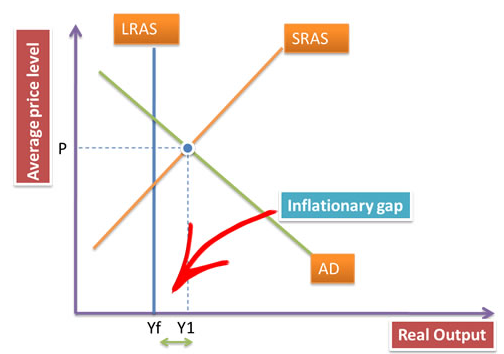
Inflationary Gap
An inflationary gap occurs when actual output exceeds full employment output.
- Aggregate demand is too high.
- Demand-pull inflation occurs.
- Resources are overutilized.
Policies Used:
- Reduce government spending
- Increase taxes
- Reduce transfer payments
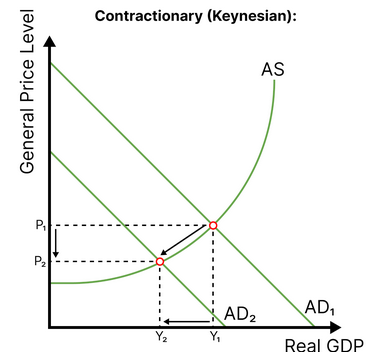
How It Works:
- Higher taxes reduce disposable income and consumption.
- Lower government spending reduces AD directly.
- This decreases inflationary pressure.
Lower AD → Lower inflation → Greater stability
Economic Significance:
- Controls inflation.
- Reduces excessive demand.
- Promotes macroeconomic stability.
Evaluation:
- May slow economic growth.
- Can increase unemployment.
- Politically unpopular due to higher taxes or lower spending.
Comparison:
| Fiscal Policy | Used For | Main Policies | Effect on AD |
|---|---|---|---|
| Expansionary | Recessionary gap | ↑ Spending, ↓ Taxes | Increase AD |
| Contractionary | Inflationary gap | ↓ Spending, ↑ Taxes | Decrease AD |
Economic Logic
- Fiscal policy works through changes in aggregate demand.
- Multiplier effects amplify policy impacts.
- Governments attempt to stabilize the business cycle.
Key Ideas:
- Expansionary policy closes recessionary gaps.
- Contractionary policy closes inflationary gaps.
- Fiscal policy affects AD through spending and taxation.
- Policies involve trade-offs and limitations.
Example 1
Explain how expansionary fiscal policy reduces unemployment.
▶️ Answer / Explanation
The government increases spending or reduces taxes.
This raises aggregate demand.
Firms increase production and hire more workers.
Thus, unemployment falls.
Example 2
Evaluate the effectiveness of contractionary fiscal policy in controlling inflation.
▶️ Answer / Explanation
Higher taxes and lower spending reduce aggregate demand.
This helps control demand-pull inflation.
However, it may slow economic growth and increase unemployment.
Thus, contractionary fiscal policy controls inflation but may create other problems.