
Expansionary and Contractionary Monetary Policies to Close Deflationary/Recessionary and Inflationary Gaps
Monetary policy is used by the central bank to influence:
- Aggregate demand (AD)
- Output
- Employment
- Inflation
Through changes in:
- Interest rates
- Money supply
- Credit conditions
the central bank attempts to stabilize the economy and close macroeconomic gaps.
Macroeconomic Equilibrium and Potential Output
Potential output refers to the level of real output produced when resources are fully employed.
This is also called the:
- Full employment level of output
- Long-run equilibrium output
Short-run equilibrium may occur at output levels above or below potential output.
Deflationary/Recessionary Gap
A deflationary gap (or recessionary gap) occurs when:
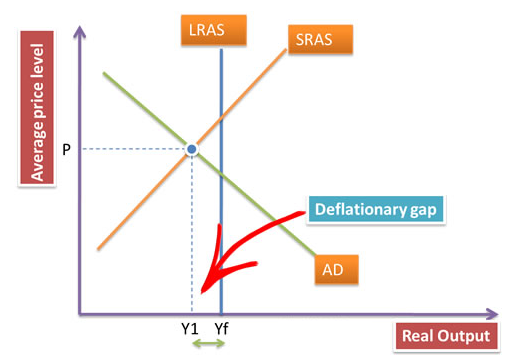
Actual output < Potential output
The economy operates below full employment.
Characteristics of a Deflationary Gap
- High cyclical unemployment
- Weak aggregate demand
- Low inflation or deflation
- Unused productive capacity
- Low business confidence
Inflationary Gap
An inflationary gap occurs when:
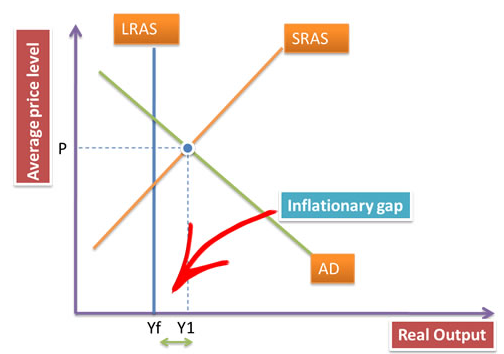
Actual output > Potential output
The economy operates beyond full employment capacity.
Characteristics of an Inflationary Gap
- High inflationary pressure
- Excessive aggregate demand
- Labour shortages
- Strong consumer spending
- Rising wages and production costs
Expansionary Monetary Policy
Expansionary monetary policy is used to increase aggregate demand and close a deflationary/recessionary gap.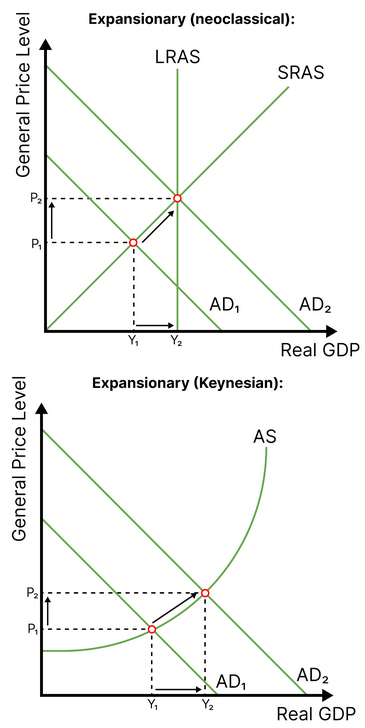
The central bank attempts to stimulate economic activity by:
- Increasing money supply
- Reducing interest rates
Main Tools of Expansionary Monetary Policy
- Lowering policy interest rates
- Buying government securities (open market operations)
- Reducing reserve requirements
- Quantitative easing
How Expansionary Monetary Policy Works
Step 1: Interest Rates Fall
The central bank lowers interest rates and increases money supply.
Step 2: Borrowing Increases
Lower interest rates reduce the cost of borrowing.
Households and firms increase:
- Consumption
- Investment
Step 3: Aggregate Demand Increases
Higher consumption and investment increase aggregate demand.
AD shifts right
Step 4: Output and Employment Increase
Firms increase production to meet higher demand.
This leads to:
- Higher real GDP
- Higher employment
- Reduced cyclical unemployment
Closing a Deflationary Gap
Expansionary monetary policy moves the economy closer to potential output.
The recessionary gap decreases as output rises.
Advantages of Expansionary Monetary Policy
- Reduces unemployment
- Stimulates economic growth
- Encourages investment and spending
- Helps avoid prolonged recession
Possible Limitations
- Effects may take time to occur.
- Consumers and firms may still lack confidence during recessions.
- Very low interest rates may create liquidity traps.
- May create inflation if expansion becomes excessive.
Contractionary Monetary Policy
Contractionary monetary policy is used to reduce aggregate demand and close an inflationary gap.
The central bank attempts to slow economic activity by: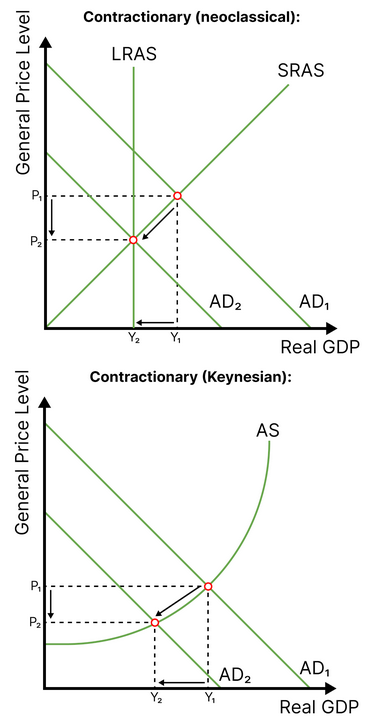
- Reducing money supply
- Increasing interest rates
Main Tools of Contractionary Monetary Policy
- Increasing policy interest rates
- Selling government securities
- Increasing reserve requirements
- Reducing liquidity in financial markets
How Contractionary Monetary Policy Works
Step 1: Interest Rates Rise
The central bank raises interest rates and reduces money supply.
Step 2: Borrowing Decreases
Higher interest rates increase the cost of borrowing.
Households and firms reduce:
- Consumption
- Investment
Step 3: Aggregate Demand Falls
Lower spending reduces aggregate demand.
AD shifts left
Step 4: Inflationary Pressure Falls
Reduced aggregate demand lowers pressure on:
- Prices
- Wages
- Production costs
The economy moves closer to potential output.
Closing an Inflationary Gap
Contractionary monetary policy decreases excessive aggregate demand.
This helps stabilize inflation.
Advantages of Contractionary Monetary Policy
- Controls inflation
- Reduces overheating in the economy
- Promotes price stability
- May improve external balance
Possible Limitations
- May reduce economic growth.
- May increase unemployment.
- Higher interest rates may reduce investment.
- Effects may occur slowly.
Comparison Between Expansionary and Contractionary Monetary Policy
| Feature | Expansionary Monetary Policy | Contractionary Monetary Policy |
|---|---|---|
| Main Goal | Increase AD and reduce unemployment | Reduce AD and control inflation |
| Interest Rates | Decrease | Increase |
| Money Supply | Increase | Decrease |
| Effect on Consumption and Investment | Increase | Decrease |
| Effect on AD | AD shifts right | AD shifts left |
| Main Macroeconomic Problem Addressed | Deflationary gap | Inflationary gap |
Monetary Policy and the Business Cycle
Monetary policy is often used to stabilize fluctuations in the business cycle.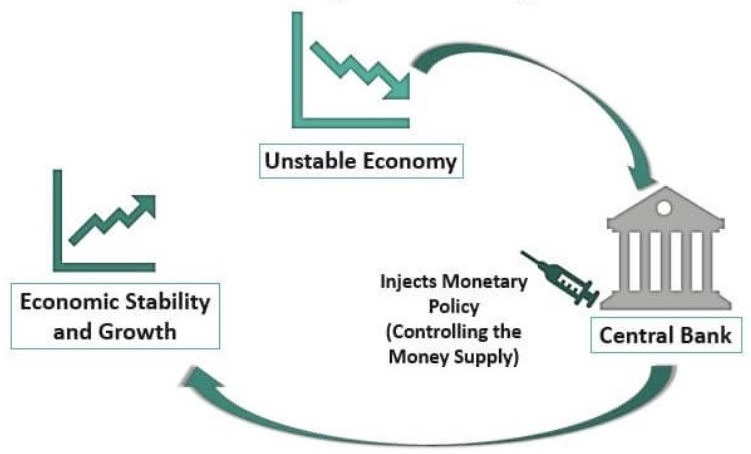
During Recession
- Expansionary monetary policy is used.
- Goal: stimulate AD and reduce unemployment.
During Inflationary Boom
- Contractionary monetary policy is used.
- Goal: reduce inflationary pressure.
Effectiveness of Monetary Policy
The effectiveness of monetary policy depends on:
- Consumer and business confidence
- Strength of the banking system
- Interest rate responsiveness
- Global economic conditions
Example 1
Explain how expansionary monetary policy may close a recessionary gap.
▶️ Answer / Explanation
The central bank lowers interest rates and increases money supply.
Borrowing becomes cheaper, causing consumption and investment to increase.
Aggregate demand shifts right, increasing output and employment.
This helps move the economy toward full employment output.
Example 2
Using an example, explain how contractionary monetary policy may reduce inflationary pressure.
▶️ Answer / Explanation
If inflation becomes very high, the central bank may increase interest rates.
Higher borrowing costs reduce consumption and investment.
Aggregate demand decreases, reducing inflationary pressure in the economy.