
Fiscal Policy
Fiscal policy refers to the use of government spending and taxation to influence the level of economic activity, achieve macroeconomic objectives, and stabilize the economy.
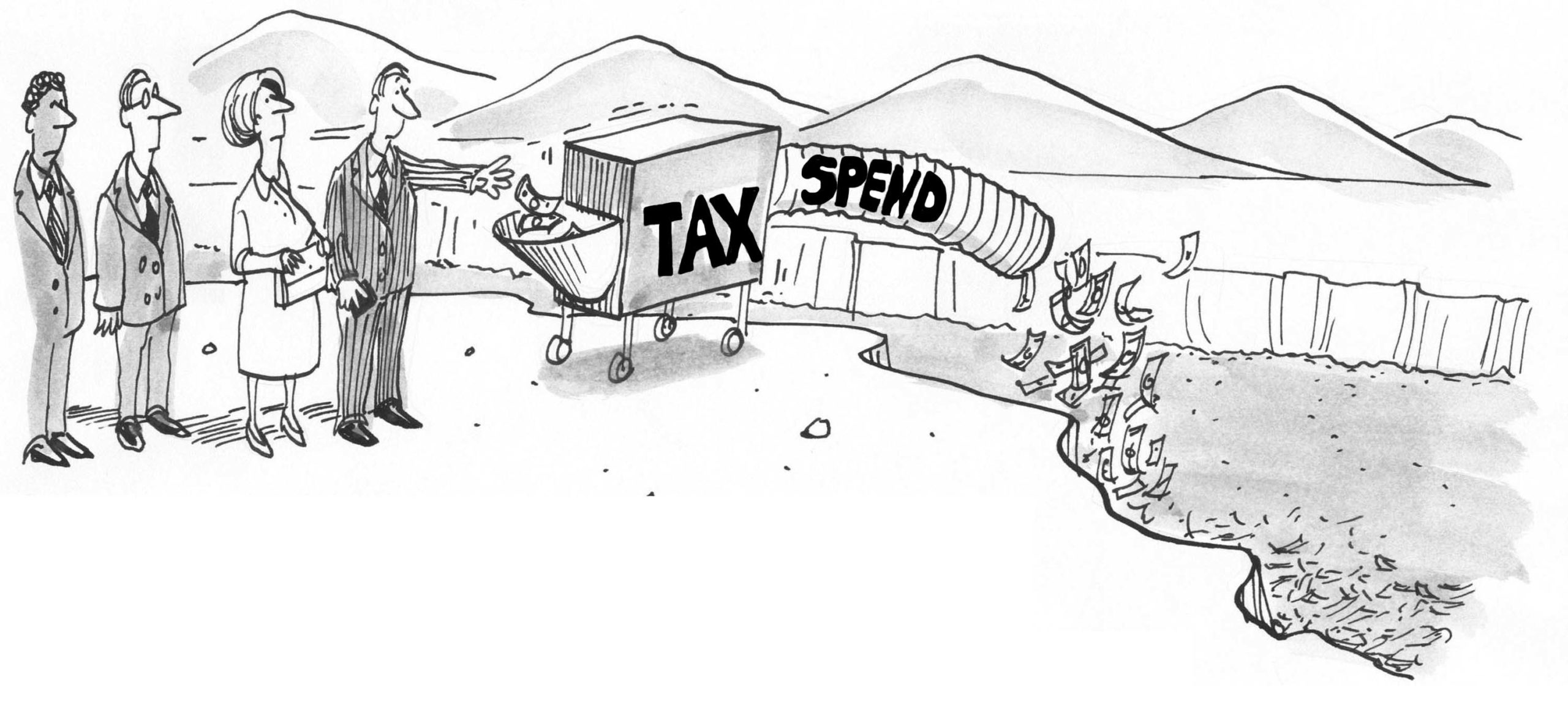
Government Revenue (Sources of Revenue)
Governments require revenue to finance public services, infrastructure, and economic policies. The main sources of revenue are taxation, income from state-owned enterprises, and sale of government assets.
1. Direct Taxation
Direct taxes are taxes imposed directly on income, wealth, or profits.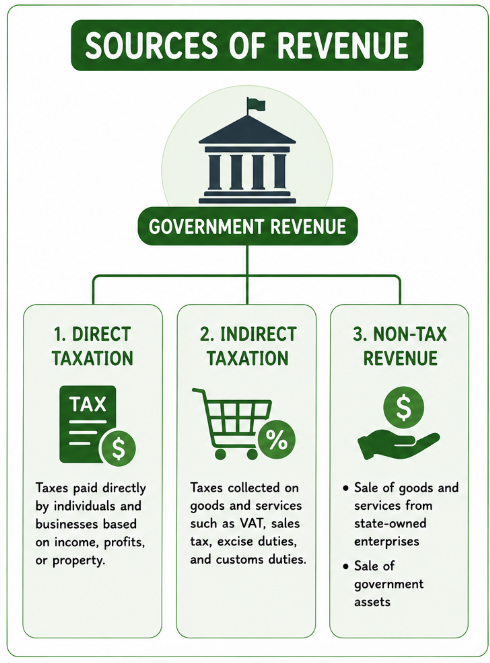
Explanation:
- Paid directly to the government by individuals or firms.
- Usually based on ability to pay.
- Difficult to shift to another person.
Examples:
- Income tax
- Corporate tax
- Wealth tax
Economic Significance:
- Provides stable government revenue.
- Can reduce income inequality.
- May reduce incentives to work or invest if too high.
2. Indirect Taxation
Indirect taxes are taxes imposed on goods and services.
Explanation:
- Collected by firms on behalf of the government.
- Can be shifted to consumers through higher prices.
Examples:
- Value Added Tax (VAT)
- Sales tax
- Excise duties
Economic Significance:
- Generates large amounts of revenue.
- Can discourage consumption of demerit goods.
- May be regressive and increase inequality.
3. Sale of Goods and Services from State-Owned Enterprises
Governments may earn revenue by providing goods and services through state-owned enterprises (SOEs).
Explanation:
- SOEs are businesses owned and operated by the government.
- Revenue is earned through prices charged for services.
Examples:
- Public transport
- Postal services
- Electricity supply
Economic Significance:
- Provides government income.
- May improve access to essential services.
- Can suffer from inefficiency if poorly managed.
4. Sale of Government Assets
Governments may raise revenue by selling government-owned assets.
Explanation:
- Known as privatization when public enterprises are sold to the private sector.
- Provides one-time revenue.
Examples:
- Sale of public companies
- Sale of government land or buildings
Economic Significance:
- Raises funds quickly.
- May improve efficiency under private ownership.
- Government loses future income from those assets.
Government Expenditure
Government expenditure refers to spending by the government on goods, services, infrastructure, and welfare programs.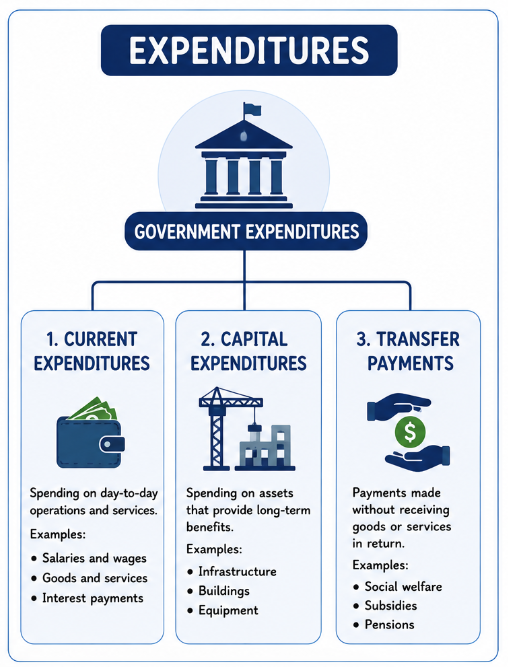
1. Current Expenditure
Current expenditure refers to government spending on day-to-day operations and services.
Examples:
- Public sector wages
- Healthcare services
- Education services
Economic Significance:
- Maintains public services.
- Supports employment and economic activity.
2. Capital Expenditure
Capital expenditure refers to spending on long-term assets and infrastructure.
Examples:
- Roads and bridges
- Schools and hospitals
- Transport infrastructure
Economic Significance:
- Increases productive capacity of the economy.
- Promotes long-term economic growth.
3. Transfer Payments
Transfer payments are payments made by the government without receiving goods or services in return.
Examples:
- Unemployment benefits
- Pensions
- Welfare payments
Economic Significance:
- Redistributes income.
- Reduces poverty and inequality.
- Supports aggregate demand.
Key Ideas:
- Fiscal policy involves taxation and government spending.
- Governments earn revenue from taxes, SOEs, and asset sales.
- Expenditure includes current spending, capital projects, and transfer payments.
- Used to achieve macroeconomic objectives.
Example 1
Explain the difference between direct and indirect taxes.
▶️ Answer / Explanation
Direct taxes are imposed on income and profits.
Indirect taxes are imposed on goods and services.
Indirect taxes can be shifted to consumers through higher prices.
Example 2
Evaluate the importance of capital expenditure for an economy.
▶️ Answer / Explanation
Capital expenditure improves infrastructure and productive capacity.
This promotes long-term economic growth.
However, it may increase government spending and debt.
Thus, it is important but costly.