
Further Policies to Reduce Poverty, Income and Wealth Inequality
Governments use a variety of policies to reduce: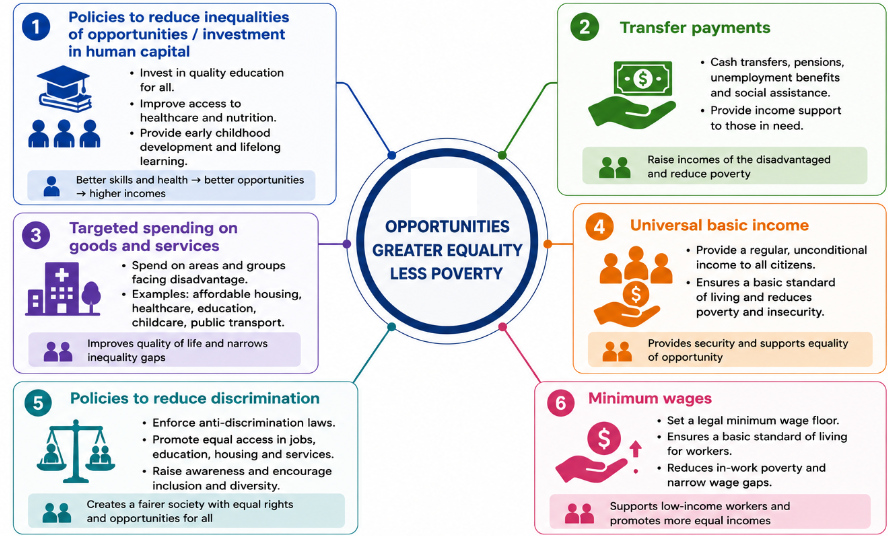
- Poverty
- Income inequality
- Wealth inequality
These policies aim to:
- Improve living standards
- Increase equality of opportunity
- Support disadvantaged groups
- Promote social stability
Important policies include:
- Policies to reduce inequalities of opportunity and investment in human capital
- Transfer payments
- Targeted spending on goods and services
1. Policies to Reduce Inequalities of Opportunity / Investment in Human Capital
Inequality of opportunity occurs when individuals do not have equal access to opportunities such as:
- Education
- Healthcare
- Training
- Employment opportunities
Governments attempt to reduce these inequalities by investing in human capital.
Meaning of Human Capital
Human capital refers to the education, skills, training, experience, and health possessed by workers.
Higher human capital increases:
- Productivity
- Employment opportunities
- Earning potential
Education Policies
Governments may improve access to education by:
- Providing free or subsidized education
- Building schools in disadvantaged areas
- Offering scholarships and financial aid
- Improving teacher training
Better education improves skills and employment opportunities.
Healthcare Investment
Governments may provide:
- Public healthcare systems
- Vaccination programs
- Nutritional support
- Healthcare subsidies
Improved health increases worker productivity and quality of life.
Training and Skill Development
Governments may provide:
- Vocational training
- Apprenticeships
- Digital skills programs
- Retraining for unemployed workers
This helps workers adapt to technological change and reduces structural unemployment.
How Investment in Human Capital Reduces Inequality
Improved education and skills allow disadvantaged individuals to:
- Access higher-paying jobs
- Increase productivity
- Escape poverty
Better education and healthcare → Higher human capital → Higher incomes
Advantages of Human Capital Investment
- Reduces long-term poverty
- Improves equality of opportunity
- Increases economic growth and productivity
- Improves living standards
Possible Limitations
- Requires large government spending.
- Benefits may take many years to appear.
- Quality of education and healthcare may vary.
2. Transfer Payments
Transfer payments are payments made by the government to individuals without requiring current production of goods or services in return.
Transfer payments redistribute income and provide financial support to vulnerable groups.
Examples of Transfer Payments
- Unemployment benefits
- Pensions
- Disability benefits
- Child support payments
- Housing assistance
- Food assistance programs
How Transfer Payments Reduce Poverty and Inequality
Transfer payments increase the disposable income of low-income households.
This helps individuals:
- Meet basic needs
- Access healthcare and education
- Maintain minimum living standards
Automatic Stabilizers
Some transfer payments act as automatic stabilizers.
During recessions:
- Unemployment benefits increase automatically.
- Household incomes are partially protected.
- Aggregate demand becomes more stable.
Advantages of Transfer Payments
- Reduce poverty directly
- Improve living standards
- Reduce income inequality
- Provide economic security
Possible Disadvantages
- Require government funding through taxation or borrowing.
- Very generous benefits may reduce work incentives for some individuals.
- May create long-term government budget pressures.
3. Targeted Spending on Goods and Services
Targeted spending refers to government spending directed specifically toward disadvantaged groups or regions.
The goal is to improve access to essential goods and services.
Examples of Targeted Spending
- Subsidized healthcare
- Public education programs
- Affordable housing projects
- Nutrition programs
- Public transportation support
- Rural development programs
How Targeted Spending Reduces Poverty and Inequality
Targeted spending improves access to essential services for low-income households.
This may:
- Reduce living costs
- Improve health and education outcomes
- Increase equality of opportunity
Examples of Targeted Programs
Education:
- Free school meals
- Scholarships for disadvantaged students
Healthcare:
- Free vaccinations
- Subsidized medical care
Regional Development
Governments may target poorer regions by investing in:
- Infrastructure
- Schools
- Hospitals
- Transport systems
This may reduce regional inequalities.
Advantages of Targeted Spending
- Supports vulnerable groups directly
- Improves living standards
- Increases access to essential services
- May improve long-term productivity
Possible Limitations
- Requires significant government expenditure.
- Programs may be inefficient or poorly targeted.
- Corruption or administrative problems may reduce effectiveness.
Comparison of the First Three Policies
| Policy | Main Goal | Main Effect |
|---|---|---|
| Investment in Human Capital | Improve skills and opportunities | Long-term reduction in inequality |
| Transfer Payments | Provide financial support | Immediate poverty reduction |
| Targeted Spending | Improve access to services | Better living standards and opportunities |
Key Notes:
- Investment in human capital improves productivity and earning potential.
- Transfer payments redistribute income and reduce poverty directly.
- Targeted government spending improves access to essential goods and services.
- These policies help reduce inequality and improve equality of opportunity.
Example 1
Explain how investment in education may reduce long-term poverty.
▶️ Answer / Explanation
Education improves human capital by increasing skills and productivity.
Workers with better education usually access higher-paying jobs and experience lower unemployment.
As a result, education investment may reduce long-term poverty and inequality.
Example 2
Using an example, explain how transfer payments help reduce poverty.
▶️ Answer / Explanation
Unemployment benefits provide income to individuals who lose jobs.
This helps households continue purchasing necessities such as food and housing.
Therefore, transfer payments reduce poverty and improve living standards.
4. Universal Basic Income (UBI)
Universal Basic Income (UBI) is a government policy in which all citizens receive a regular cash payment regardless of:
- Income level
- Employment status
- Wealth
The payment is usually:
- Universal
- Unconditional
- Regular
Main Purpose of UBI
UBI aims to:
- Reduce poverty
- Provide income security
- Reduce income inequality
- Protect people from unemployment and technological change
How UBI Reduces Poverty and Inequality
UBI guarantees a minimum level of income for all individuals.
This helps households:
- Meet basic needs
- Reduce financial insecurity
- Maintain minimum living standards
Guaranteed income → Higher disposable income for low-income groups → Reduced poverty
Protection Against Automation and Job Losses
Supporters argue that UBI may become increasingly important because:
- Automation may replace jobs.
- Technological change may create structural unemployment.
UBI provides income support even when employment becomes unstable.
Advantages of UBI
- Direct reduction in poverty
- Provides financial security
- May reduce administrative costs compared to complex welfare systems
- Supports individuals during unemployment or retraining
Possible Disadvantages of UBI
- Very expensive for governments to finance.
- May require higher taxes or borrowing.
- Some economists argue it may reduce incentives to work.
- Payments also go to wealthy households unless heavily taxed back.
Examples of UBI Experiments
Some countries and regions have tested limited UBI programs to study effects on:
- Employment
- Poverty
- Well-being
5. Policies to Reduce Discrimination
Discrimination occurs when individuals or groups are treated unfairly because of characteristics such as:
- Gender
- Race or ethnicity
- Religion
- Age
- Disability
Discrimination may reduce access to:
- Education
- Employment
- Promotions
- Income opportunities
This contributes to poverty and economic inequality.
Government Policies to Reduce Discrimination
Governments may introduce:
- Anti-discrimination laws
- Equal pay legislation
- Affirmative action programs
- Equal access policies in education and employment
Anti-Discrimination Laws
These laws prohibit unfair treatment in:
- Hiring
- Wages
- Promotion
- Education access
This helps disadvantaged groups gain fairer economic opportunities.
Equal Pay Policies
Governments may require equal pay for equal work.
This aims to reduce wage gaps between groups.
Affirmative Action
Affirmative action policies give additional support or opportunities to historically disadvantaged groups.
Examples:
- Reserved educational places
- Diversity hiring programs
- Scholarships for disadvantaged communities
How Reducing Discrimination Reduces Inequality
Reducing discrimination improves:
- Employment opportunities
- Income opportunities
- Social mobility
- Access to education
This helps reduce poverty and inequality among disadvantaged groups.
Advantages of Anti-Discrimination Policies
- Promote fairness and equity
- Improve equality of opportunity
- Increase labour force participation
- Improve economic efficiency by using talent more effectively
Possible Limitations
- Discrimination may continue informally despite laws.
- Policies may be difficult to enforce fully.
- Some policies may become politically controversial.
6. Minimum Wages
A minimum wage is the legal minimum hourly or monthly wage employers are allowed to pay workers.
Governments introduce minimum wages to protect low-income workers.
How Minimum Wages Reduce Poverty and Inequality
Minimum wages increase earnings for low-paid workers.
This may:
- Reduce working poverty
- Increase disposable income
- Improve living standards
- Reduce income inequality
Effects on Living Standards
Higher wages allow workers to afford:
- Better housing
- Healthcare
- Nutrition
- Education
Effects on Aggregate Demand
Low-income households usually spend a large proportion of income.
Higher minimum wages may therefore increase:
- Consumer spending
- Aggregate demand
- Economic activity
Possible Disadvantages of Minimum Wages
If minimum wages are set too high:
- Firms may reduce hiring.
- Unemployment may increase.
- Automation may become more attractive.
Low-skilled and young workers may be affected most.
Minimum Wage and Labour Demand
If the minimum wage is above equilibrium wage levels:
- Labour supply may exceed labour demand.
- Unemployment may occur.
Advantages of Minimum Wages
- Reduces low-pay employment
- Improves living standards
- Reduces working poverty
- May reduce inequality
Possible Limitations
- May increase unemployment if set too high.
- Small businesses may face higher costs.
- Some workers in informal sectors may not benefit.
Comparison of the Final Three Policies
| Policy | Main Goal | Main Effect |
|---|---|---|
| Universal Basic Income | Provide guaranteed income | Reduce poverty and income insecurity |
| Policies to Reduce Discrimination | Improve equal opportunities | Reduce inequality between groups |
| Minimum Wages | Protect low-income workers | Increase earnings and reduce working poverty |
Key Notes:
- Universal basic income provides guaranteed financial support to all individuals.
- Anti-discrimination policies improve equality of opportunity.
- Minimum wages increase earnings for low-paid workers.
- These policies aim to reduce poverty, improve living standards, and reduce inequality.
Example 1
Explain how minimum wages may reduce poverty.
▶️ Answer / Explanation
Minimum wages increase earnings for low-paid workers.
Higher incomes allow households to afford better housing, food, healthcare, and education.
This reduces working poverty and improves living standards.
Example 2
Using an example, explain how anti-discrimination policies may reduce economic inequality.
▶️ Answer / Explanation
If governments introduce equal pay laws, workers performing the same job must receive equal wages regardless of gender or race.
This improves income opportunities for disadvantaged groups and helps reduce wage inequality.