
Goals of Fiscal Policy
1. Low and Stable Inflation
One important goal of fiscal policy is to achieve low and stable inflation, meaning a moderate and predictable increase in the general price level over time.
Stable prices → Economic stability → Better decision-making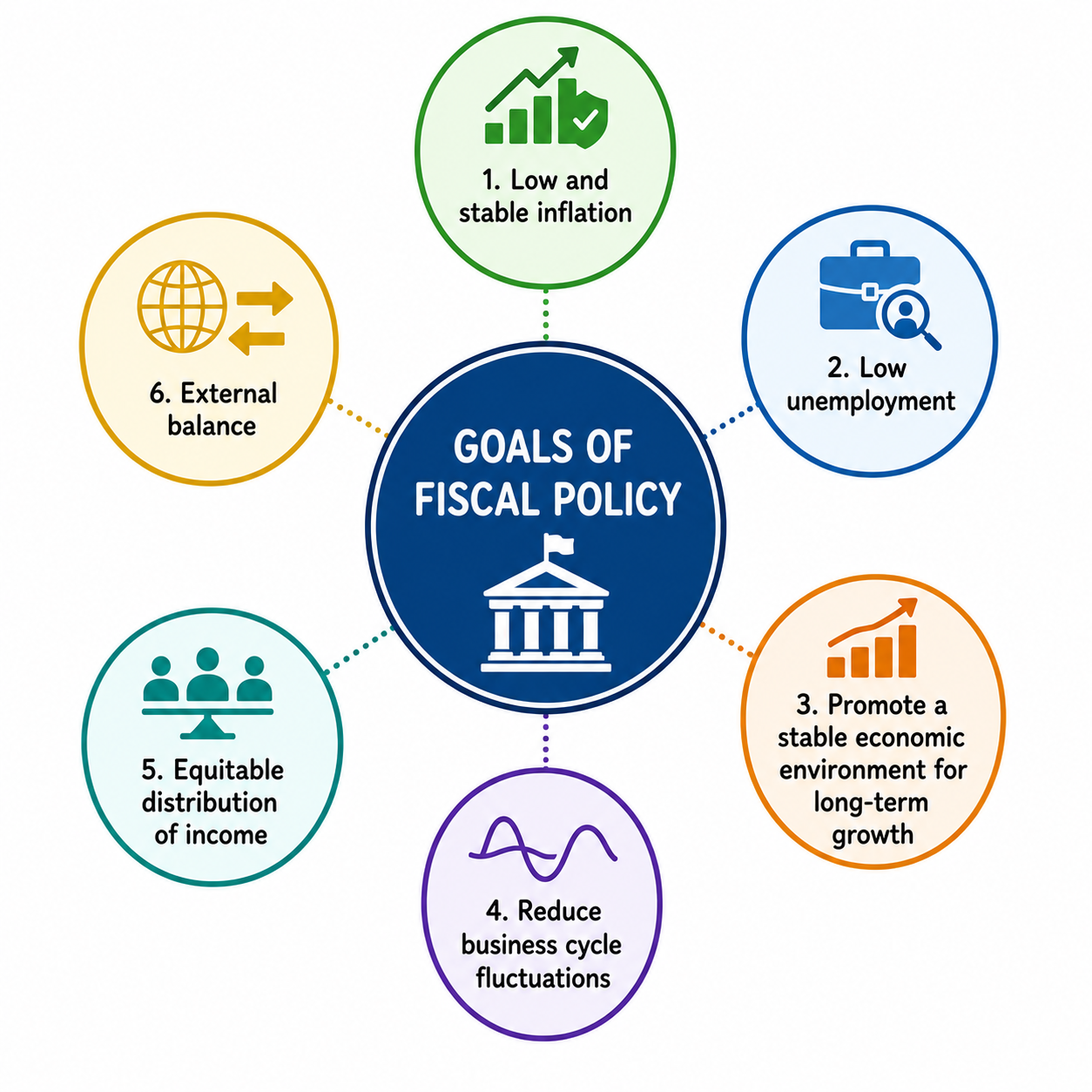
Explanation:
- High inflation reduces the purchasing power of money.
- It creates uncertainty for households and firms.
- Fiscal policy can reduce excessive aggregate demand through:
- Higher taxes
- Lower government spending
Economic Significance:
- Maintains confidence in the economy.
- Encourages saving and investment.
- Protects real incomes and living standards.
Evaluation:
- Very low inflation may reduce economic growth.
- Contractionary fiscal policy may increase unemployment.
- Governments must balance inflation control with growth objectives.
2. Low Unemployment
Fiscal policy aims to achieve low unemployment by increasing economic activity and creating jobs.
Higher demand → More production → More employment
Explanation:
- During recessions, unemployment rises due to low aggregate demand.
- Governments can use expansionary fiscal policy:
- Increase government spending
- Reduce taxes
- This increases demand, output, and employment.
Economic Significance:
- Improves living standards.
- Increases income and consumption.
- Reduces poverty and social problems.
Evaluation:
- Reducing unemployment may increase inflation.
- Government spending may increase budget deficits.
- Some unemployment may be structural and not solved by demand management.
3. Promote a Stable Economic Environment for Long-Term Growth
Fiscal policy aims to create a stable economic environment that encourages long-term economic growth.
Economic stability → Confidence → Investment → Growth
Explanation:
- Stable economic conditions encourage firms to invest and expand.
- Governments may invest in:
- Infrastructure
- Education
- Healthcare
- These improve productivity and productive capacity.
Economic Significance:
- Encourages business confidence.
- Promotes technological progress and efficiency.
- Raises long-term standards of living.
Evaluation:
- Large government spending may increase public debt.
- Poorly planned spending may waste resources.
- Long-term growth also depends on private sector performance.
Key Ideas:
- Fiscal policy helps control inflation.
- It can reduce unemployment through demand management.
- Stable conditions encourage long-term economic growth.
- Goals may sometimes conflict with each other.
Example 1
Explain how fiscal policy can reduce unemployment.
▶️ Answer / Explanation
The government can increase spending or reduce taxes.
This raises aggregate demand.
Firms increase production and hire more workers.
Thus, unemployment falls.
Example 2
Evaluate the importance of low and stable inflation.
▶️ Answer / Explanation
Low inflation protects purchasing power and increases confidence.
It encourages saving and investment.
However, policies to reduce inflation may slow economic growth.
Thus, stable inflation is important but difficult to maintain.
4. Reduce Business Cycle Fluctuations
One goal of fiscal policy is to reduce fluctuations in the business cycle and stabilize economic activity over time.
Booms and recessions → Economic instability → Fiscal stabilization
Explanation:
- Economies experience periods of rapid growth (booms) and decline (recessions).
- Large fluctuations create instability in employment, prices, and output.
- Governments use fiscal policy to smooth these fluctuations.
During Recession:
- Government may use expansionary fiscal policy:
- Increase government spending
- Reduce taxes
- This increases aggregate demand and supports recovery.
During Inflationary Boom:
- Government may use contractionary fiscal policy:
- Reduce spending
- Increase taxes
- This reduces excessive demand and inflationary pressure.
Economic Significance:
- Reduces uncertainty in the economy.
- Supports stable employment and growth.
- Improves business and consumer confidence.
Evaluation:
- Fiscal policy may have time lags.
- Government intervention may not always be effective.
- Frequent policy changes can create uncertainty.
5. Equitable Distribution of Income
Fiscal policy aims to achieve a more equitable distribution of income by reducing income inequality.
Redistribution → Greater equity → Improved social welfare
Explanation:
- Governments use progressive taxation and transfer payments.
- Higher-income groups pay a larger proportion of income in taxes.
- Low-income groups receive benefits and public services.
Methods Used:
- Progressive income taxes
- Welfare payments
- Subsidized healthcare and education
Economic Significance:
- Reduces poverty and inequality.
- Improves access to opportunities.
- Promotes social stability.
Evaluation:
- High taxes may reduce incentives to work and invest.
- Transfer payments increase government expenditure.
- Perfect equality may reduce efficiency.
6. External Balance
Fiscal policy aims to help maintain external balance, meaning a sustainable balance between exports and imports.
Stable trade position → External stability
Explanation:
- High aggregate demand may increase imports.
- This can worsen the current account balance.
- Governments may use contractionary fiscal policy to reduce demand for imports.
Economic Significance:
- Prevents large trade deficits.
- Supports currency stability.
- Improves international confidence.
Evaluation:
- Fiscal policy has limited direct control over exports.
- Reducing imports through lower demand may slow growth.
- External balance also depends on exchange rates and global conditions.
Key Ideas:
- Fiscal policy helps stabilize the business cycle.
- It can reduce inequality through redistribution.
- It supports external balance and economic stability.
- Different goals may conflict with each other.
Example 1
Explain how fiscal policy can reduce business cycle fluctuations.
▶️ Answer / Explanation
During recessions, governments increase spending or reduce taxes.
This increases aggregate demand and supports recovery.
During inflationary booms, governments reduce spending or raise taxes.
This stabilizes the economy.
Example 2
Evaluate the effectiveness of fiscal policy in reducing income inequality.
▶️ Answer / Explanation
Progressive taxes and transfer payments reduce inequality.
They improve access to healthcare and education.
However, high taxes may reduce incentives to work.
Thus, fiscal policy can improve equity but may affect efficiency.