
Goals of Monetary Policy
Monetary policy is used by the central bank to achieve important macroeconomic objectives that support economic stability and growth.
The major goals of monetary policy are: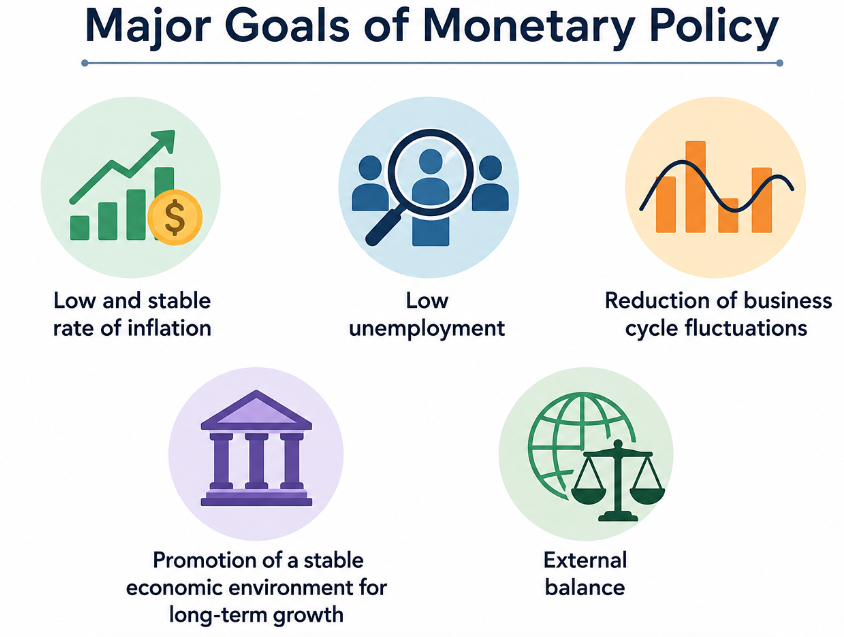
- Low and stable rate of inflation
- Low unemployment
- Reduction of business cycle fluctuations
- Promotion of a stable economic environment for long-term growth
- External balance
1. Low and Stable Rate of Inflation
One of the primary goals of monetary policy is maintaining a low and stable rate of inflation.
Inflation refers to a sustained increase in the general price level over time.
Why Low and Stable Inflation is Important
Low and stable inflation helps:
- Maintain purchasing power
- Reduce uncertainty
- Protect savings and incomes
- Encourage investment and economic planning
Very high inflation may create:
- Economic instability
- Reduced confidence
- Lower investment
- Reduced international competitiveness
Deflation and Very Low Inflation
Monetary authorities also try to avoid:
- Deflation
- Extremely low inflation
Deflation may reduce spending and investment and increase unemployment.
Inflation Targeting
Inflation targeting is a monetary policy strategy in which the central bank sets a specific target inflation rate.
The central bank adjusts interest rates and money supply to keep inflation near the target.
Examples of Inflation Targets
Many central banks target inflation rates around:
\( \mathrm{2\%} \)
or another low positive rate.
How Inflation Targeting Works
If inflation rises above the target:
- The central bank may increase interest rates.
- Aggregate demand decreases.
- Inflationary pressure falls.
If inflation falls below the target:
- The central bank may lower interest rates.
- Spending and investment increase.
- Inflation may rise toward the target.
Advantages of Inflation Targeting
- Provides clear policy direction
- Reduces inflation uncertainty
- Improves credibility of the central bank
- Helps stabilize expectations
Possible Limitations
- Supply-side inflation may be difficult to control.
- Strict inflation targeting may slow economic growth.
- Interest rate increases may raise unemployment.
2. Low Unemployment
Another major goal of monetary policy is maintaining low unemployment.
High unemployment leads to:
- Lost output
- Lower incomes
- Poverty
- Social instability
How Monetary Policy Reduces Unemployment
During recessions or periods of weak demand, the central bank may use expansionary monetary policy.
This includes:
- Lowering interest rates
- Increasing money supply
Lower interest rates encourage:
- Consumption
- Investment
- Aggregate demand
Result:
- Output and employment increase.
Relationship Between Inflation and Unemployment
There may be a short-run trade-off between:
- Inflation
- Unemployment
Policies that strongly reduce unemployment may increase inflationary pressure.
Natural Rate of Unemployment
Monetary policy cannot eliminate all unemployment.
Even at full employment, some unemployment exists because of:
- Frictional unemployment
- Structural unemployment
- Seasonal unemployment
3. Reduce Business Cycle Fluctuations
The economy experiences fluctuations in economic activity known as the business cycle.
Business cycles involve periods of:
- Economic expansion
- Economic contraction or recession
Goal of Stabilization
Monetary policy aims to reduce large fluctuations in:
- Output
- Employment
- Inflation
This helps stabilize the economy.
Expansionary Monetary Policy During Recession
During recessions:
- Interest rates may be lowered.
- Money supply may increase.
- Aggregate demand may rise.
This helps support:
- Economic growth
- Employment
Contractionary Monetary Policy During Inflationary Booms
During periods of excessive inflation or rapid economic expansion:
- Interest rates may increase.
- Aggregate demand may decrease.
This reduces overheating in the economy.
Importance of Stable Economic Fluctuations
Reducing business cycle fluctuations helps:
- Increase investor confidence
- Reduce unemployment volatility
- Promote stable growth
4. Promote a Stable Economic Environment for Long-Term Growth
Monetary policy also aims to create a stable macroeconomic environment that supports long-term economic growth.
Importance of Economic Stability
Stable inflation and interest rates encourage:
- Business investment
- Consumer confidence
- Long-term planning
- Financial stability
Investment and Growth
Businesses are more likely to invest when:
- Inflation is predictable
- Interest rates are stable
- Economic uncertainty is low
Higher investment increases:
- Productive capacity
- Employment
- Long-run economic growth
Financial System Stability
Central banks also attempt to maintain stability in:
- Banking systems
- Financial markets
- Credit systems
Financial crises may severely damage long-term growth.
5. External Balance
External balance refers to maintaining stability in a country’s international economic position.
This includes:
- Exchange rates
- Balance of payments
- International competitiveness
Role of Interest Rates in External Balance
Interest rates affect international capital flows and exchange rates.
Higher Interest Rates
Higher interest rates may attract foreign investment because investors seek higher returns.
This may:
- Increase demand for the currency
- Cause currency appreciation
Lower Interest Rates
Lower interest rates may reduce demand for the currency.
This may:
- Cause currency depreciation
- Increase export competitiveness
- Reduce imports
Importance of External Balance
Maintaining external balance helps:
- Reduce exchange rate instability
- Support international trade
- Maintain investor confidence
Summary of Goals of Monetary Policy
| Goal | Main Purpose |
|---|---|
| Low and Stable Inflation | Maintain price stability |
| Low Unemployment | Increase employment and output |
| Reduce Business Cycle Fluctuations | Stabilize economic activity |
| Long-Term Growth Stability | Encourage investment and confidence |
| External Balance | Maintain exchange rate and international stability |
Key Ideas:
- The central bank uses monetary policy to stabilize the economy.
- Low and stable inflation is a major monetary policy objective.
- Expansionary monetary policy may reduce unemployment.
- Monetary policy helps smooth business cycle fluctuations.
- Stable inflation and interest rates support long-term economic growth.
- Interest rates influence exchange rates and external balance.
Example 1
Explain how inflation targeting may help stabilize an economy.
▶️ Answer / Explanation
Inflation targeting provides a clear inflation goal for the central bank.
If inflation rises above the target, interest rates may increase to reduce aggregate demand.
This helps maintain stable prices and reduces economic uncertainty.
Example 2
Using an example, explain how monetary policy may reduce unemployment during a recession.
▶️ Answer / Explanation
During a recession, the central bank may lower interest rates.
Cheaper borrowing encourages consumption and investment.
Aggregate demand increases, leading firms to increase production and employment.
As a result, unemployment may decrease.