
Potential Conflict Between Macroeconomic Objectives
Governments often aim to achieve several macroeconomic objectives simultaneously.
However, some objectives may conflict with one another. Policies designed to achieve one objective may make it more difficult to achieve another objective.
Important potential conflicts include:
- High economic growth and low inflation
- High economic growth and environmental sustainability
- High economic growth and equity in income distribution
High Economic Growth and Low Inflation
Economic growth refers to an increase in real output or real GDP over time.
Low inflation refers to maintaining a low and stable increase in the general price level.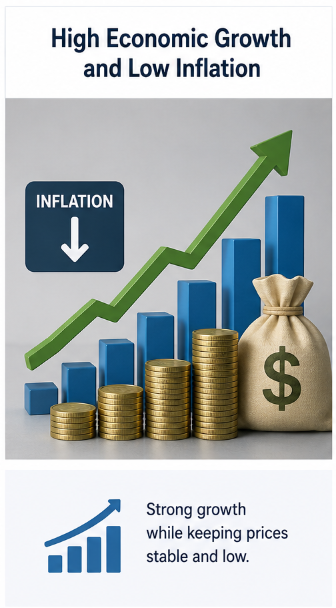
Although economic growth is desirable, rapid growth may create inflationary pressure.
Why a Conflict May Exist
High economic growth is often associated with rising aggregate demand.
As aggregate demand increases:
- Consumers spend more.
- Firms invest more.
- Employment increases.
However:
- Demand may exceed productive capacity.
- Prices may rise.
- Demand-pull inflation may occur.
Economic growth ↑ → AD ↑ → Inflation ↑
Labour Market Pressure
During periods of rapid growth:
- Demand for labour increases.
- Labour shortages may develop.
- Wages may rise.
Higher wages increase production costs.
Result:
- Cost-push inflation may also increase.
Example of the Conflict
If the government uses expansionary fiscal policy to stimulate growth:
- Aggregate demand increases.
- Output and employment rise.
- Economic growth increases.
However:
- Inflationary pressure may develop.
Possible Solutions
Governments may reduce the conflict using:
- Supply-side policies
- Productivity improvements
- Technological development
These policies increase productive capacity and allow growth with lower inflationary pressure.
High Economic Growth and Environmental Sustainability
Environmental sustainability means meeting present economic needs without reducing the ability of future generations to meet their needs.
Economic growth may conflict with environmental sustainability because higher production often increases resource use and pollution.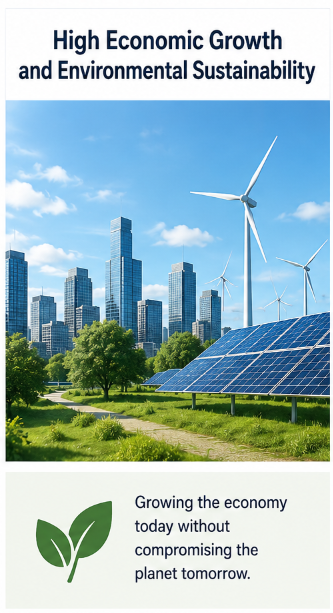
Why a Conflict May Exist
Economic growth usually requires:
- Higher industrial production
- Greater energy use
- Increased transportation
- More resource extraction
These activities may damage the environment.
Environmental Problems Associated with Growth
- Air and water pollution
- Climate change
- Deforestation
- Loss of biodiversity
- Resource depletion
Economic growth ↑ → Resource use ↑ → Environmental pressure ↑
Example of the Conflict
If factories increase production rapidly:
- Economic growth rises.
- Employment and income increase.
However:
- Carbon emissions and pollution may increase.
Sustainable Growth
Governments aim to promote sustainable economic growth.
This means achieving growth while protecting environmental quality.
Policies to Reduce the Conflict
- Investment in renewable energy
- Environmental regulations
- Carbon taxes
- Cleaner technologies
- Energy efficiency improvements
High Economic Growth and Equity in Income Distribution
Equity in income distribution refers to fairness in how income is shared across society.
Economic growth may sometimes increase income inequality.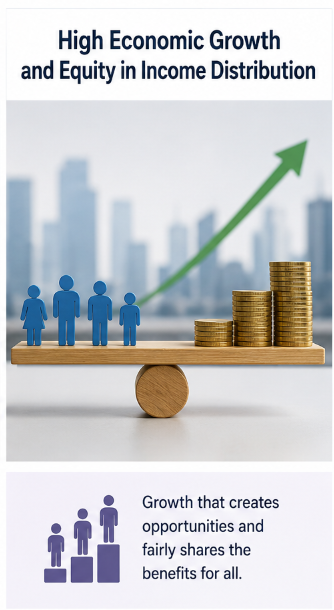
Why a Conflict May Exist
The benefits of economic growth may not be distributed equally.
Some groups may benefit more than others.
Reasons Why Inequality May Increase During Growth
1. Skilled Workers Benefit More
- Technological growth may increase demand for highly skilled workers.
- Skilled workers may experience larger wage increases.
2. Capital Owners Gain More
- Business owners and investors may receive higher profits and dividends.
- Wealth inequality may increase.
3. Regional Differences
- Some regions may grow faster than others.
- Urban areas may benefit more than rural areas.
4. Unequal Access to Opportunities
- People with better education and training may benefit more from growth.
Example of the Conflict
If growth is driven mainly by technology industries:
- Highly educated workers may receive high incomes.
- Low-skilled workers may experience slower wage growth.
Result:
- Income inequality may widen.
Policies to Reduce the Conflict
- Progressive taxation
- Transfer payments
- Education and training programs
- Minimum wage policies
- Access to healthcare and public services
Comparison of Potential Conflicts
| Macroeconomic Objectives | Reason for Conflict |
|---|---|
| High Growth vs Low Inflation | Rapid AD growth may increase inflation |
| High Growth vs Environmental Sustainability | Growth may increase pollution and resource depletion |
| High Growth vs Equity | Benefits of growth may be unevenly distributed |
Importance of Balancing Objectives
Governments attempt to balance:
- Economic growth
- Price stability
- Environmental protection
- Equitable income distribution
Achieving all objectives simultaneously is difficult because policies may create trade-offs.
Key Ideas:
- Rapid economic growth may increase inflationary pressure.
- Economic growth may create environmental damage if unsustainable.
- The benefits of growth may not be distributed equally.
- Governments use various policies to reduce these conflicts.
Example 1
Explain how rapid economic growth may create inflation.
▶️ Answer / Explanation
Rapid economic growth usually increases aggregate demand.
Firms increase production and hire more workers.
If demand grows faster than productive capacity, prices rise.
This creates demand-pull inflation.
Example 2
Using an example, explain why economic growth may conflict with environmental sustainability.
▶️ Answer / Explanation
If industrial production increases rapidly, factories may use more fossil fuels and natural resources.
Economic growth and employment may increase.
However, pollution and carbon emissions may also rise.
This creates a conflict between economic growth and environmental sustainability.