
Equivalence of the Income, Output, and Expenditure Approaches to National Income Accounting
National income can be measured using three different approaches:
- Income approach
- Output (production) approach
- Expenditure approach
Although these methods measure economic activity from different perspectives, they should theoretically produce the same value of national income. This equivalence exists because of the circular flow of income in the economy.
Output = Income = Expenditure
The Circular Flow Basis of Equivalence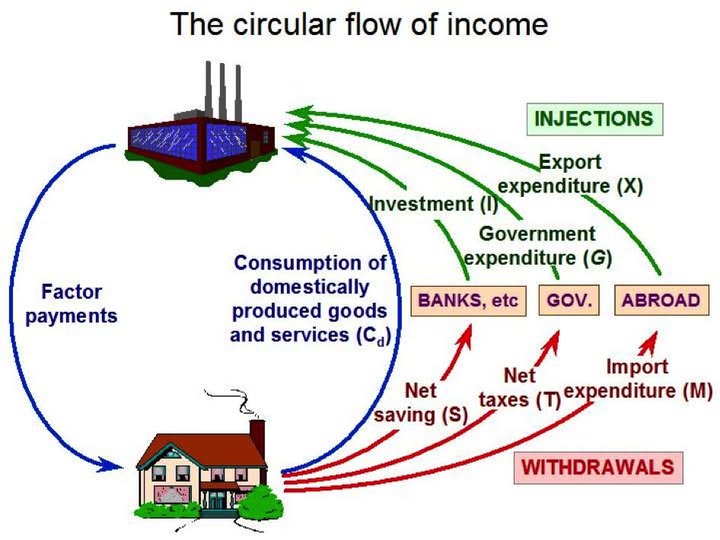
In the circular flow model:
- Firms produce goods and services using factors of production.
- Households provide factors such as labour and receive income.
- Households spend this income on goods and services produced by firms.
This creates a continuous flow:
- Production of goods and services creates output.
- Production generates income for factors of production.
- Income is used for expenditure on goods and services.
Therefore:
Total Output = Total Income = Total Expenditure
The Output Approach
The output approach measures national income by calculating the total value of final goods and services produced within an economy over a given period.
- Focuses on the value of production.
- Only final goods are included to avoid double counting.
- Measures contribution of different sectors such as agriculture, manufacturing, and services.
Key Idea:
- Production creates economic value and contributes to national output.
The Income Approach
The income approach measures national income by adding all incomes earned by factors of production.
Main components include:
- Wages (labour)
- Rent (land)
- Interest (capital)
- Profit (entrepreneurship)
Key Idea:
- All production generates income for someone in the economy.
The Expenditure Approach
The expenditure approach measures national income by calculating total spending on final goods and services.
Main components:
- Consumption (C)
- Investment (I)
- Government Spending (G)
- Net Exports (X − M)
$\mathrm{GDP = C + I + G + (X − M)}$
Key Idea:
- Expenditure on output equals the value of output produced.
Why the Three Approaches Are Equivalent
The three methods are equivalent because every economic transaction has three sides:
| Economic Activity | Measured As |
|---|---|
| Production of goods/services | Output |
| Payment to factors of production | Income |
| Purchase of goods/services | Expenditure |
For example:
- A firm produces a table worth $100 → output = $100
- The firm pays wages and profit totaling $100 → income = $100
- A consumer buys the table for $100 → expenditure = $100
Thus, all three approaches measure the same economic activity from different viewpoints.
Practical Differences and Statistical Discrepancies
In practice, the three approaches may produce slightly different results due to:
- Measurement errors
- Incomplete data
- Informal economic activity
- Time lags in recording transactions
Governments use statistical adjustments to reconcile differences.
Importance of the Equivalence Concept
- Demonstrates the interconnected nature of economic activity.
- Supports understanding of the circular flow model.
- Provides multiple methods for measuring economic performance.
- Helps verify accuracy of national income statistics.
Example 1
Explain why the income and expenditure approaches should theoretically produce the same national income value.
▶️ Answer / Explanation
Expenditure on goods and services becomes income for producers and factor owners.
For example, when consumers purchase goods, firms receive revenue and use it to pay wages, rent, interest, and profit.
Therefore, total expenditure equals total income in the economy.
This equality is explained by the circular flow of income.
Example 2
Using an example, explain the relationship between output and income in national income accounting.
▶️ Answer / Explanation
If a bakery produces bread worth $1,000, this production contributes $1,000 to national output.
The bakery then pays wages, rent, and profit totaling $1,000.
Thus, the value of output produced becomes income earned by factors of production.
This shows the equivalence between the output and income approaches.