
Interventionist Supply-Side Policies
Interventionist supply-side policies involve direct government intervention in the economy to improve productive capacity, efficiency, and long-term economic growth.
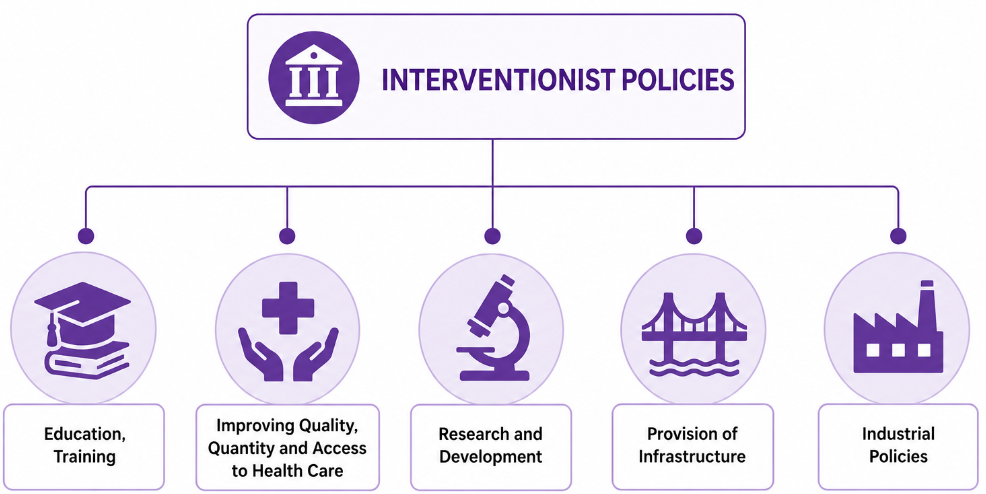
1. Education and Training
Governments invest in education and training to improve the quality of labour and increase productivity.
Better skills → Higher productivity → Higher economic growth
Explanation:
- Education improves knowledge, skills, and qualifications.
- Training programs help workers adapt to changing technologies and industries.
- Improves human capital.
Economic Significance:
- Increases labour productivity.
- Reduces structural unemployment.
- Improves international competitiveness.
- Supports technological progress and innovation.
Evaluation:
- Education policies are expensive.
- Benefits may take many years to appear.
- Quality of education matters more than spending alone.
2. Improving Quality, Quantity, and Access to Health Care
Governments improve healthcare systems to increase worker productivity and economic efficiency.
Better healthcare → Healthier workforce → Higher productivity
Explanation:
- Healthy workers are more productive and miss fewer workdays.
- Improved healthcare increases labour force participation.
- Access to healthcare improves quality of life and human capital.
Economic Significance:
- Raises productivity and efficiency.
- Supports long-term economic growth.
- Reduces economic costs of illness.
Evaluation:
- Healthcare systems require large government expenditure.
- Benefits may take time to appear.
- Inefficient healthcare systems may waste resources.
3. Research and Development (R&D)
Governments support research and development (R&D) to encourage innovation and technological progress.
Innovation → Higher productivity → Economic growth
Explanation:
- Governments may provide:
- R&D subsidies
- Research grants
- Tax incentives
- Encourages development of new technologies and production methods.
Economic Significance:
- Increases productivity and efficiency.
- Improves competitiveness of domestic firms.
- Promotes long-term growth and higher living standards.
Evaluation:
- R&D investment is risky and uncertain.
- Governments may incorrectly allocate funds.
- Benefits are often long term.
4. Provision of Infrastructure
Governments invest in infrastructure to improve the efficiency of economic activity.
Better infrastructure → Lower business costs → Higher efficiency
Explanation:
- Infrastructure includes:
- Roads and railways
- Ports and airports
- Electricity and communication systems
- Efficient infrastructure reduces transport and production costs.
Economic Significance:
- Improves productivity and mobility.
- Encourages investment.
- Supports regional development and economic growth.
Evaluation:
- Infrastructure projects are expensive.
- Construction may take many years.
- Poor planning can waste public funds.
5. Industrial Policies
Industrial policies involve government support for specific industries considered important for economic development.
Support for key industries → Structural development → Growth and competitiveness
Explanation:
- Governments may provide:
- Subsidies
- Protection from foreign competition
- Investment support
- Often targets strategic or emerging industries.
Economic Significance:
- Supports industrial development.
- Encourages innovation and employment.
- May strengthen international competitiveness.
Evaluation:
- Governments may support inefficient industries.
- Protection may reduce competition and efficiency.
- Policies may become politically influenced.
Overall Economic Logic:
- Interventionist policies improve the quality of factors of production.
- They focus on long-term increases in productive capacity.
- Government investment can correct market failures in education, healthcare, infrastructure, and innovation.
Example 1
Explain how education and training promote economic growth.
▶️ Answer / Explanation
Education improves worker skills and productivity.
Training helps workers adapt to technological changes.
This increases productive capacity and long-term growth.
Example 2
Evaluate the importance of infrastructure investment.
▶️ Answer / Explanation
Infrastructure reduces transport and production costs.
This improves efficiency and encourages investment.
However, projects are expensive and take time to complete.
Thus, infrastructure is important but costly.