
Measurement of Unemployment and the Unemployment Rate
Unemployment occurs when people who are willing and able to work at the current wage rate are unable to find employment.

Unemployment is an important macroeconomic indicator because it reflects how efficiently labour resources are being used in an economy.
Meaning of the Labour Force
The labour force includes: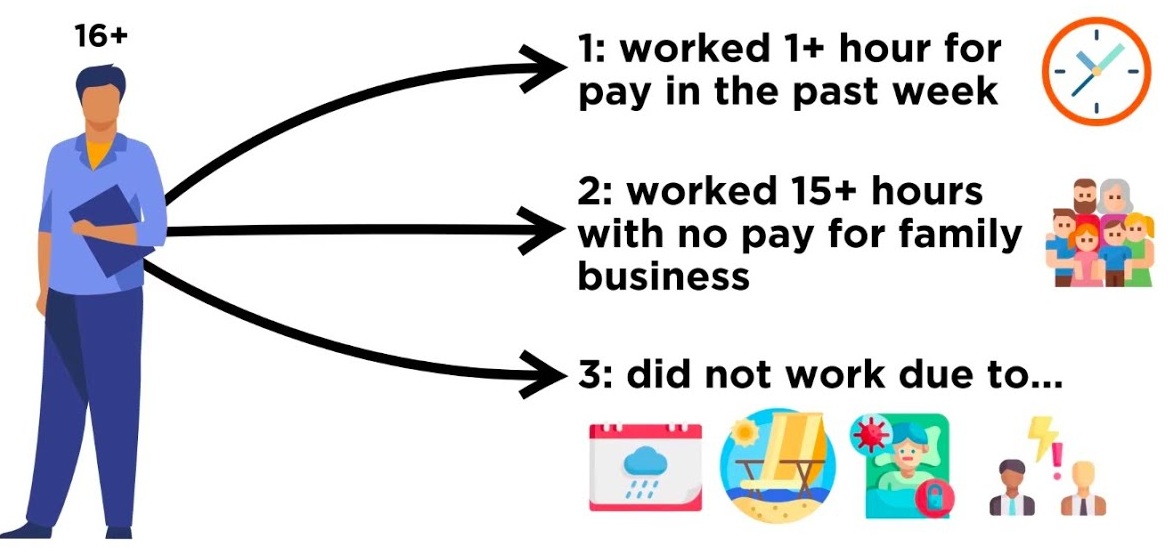
- People who are employed
- People who are unemployed but actively seeking work
The labour force does not include:
- Children
- Retired people
- Full-time students not seeking work
- People unable to work
- Discouraged workers who stopped looking for jobs
Meaning of the Unemployment Rate
The unemployment rate measures the percentage of the labour force that is unemployed.
It shows the extent to which labour resources are unused in the economy.
\( \mathrm{Unemployment\ Rate = \dfrac{Number\ of\ Unemployed}{Labour\ Force} \times 100} \)
Interpretation of the Unemployment Rate
- A high unemployment rate indicates underutilized labour resources.
- A low unemployment rate suggests stronger labour market conditions.
- Very low unemployment may create labour shortages and inflationary pressure.
Example of Unemployment Rate Calculation
If:
- Number of unemployed people = \( \mathrm{2\ million} \)
- Labour force = \( \mathrm{40\ million} \)
Then:
\( \mathrm{Unemployment\ Rate = \dfrac{2}{40} \times 100 = 5\%} \)
The unemployment rate is \( \mathrm{5\%} \).
Methods of Measuring Unemployment
Governments and statistical agencies use different methods to measure unemployment.
1. Labour Force Surveys
- Households are surveyed about employment status.
- People are classified as employed, unemployed, or outside the labour force.
Advantages:
- Provides broad information about labour markets.
- Includes unemployed people not receiving benefits.
2. Claimant Count Method
- Measures the number of people claiming unemployment-related benefits.
Advantages:
- Easy to collect data.
- Updated regularly.
Limitation:
- Does not include unemployed people who do not claim benefits.
Importance of Measuring Unemployment
- Helps governments evaluate economic performance.
- Used in policy making.
- Shows labour market conditions.
- Important for analysing economic growth and inflation.
Difficulties of Measuring Unemployment
Although unemployment statistics are important, measuring unemployment accurately is difficult.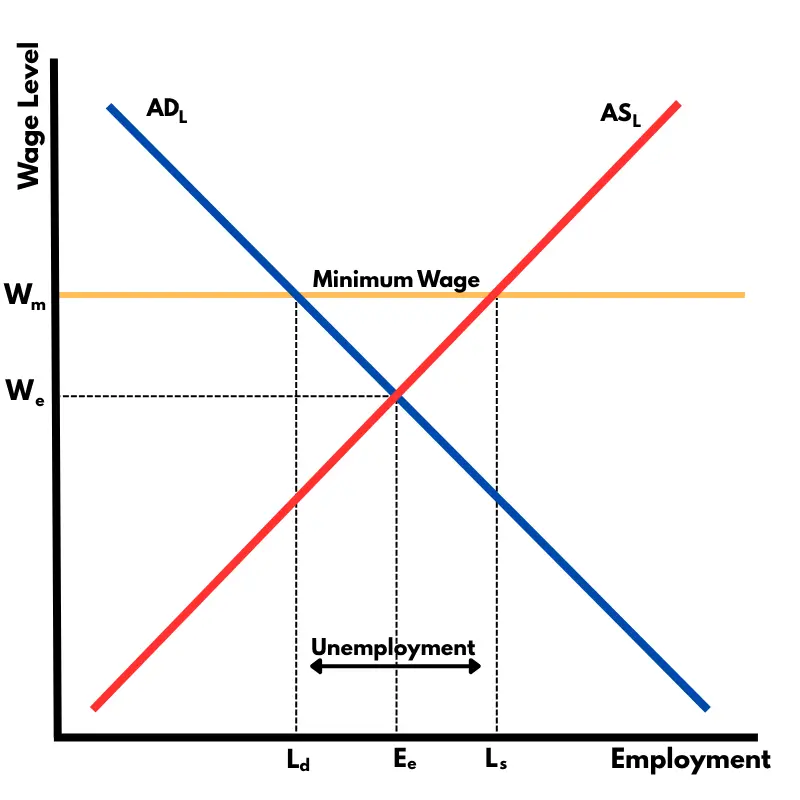
Different methods and definitions may produce different unemployment figures.
1. Hidden Unemployment
Some unemployed people are not included in official statistics.
Examples:
- Discouraged workers who stop searching for jobs
- People working very few hours but wanting full-time work
Effect:
- Official unemployment may underestimate true unemployment.
2. Informal Economy
Some people work in the informal or underground economy.
- They may officially appear unemployed while actually earning income informally.
Effect:
- Unemployment data may become inaccurate.
3. Differences in Definitions
Countries may use different definitions of unemployment.
- Different rules about who counts as actively seeking work may exist.
- This makes international comparisons difficult.
4. Underemployment
Underemployment occurs when people work fewer hours than they would like or work in jobs below their skill level.
Examples:
- A highly qualified engineer working part-time in a low-skilled job
Effect:
- Official unemployment statistics may not reflect full labour market problems.
5. Claimant Count Limitations
- Some unemployed people may not qualify for benefits.
- Others may choose not to claim benefits.
Effect:
- Claimant count may underestimate unemployment.
6. Temporary and Seasonal Work
- People moving between temporary jobs may be difficult to classify.
- Seasonal employment patterns affect unemployment data.
Consequences of Inaccurate Measurement
- Governments may design ineffective policies.
- True labour market conditions may be misunderstood.
- Economic performance may appear stronger or weaker than reality.
Comparison of Measurement Issues
| Difficulty | Explanation |
|---|---|
| Hidden unemployment | Discouraged workers excluded |
| Underemployment | People employed below desired hours/skills |
| Informal economy | Unrecorded work affects statistics |
| Different definitions | Difficult international comparison |
| Claimant count limitations | Not all unemployed claim benefits |
Key Ideas:
- The unemployment rate measures the percentage of the labour force that is unemployed.
- Labour force surveys and claimant counts are common measurement methods.
- Unemployment is difficult to measure accurately.
- Hidden unemployment and underemployment may cause official statistics to underestimate labour market problems.
Example 1
Calculate the unemployment rate if the labour force is \( \mathrm{60\ million} \) and \( \mathrm{3\ million} \) people are unemployed.
▶️ Answer / Explanation
\( \mathrm{Unemployment\ Rate = \dfrac{3}{60} \times 100} \)
\( \mathrm{= 5\%} \)
The unemployment rate is \( \mathrm{5\%} \).
Example 2
Explain why official unemployment statistics may underestimate true unemployment.
▶️ Answer / Explanation
Some unemployed people stop searching for work because they become discouraged.
These discouraged workers are often excluded from the labour force.
People working part-time but wanting full-time work may also not be counted as unemployed.
As a result, official unemployment figures may underestimate actual labour market problems.
Causes of Unemployment
Unemployment occurs for different reasons depending on the conditions of the economy and the labour market.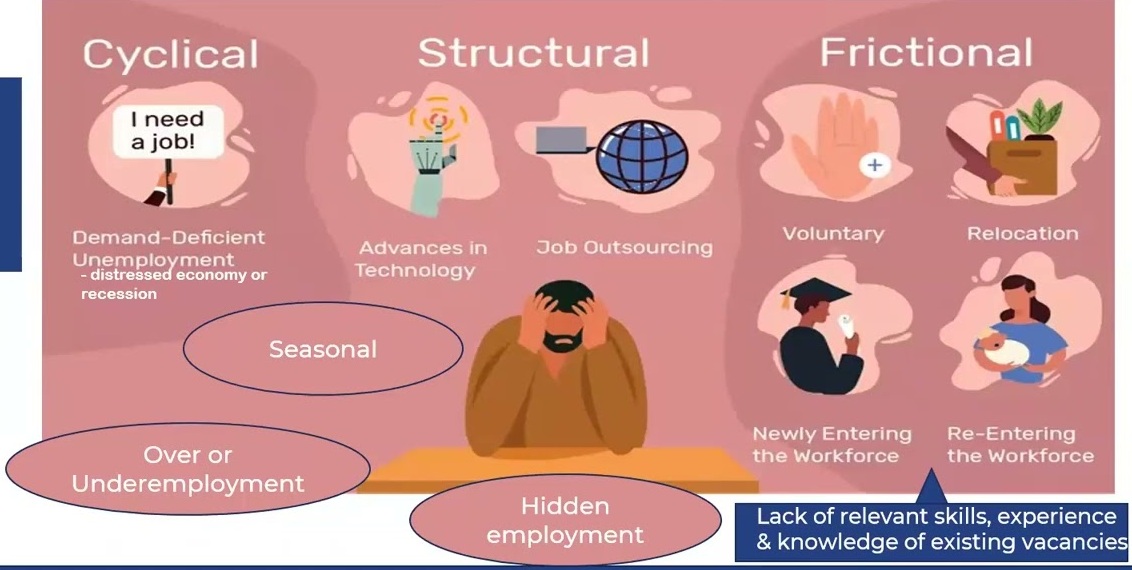
Economists classify unemployment into different types based on its causes.
The main causes of unemployment are:
- Cyclical (demand-deficient) unemployment
- Structural unemployment
- Seasonal unemployment
- Frictional unemployment
1. Cyclical (Demand-Deficient) Unemployment
Cyclical unemployment, also called demand-deficient unemployment, occurs when there is insufficient aggregate demand in the economy.
It is associated with downturns in the business cycle and recessions.
How Cyclical Unemployment Occurs
- Aggregate demand falls.
- Firms experience lower demand for goods and services.
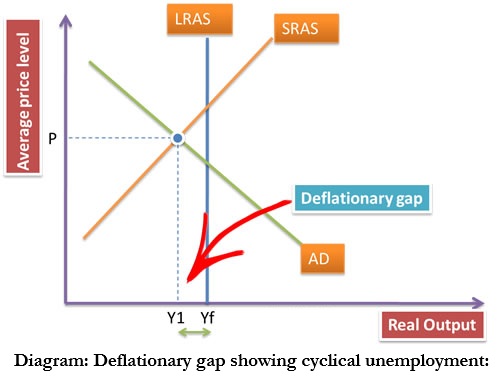
- Production decreases.
- Firms reduce their workforce.
AD ↓ → Output ↓ → Employment ↓
Characteristics of Cyclical Unemployment
- Occurs during recessions.
- Affects many industries at the same time.
- Usually temporary if economic recovery occurs.
Examples of Cyclical Unemployment
- Workers losing jobs during a recession.
- Firms reducing staff because consumers spend less.
Policies to Reduce Cyclical Unemployment
- Expansionary fiscal policy
- Expansionary monetary policy
- Policies to increase aggregate demand
2. Structural Unemployment
Structural unemployment occurs when there is a mismatch between workers’ skills and the skills demanded by employers.
It usually results from long-term changes in the structure of the economy.
Causes of Structural Unemployment
a. Technological Change
- Automation may replace workers.
- Some skills become outdated.
b. Changes in Consumer Demand
- Demand for certain products may decrease permanently.
- Industries may shrink or disappear.
c. Globalization and International Competition
- Firms may relocate production to lower-cost countries.
- Domestic industries may decline.
d. Geographical Immobility
- Workers may not move to regions with available jobs.
e. Occupational Immobility
- Workers may lack skills required for new jobs.
Characteristics of Structural Unemployment
- Often long term.
- May persist even when the economy grows.
- Requires retraining and education programs.
Examples of Structural Unemployment
- Factory workers losing jobs because of automation.
- Coal industry workers unemployed after transition to renewable energy.
Policies to Reduce Structural Unemployment
- Education and retraining programs
- Labour mobility support
- Supply-side policies
3. Seasonal Unemployment
Seasonal unemployment occurs because some industries operate only during certain times of the year.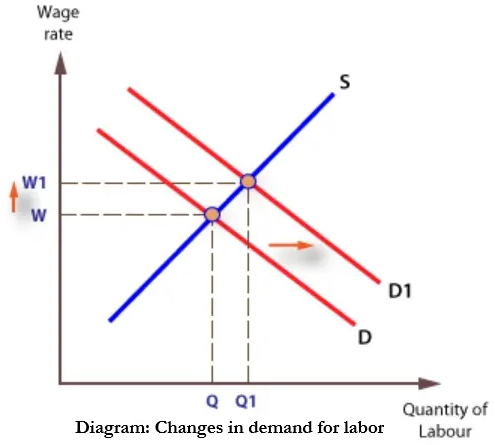
Causes of Seasonal Unemployment
- Seasonal changes in weather
- Tourism patterns
- Agricultural production cycles
- Holiday-related employment changes
Characteristics of Seasonal Unemployment
- Occurs regularly each year.
- Usually temporary and predictable.
- Affects industries dependent on seasons.
Examples of Seasonal Unemployment
- Ski resort workers unemployed during summer.
- Agricultural workers unemployed after harvest season.
- Tourism workers unemployed during off-season periods.
Policies to Reduce Seasonal Unemployment
- Encouraging year-round tourism
- Diversifying local economies
- Temporary government support programs
4. Frictional Unemployment
Frictional unemployment occurs when workers are temporarily between jobs.
It is a normal part of labour market movement.
Causes of Frictional Unemployment
- Workers voluntarily leaving jobs to find better opportunities.
- Graduates searching for first jobs.
- People relocating to new areas.
- Time needed to match workers with suitable jobs.
Characteristics of Frictional Unemployment
- Usually short term.
- Exists even in healthy economies.
- Reflects normal labour market mobility.
Examples of Frictional Unemployment
- A worker leaving one job before starting another.
- A university graduate searching for employment.
Policies to Reduce Frictional Unemployment
- Improved job information systems
- Better employment services
- Online job-matching platforms
Comparison of Types of Unemployment
| Type | Main Cause | Nature |
|---|---|---|
| Cyclical | Low aggregate demand | Linked to recessions |
| Structural | Skill/job mismatch | Long term |
| Seasonal | Seasonal changes | Regular and temporary |
| Frictional | Job transitions | Short term |
Importance of Understanding Causes of Unemployment
- Different types require different policy responses.
- Helps governments design effective employment policies.
- Important for macroeconomic stability and growth.
Key Ideas:
- Cyclical unemployment results from insufficient aggregate demand.
- Structural unemployment results from changes in the economy and labour market mismatch.
- Seasonal unemployment occurs because of seasonal economic activity.
- Frictional unemployment reflects normal labour market movement.
Example 1
Explain how a recession may create cyclical unemployment.
▶️ Answer / Explanation
During a recession, aggregate demand decreases.
Firms experience lower sales and reduce production.
To cut costs, firms may lay off workers.
This creates cyclical or demand-deficient unemployment.
Example 2
Using an example, explain structural unemployment.
▶️ Answer / Explanation
If automation replaces factory workers, many workers may lose jobs.
Their existing skills may no longer match labour market needs.
Workers may remain unemployed until retrained for new occupations.
This is structural unemployment.
Natural Rate of Unemployment
The natural rate of unemployment refers to the level of unemployment that exists when the economy is operating at full employment equilibrium.
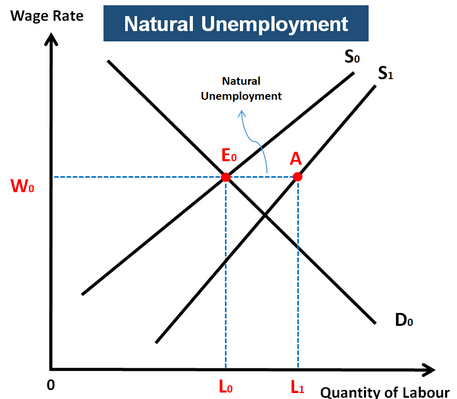
It represents unemployment that exists even when there is no cyclical (demand-deficient) unemployment.
Natural rate of unemployment = Structural + Seasonal + Frictional unemployment
Meaning of Full Employment
Full employment does not mean zero unemployment.
Even in a healthy economy:
- Some workers are changing jobs.
- Some workers lack required skills.
- Some industries operate seasonally.
Therefore, some unemployment always exists naturally.
Components of the Natural Rate of Unemployment
The natural rate consists of:
- Structural unemployment
- Seasonal unemployment
- Frictional unemployment
It does not include cyclical unemployment.
1. Frictional Unemployment
Frictional unemployment occurs because workers need time to move between jobs.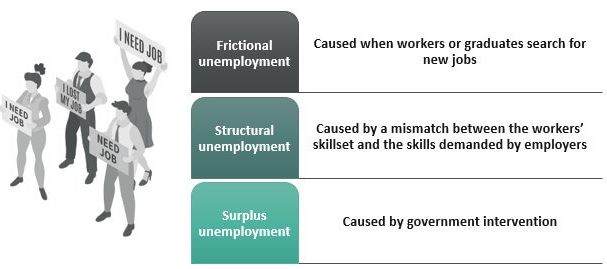
Examples:
- Graduates searching for first jobs
- Workers leaving jobs voluntarily to find better opportunities
Why It Exists Naturally:
- Labour markets require time to match workers with suitable jobs.
- Workers constantly enter and leave the labour force.
2. Structural Unemployment
Structural unemployment exists because of long-term changes in the economy.
Examples:
- Technological change making some skills obsolete
- Industries declining because of globalization
Why It Exists Naturally:
- Economies continuously change.
- Workers may need retraining or relocation.
3. Seasonal Unemployment
Seasonal unemployment occurs because some jobs are available only during certain times of the year.
Examples:
- Agricultural workers between harvest seasons
- Tourism workers during off-season periods
Why It Exists Naturally:
- Seasonal patterns are part of many industries.
Exclusion of Cyclical Unemployment
Cyclical unemployment is not included in the natural rate because it occurs only during recessions when aggregate demand is insufficient.
At full employment equilibrium: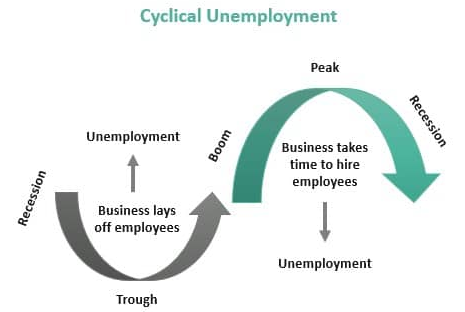
- Cyclical unemployment is assumed to be zero.
Why the Natural Rate Changes Over Time
The natural rate of unemployment is not fixed permanently.
It may change because of:
- Technological progress
- Labour market policies
- Education and training levels
- Demographic changes
- Changes in labour mobility
Factors That May Increase the Natural Rate
- Rapid technological change
- Skill mismatches
- Low labour mobility
- Weak education systems
Factors That May Reduce the Natural Rate
- Improved education and training
- Better job information systems
- Higher labour mobility
- Flexible labour markets
Importance of the Natural Rate of Unemployment
- Helps governments understand full employment.
- Used in macroeconomic policy analysis.
- Important for analysing inflation and unemployment relationships.
- Shows that some unemployment is unavoidable.
Natural Rate and Inflation
Monetarist and New Classical economists argue that attempts to reduce unemployment below the natural rate may create inflation.
Reason:
- Labour shortages increase wages.
- Higher wages increase production costs and prices.
Comparison Between Natural and Cyclical Unemployment
| Aspect | Natural Unemployment | Cyclical Unemployment |
|---|---|---|
| Main Cause | Structural, frictional, seasonal factors | Insufficient aggregate demand |
| Exists at Full Employment? | Yes | No |
| Nature | Normal and unavoidable | Associated with recessions |
| Policy Focus | Supply-side policies | Demand-management policies |
Key Ideas:
- The natural rate of unemployment exists even at full employment equilibrium.
- It consists of structural, frictional, and seasonal unemployment.
- Cyclical unemployment is excluded from the natural rate.
- The natural rate changes over time depending on labour market conditions.
Example 1
Explain why frictional unemployment is included in the natural rate of unemployment.
▶️ Answer / Explanation
Workers regularly move between jobs or enter the labour force for the first time.
It takes time to search for suitable employment.
This temporary unemployment exists even in a healthy economy.
Therefore, frictional unemployment is part of the natural rate.
Example 2
Using an example, explain why cyclical unemployment is not part of the natural rate of unemployment.
▶️ Answer / Explanation
During a recession, aggregate demand decreases and firms reduce production.
Workers may lose jobs because of insufficient demand for goods and services.
This unemployment disappears when the economy returns to full employment.
Therefore, cyclical unemployment is not included in the natural rate.
Costs of Unemployment
Unemployment creates costs not only for unemployed individuals, but also for society and the economy as a whole.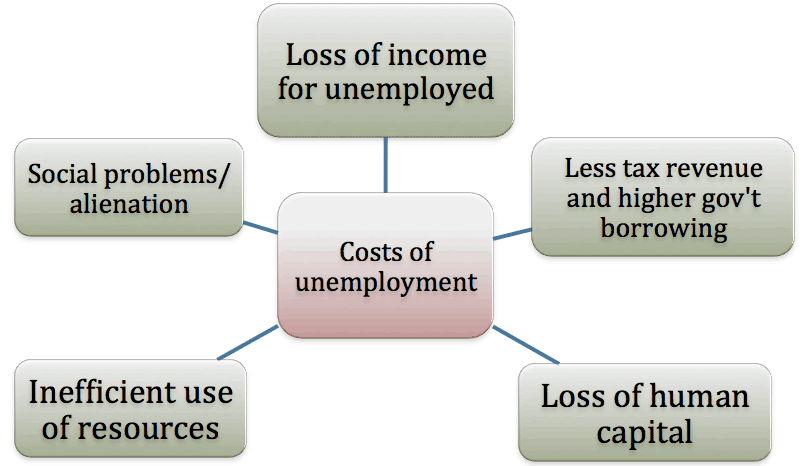
The costs of unemployment can be divided into:
- Personal costs
- Social costs
- Economic costs
The severity of these costs often increases when unemployment is high or long term.
1. Personal Costs of Unemployment
Personal costs are the negative effects experienced directly by unemployed individuals and their families.
a. Loss of Income
- Unemployed workers lose wages and salaries.
- Household income falls.
- People may struggle to afford necessities such as food, housing, and healthcare.
Unemployment → Lower income → Lower living standards
b. Lower Living Standards
- Consumption of goods and services decreases.
- Families may reduce spending on education, healthcare, and leisure.
- Poverty risk may increase.
c. Psychological and Emotional Stress
- Unemployment may cause stress, anxiety, and depression.
- People may experience loss of confidence and self-esteem.
- Long-term unemployment can worsen mental health problems.
d. Skill Loss and Reduced Employability
- Long periods without work may reduce workers’ skills and experience.
- Technological changes may make skills outdated.
- Future employment opportunities may become more limited.
e. Family Problems
- Financial pressure may create family conflict.
- Children’s education and well-being may be affected.
2. Social Costs of Unemployment
Social costs are the negative effects of unemployment on communities and society.
a. Increased Poverty and Inequality
- Unemployment may widen income inequality.
- Poverty levels may rise.
- Social exclusion may increase.
b. Higher Crime Rates
- Long-term unemployment may contribute to higher crime rates in some areas.
- Economic hardship may increase social instability.
c. Health Problems
- Stress and financial insecurity may increase physical and mental health problems.
- Communities with high unemployment may experience poorer overall health outcomes.
d. Social and Political Instability
- Persistent unemployment may increase dissatisfaction with governments.
- Social tensions and protests may rise.
e. Loss of Social Cohesion
- Communities affected by unemployment may experience reduced trust and weaker social relationships.
3. Economic Costs of Unemployment
Economic costs refer to the negative effects of unemployment on the overall economy.
a. Loss of Output
- Unemployed workers do not contribute to production.
- The economy operates below potential output.
- Real GDP becomes lower than possible.
Unemployment → Underutilized resources → Lower real GDP
b. Opportunity Cost of Idle Resources
- Labour resources remain unused.
- Potential goods and services are not produced.
c. Lower Government Tax Revenue
- Unemployed people pay less income tax.
- Consumer spending decreases, reducing indirect tax revenue.
d. Higher Government Spending
- Governments may spend more on unemployment benefits and welfare programs.
- Budget deficits may increase.
e. Reduced Investment and Growth
- Low demand may discourage firms from investing.
- Long-term economic growth may slow.
f. Brain Drain
- Highly skilled workers may migrate to other countries seeking employment.
- The economy loses valuable human capital.
Short-Term vs Long-Term Unemployment Costs
Short-Term Unemployment:
- Usually creates temporary income loss and reduced spending.
Long-Term Unemployment:
- Creates more severe social, psychological, and economic damage.
- Skill erosion and persistent poverty may develop.
Comparison of Costs of Unemployment
| Type of Cost | Examples |
|---|---|
| Personal Costs | Income loss, stress, lower living standards |
| Social Costs | Poverty, crime, social instability |
| Economic Costs | Lower GDP, lower tax revenue, higher welfare spending |
Importance of Reducing Unemployment
- Improves living standards and economic well-being.
- Increases economic efficiency and output.
- Reduces poverty and social problems.
- Supports long-term economic growth.
Key Ideas:
- Unemployment creates personal, social, and economic costs.
- Long-term unemployment can create severe psychological and social problems.
- Unemployment reduces economic output and government revenue.
- Reducing unemployment is an important macroeconomic objective.
Example 1
Explain how unemployment may reduce economic growth.
▶️ Answer / Explanation
When workers are unemployed, labour resources remain unused.
The economy produces less output than its potential capacity.
Lower production reduces real GDP and economic growth.
Therefore, unemployment creates an economic cost through lost output.
Example 2
Using an example, explain a personal cost of unemployment.
▶️ Answer / Explanation
If a worker loses their job, household income may fall significantly.
The family may struggle to pay for housing, healthcare, and education.
The unemployed worker may also experience stress and loss of confidence.
This shows how unemployment creates personal and psychological costs.