
Macroeconomic Equilibrium
Macroeconomic equilibrium occurs when the total quantity of goods and services demanded in the economy is equal to the total quantity of goods and services supplied.
At this point: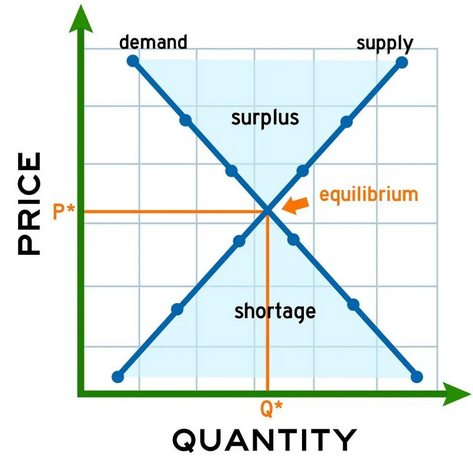
- Aggregate demand (AD) equals aggregate supply (AS).
- There is no tendency for real output or the general price level to change unless external conditions change.
\( \mathrm{AD = AS} \)
Macroeconomic equilibrium determines:
- Real national output
- Employment levels
- The general price level
Meaning of Macroeconomic Equilibrium
The equilibrium point represents a balance between total spending and total production in the economy.
- If aggregate demand exceeds aggregate supply, output and prices tend to rise.
- If aggregate supply exceeds aggregate demand, output and prices tend to fall.
- Equilibrium occurs where these forces are balanced.
Aggregate Demand and Aggregate Supply Interaction
Macroeconomic equilibrium is determined by the interaction of:
- Aggregate demand (AD):
- Total spending in the economy.
- Aggregate supply (AS):
- Total output firms are willing and able to produce.
The equilibrium point occurs where the AD curve intersects the AS curve.
Importance of Macroeconomic Equilibrium
- Helps determine national income and output.
- Important for understanding inflation and unemployment.
- Used in macroeconomic policy analysis.
- Shows the overall performance of the economy.
Types of Macroeconomic Equilibrium
Macroeconomic equilibrium may occur:
- Below full employment output
- At full employment output
- Above full employment output
This leads to:
- Recessionary gaps
- Full employment equilibrium
- Inflationary gaps
Short-Run Equilibrium
Short-run equilibrium occurs where aggregate demand intersects the short-run aggregate supply (SRAS) curve.
In the short run: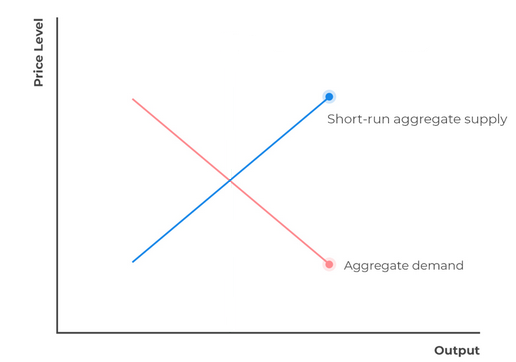
- Wages and some costs are relatively inflexible.
- Output can deviate from potential output.
- The economy may experience unemployment or inflationary pressure.
Short-run equilibrium = Intersection of \( \mathrm{AD} \) and \( \mathrm{SRAS} \)
Characteristics of Short-Run Equilibrium
- Determines actual real GDP and price level in the short run.
- May occur below or above full employment output.
- Changes in AD or SRAS shift the equilibrium position.
Short-Run Equilibrium Below Full Employment
If equilibrium output is below potential output:
- A recessionary or deflationary gap exists.
- Unemployment is high.
- Resources are underutilized.
Actual output < Potential output
Short-Run Equilibrium at Full Employment
If equilibrium output equals potential output:
- The economy operates at full employment.
- Resources are efficiently utilized.
- Inflation remains relatively stable.
Actual output = Potential output
Short-Run Equilibrium Above Full Employment
If equilibrium output exceeds potential output:
- An inflationary gap exists.
- Demand exceeds sustainable productive capacity.
- Strong inflationary pressures develop.
Actual output > Potential output
Adjustment Toward New Short-Run Equilibrium
Changes in aggregate demand or SRAS cause shifts in equilibrium.
Examples:
- Increase in AD raises output and price level.
- Decrease in AD lowers output and employment.
- Increase in SRAS increases output and lowers inflationary pressure.
Importance of Short-Run Equilibrium
- Helps explain business cycle fluctuations.
- Used to analyse inflation and unemployment.
- Important for fiscal and monetary policy decisions.
Comparison Between General Equilibrium and Short-Run Equilibrium
| Concept | Main Idea |
|---|---|
| Macroeconomic Equilibrium | \( \mathrm{AD = AS} \) |
| Short-Run Equilibrium | Intersection of \( \mathrm{AD} \) and \( \mathrm{SRAS} \) |
| Below Full Employment | Recessionary gap |
| Above Full Employment | Inflationary gap |
Key Ideas:
- Macroeconomic equilibrium occurs where aggregate demand equals aggregate supply.
- Short-run equilibrium is determined by AD and SRAS interaction.
- Equilibrium output may differ from potential output.
- Inflationary and recessionary gaps may exist in the short run.
Example 1
Explain what happens when aggregate demand exceeds aggregate supply.
▶️ Answer / Explanation
When aggregate demand exceeds aggregate supply, firms experience rising demand for goods and services.
Firms increase production and may raise prices.
As a result, real output and the general price level tend to increase.
This may create inflationary pressure in the economy.
Example 2
Using an example, explain a short-run equilibrium below full employment.
▶️ Answer / Explanation
During a recession, consumer spending and investment may decrease.
Aggregate demand shifts left and equilibrium output falls below potential output.
Firms reduce production and unemployment rises.
This situation represents a recessionary gap in short-run equilibrium.
Equilibrium in the Monetarist/New Classical Model
The Monetarist/New Classical model argues that the economy naturally moves toward a long-run equilibrium at the full employment level of output.
According to this view:
- Markets function efficiently.
- Wages and prices are flexible.
- The economy is self-correcting.
- Government intervention is usually unnecessary in the long run.
Determination of Long-Run Equilibrium at Full Employment Level of Output
In the Monetarist/New Classical model, long-run equilibrium occurs where: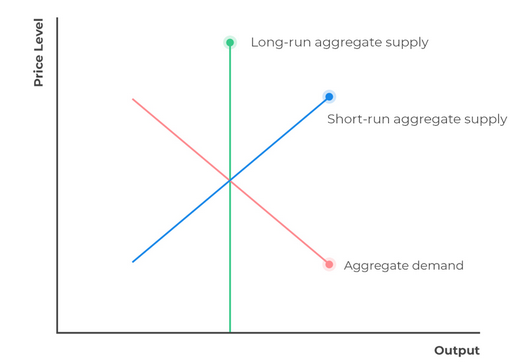
- Aggregate demand (AD)
- Short-run aggregate supply (SRAS)
- Long-run aggregate supply (LRAS)
all intersect at the full employment level of output.
The LRAS curve is vertical because long-run output depends only on productive capacity, not on the price level.
Long-run equilibrium occurs at potential output
Potential output is the maximum level of real output the economy can produce when resources are fully employed efficiently.
Characteristics of Long-Run Equilibrium
- Resources are fully employed.
- Real GDP equals potential GDP.
- Only natural unemployment exists.
- The economy operates at sustainable capacity.
- No inflationary or recessionary gap exists.
Role of the LRAS Curve
The LRAS curve determines the economy’s long-run productive capacity.
- Changes in AD affect only the price level in the long run.
- Long-run output remains fixed at potential output.
Key Insight:
- Demand-side policies cannot permanently increase real output beyond potential output.
Automatic Adjustment to Full Employment Equilibrium
According to Monetarists/New Classical economists, the economy automatically adjusts back to full employment equilibrium after short-run disturbances.
This happens because wages and prices are flexible.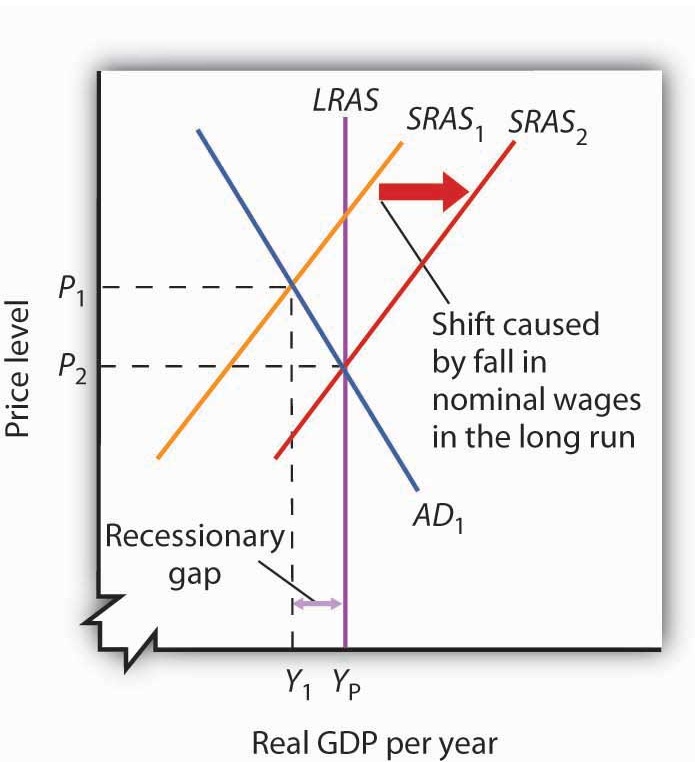
Adjustment from a Recessionary Gap
If actual output falls below potential output:
- Unemployment rises above the natural rate.
- Excess labour supply puts downward pressure on wages.
- Lower wages reduce firms’ production costs.
- SRAS shifts to the right.
- The economy returns to full employment equilibrium.
Recessionary gap → Wages ↓ → SRAS shifts right → Return to full employment
Adjustment from an Inflationary Gap
If actual output exceeds potential output: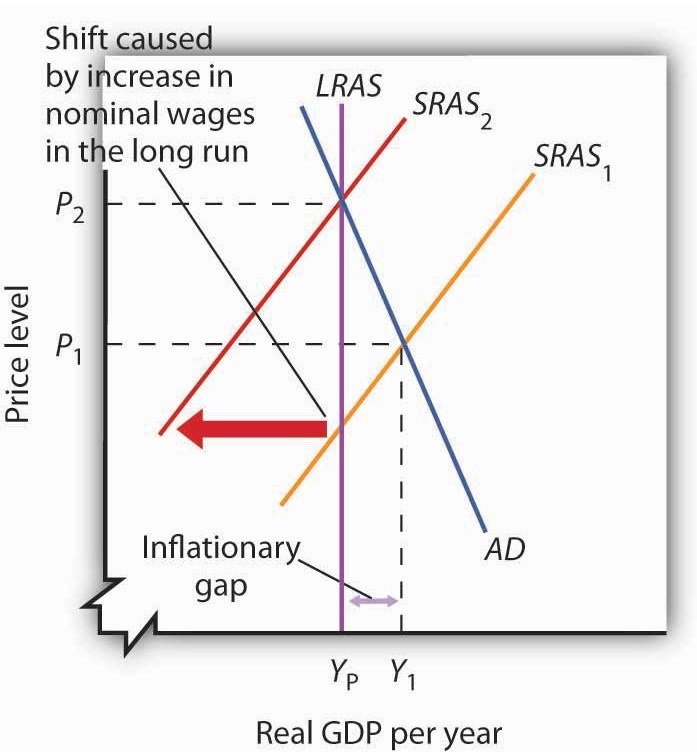
- Labour shortages develop.
- Wages rise due to excess demand for labour.
- Higher wages increase production costs.
- SRAS shifts to the left.
- The economy returns to potential output.
Inflationary gap → Wages ↑ → SRAS shifts left → Return to full employment
Why the Economy Self-Corrects
The self-correcting mechanism is based on:
- Flexible wages
- Flexible prices
- Competitive markets
- Rational behaviour of firms and workers
According to Monetarists:
- Persistent unemployment cannot exist in competitive markets.
- Market forces restore equilibrium automatically.
Natural Rate of Unemployment
At full employment equilibrium, unemployment still exists, but only at the natural rate of unemployment.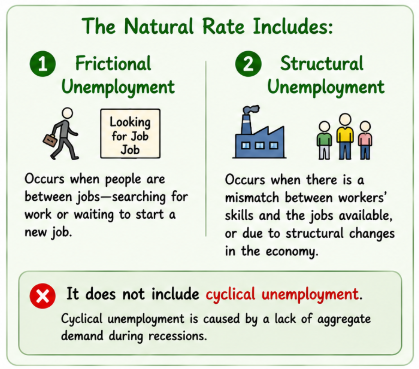
The natural rate includes:
- Frictional unemployment
- Structural unemployment
It does not include cyclical unemployment.
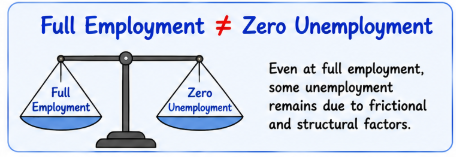
Meaning of Full Employment
Full employment means that all available resources are efficiently utilized.
- People who are willing and able to work at current wages can find jobs.
- Some unemployment still exists due to normal labour market changes.
Implications of the Monetarist/New Classical Model
- The economy is stable in the long run.
- Government intervention should be limited.
- Expansionary demand policies mainly create inflation in the long run.
- Supply-side policies are more effective for long-term growth.
Summary Table
| Concept | Monetarist/New Classical View |
|---|---|
| LRAS Curve | Vertical at potential output |
| Long-Run Equilibrium | Occurs at full employment output |
| Adjustment Mechanism | Flexible wages and prices |
| Natural Rate of Unemployment | Exists even at full employment |
| Role of Government | Limited role in stabilization |
Key Ideas:
- The Monetarist/New Classical model assumes the economy self-corrects.
- Long-run equilibrium occurs at potential output.
- Flexible wages and prices restore full employment equilibrium.
- Only natural unemployment exists at full employment.
Example 1
Explain why the Monetarist LRAS curve is vertical.
▶️ Answer / Explanation
According to Monetarists, long-run output depends only on productive capacity and available resources.
Changes in the general price level do not affect real output in the long run.
Therefore, the LRAS curve is vertical at potential output.
Example 2
Using an example, explain how the economy automatically adjusts from a recessionary gap in the Monetarist model.
▶️ Answer / Explanation
If output falls below potential output, unemployment rises.
Workers may accept lower wages because of excess labour supply.
Lower wages reduce firms’ production costs and increase SRAS.
The SRAS curve shifts right until the economy returns to full employment equilibrium.
Equilibrium in the Keynesian Model
The Keynesian model argues that the economy may not automatically move toward full employment equilibrium.
According to Keynesian economists: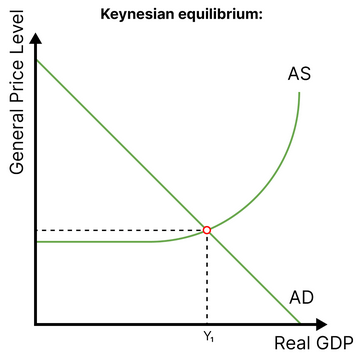
- Wages and prices may be inflexible, especially downward.
- Aggregate demand is the main determinant of output and employment in the short run.
- The economy can remain in equilibrium below full employment for long periods.
- Government intervention may be necessary to stabilize the economy.
Keynesian View of Macroeconomic Equilibrium
In the Keynesian model, equilibrium occurs where:
\( \mathrm{AD = AS} \)
However, this equilibrium does not necessarily occur at full employment output.
The economy may settle at:
- Full employment equilibrium
- Recessionary/deflationary equilibrium
- Inflationary equilibrium
Key Insight:
- Equilibrium does not always mean the economy is healthy or efficient.
Persistence of Deflationary/Recessionary Gaps
A central idea in Keynesian economics is that the economy may experience a persistent recessionary gap.
A recessionary gap exists when:
Actual output < Potential output
This means:
- Aggregate demand is insufficient.
- Resources are underutilized.
- Unemployment is high.
- The economy operates below full employment.
Why Recessionary Gaps May Persist
Keynesians argue that market forces may not quickly restore full employment.
The main reason is the inflexibility of wages and prices.
1. Downward Wage Rigidity
Workers and labour unions may resist wage cuts.
- Firms may be unwilling to reduce wages.
- Minimum wage laws and contracts may prevent wage reductions.
- As a result, labour markets may not clear automatically.
Effect:
- High unemployment may persist.
2. Weak Aggregate Demand
Low consumption and investment can keep aggregate demand weak.
- Households may reduce spending during recessions.
- Firms may delay investment because of pessimistic expectations.
- This reduces output and employment further.
3. Negative Expectations
Pessimistic expectations can worsen recessions.
- Consumers may save more and spend less.
- Firms may reduce hiring and investment.
- Low confidence reduces AD further.
4. Multiplier Effect
Keynesians emphasize that decreases in spending can create larger decreases in national income.
Example:
- If firms reduce investment, workers lose income.
- Lower income reduces consumption.
- Further reductions in spending occur throughout the economy.
This can deepen and prolong recessions.
Keynesian Equilibrium Below Full Employment
In the Keynesian model, equilibrium may occur where AD intersects AS at an output level below potential output.
Characteristics:
- Cyclical unemployment exists.
- Idle productive resources remain unused.
- The economy does not self-correct quickly.
Role of Government Intervention
Because recessionary gaps may persist, Keynesians support government intervention to increase aggregate demand.
Policies used:
- Expansionary fiscal policy
- Higher government spending
- Lower taxes
- Expansionary monetary policy
- Lower interest rates
- Increase in money supply
Goal:
- Increase aggregate demand and restore full employment output.
Comparison with the Monetarist/New Classical View
| Aspect | Keynesian View | Monetarist/New Classical View |
|---|---|---|
| Wages and Prices | Often inflexible | Flexible |
| Self-Correction | Weak or slow | Strong and automatic |
| Recessionary Gaps | May persist | Temporary |
| Role of Government | Important | Limited |
| Main Problem | Insufficient aggregate demand | Market distortions |
Importance of the Keynesian Model
- Helps explain prolonged recessions and unemployment.
- Supports use of demand-management policies.
- Important for understanding the Great Depression and modern recessions.
Key Ideas:
- Equilibrium may occur below full employment.
- Recessionary gaps can persist because wages and prices are inflexible.
- Weak aggregate demand can cause prolonged unemployment.
- Government intervention may be needed to restore full employment.
Example 1
Explain why Keynesians believe recessionary gaps may persist.
▶️ Answer / Explanation
Keynesians argue that wages and prices may not fall easily during recessions.
Workers may resist wage cuts and firms may reduce production instead.
As aggregate demand remains weak, unemployment may continue for a long time.
Therefore, recessionary gaps may persist without government intervention.
Example 2
Using an example, explain how expansionary fiscal policy may reduce a recessionary gap.
▶️ Answer / Explanation
If the government increases spending on infrastructure projects, firms receive more income and hire more workers.
Household income and consumption increase.
Aggregate demand rises, increasing output and employment.
This helps move the economy closer to full employment equilibrium.