
Market-Based Supply-Side Policies
Market-based supply-side policies aim to improve the efficiency of markets by increasing competition and reducing government intervention.
More competition → Greater efficiency → Higher productivity and growth
1. Policies to Encourage Competition
Governments use policies that increase competition in product markets in order to improve efficiency, lower prices, and increase innovation.
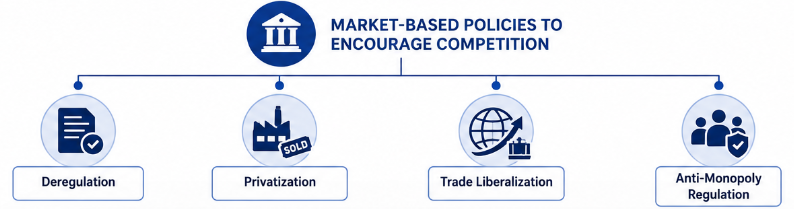
a) Deregulation
Deregulation refers to the removal or reduction of government rules and restrictions in markets.
Fewer regulations → Easier business activity → Greater competition
Explanation:
- Governments reduce legal restrictions on firms.
- Entry barriers become lower.
- Firms face greater competitive pressure.
Economic Significance:
- Encourages efficiency and innovation.
- May lower prices for consumers.
- Increases consumer choice.
Evaluation:
- Too little regulation may reduce consumer and worker protection.
- Can increase market instability in some industries.
b) Privatization
Privatization is the transfer of ownership of state-owned enterprises to the private sector.
Private ownership → Profit incentive → Greater efficiency
Explanation:
- Private firms are driven by profit motives.
- Competition and shareholder pressure encourage efficiency.
- Governments reduce direct involvement in production.
Economic Significance:
- May improve productive efficiency.
- Reduces government spending burden.
- Can increase innovation and investment.
Evaluation:
- Private firms may prioritize profit over public welfare.
- Essential services may become expensive.
- Natural monopolies may still require regulation.
c) Trade Liberalization
Trade liberalization involves reducing barriers to international trade such as tariffs and quotas.
Fewer trade barriers → More foreign competition → Greater efficiency
Explanation:
- Domestic firms face competition from foreign producers.
- Firms must improve efficiency to survive.
- Consumers gain access to cheaper and wider varieties of goods.
Economic Significance:
- Promotes efficiency and innovation.
- Increases consumer choice.
- Supports economic growth through specialization.
Evaluation:
- Domestic firms may struggle against foreign competition.
- Some industries may experience unemployment.
- Benefits may not be equally distributed.
d) Anti-Monopoly Regulation
Anti-monopoly regulation refers to government policies that prevent firms from abusing market power.
Less market power → More competition → Greater efficiency
Explanation:
- Governments regulate mergers and anti-competitive practices.
- Prevents formation of monopolies or cartels.
- Protects consumers and smaller firms.
Economic Significance:
- Promotes allocative and productive efficiency.
- Prevents excessive prices.
- Encourages innovation and competition.
Evaluation:
- Regulation may increase administrative costs.
- Large firms may still benefit from economies of scale.
- Overregulation may discourage investment.
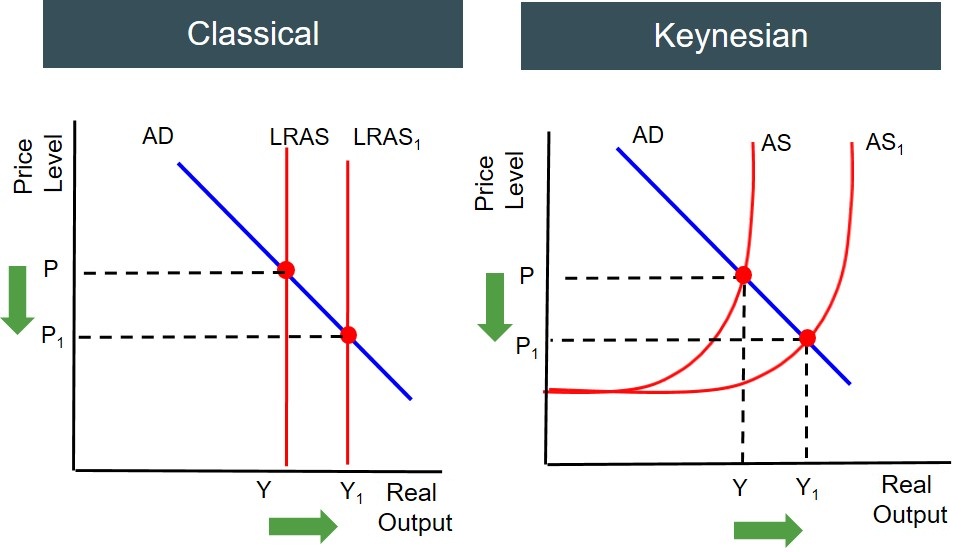
Diagram: AD/AS model with the LRAS curve to show the effect of supply-side policies:
Example 1
Explain how deregulation promotes efficiency.
▶️ Answer / Explanation
Deregulation reduces restrictions on firms.
This increases competition and lowers entry barriers.
Firms become more efficient to survive in the market.
Example 2
Evaluate the effects of trade liberalization on domestic industries.
▶️ Answer / Explanation
Trade liberalization increases competition and efficiency.
Consumers benefit from lower prices and greater choice.
However, domestic firms may lose market share and jobs.
Thus, trade liberalization has both benefits and costs.
2. Labour Market Policies
Labour market policies aim to increase the flexibility and efficiency of labour markets in order to reduce unemployment and improve productivity.
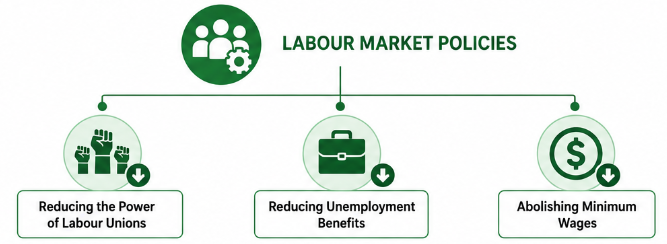
a) Reducing the Power of Labour Unions
Governments may reduce the power of labour unions to increase labour market flexibility.
Weaker unions → More flexible wages → Lower labour costs
Explanation:
- Labour unions negotiate for higher wages and better working conditions.
- Strong unions may increase labour costs for firms.
- Governments may limit union power through labour laws and restrictions on strikes.
Economic Significance:
- Lower labour costs may encourage firms to hire more workers.
- Improves labour market flexibility.
- May reduce structural unemployment.
Evaluation:
- Workers may lose bargaining power and job security.
- Income inequality may increase.
- Lower wages may reduce worker morale and productivity.
b) Reducing Unemployment Benefits
Governments may reduce unemployment benefits to encourage people to seek employment more actively.
Lower benefits → Greater incentive to work → Lower unemployment
Explanation:
- High unemployment benefits may reduce incentives to find work.
- Reducing benefits increases the opportunity cost of remaining unemployed.
- Workers may accept jobs more quickly.
Economic Significance:
- Can reduce long-term unemployment.
- Increases labour force participation.
- Reduces government welfare expenditure.
Evaluation:
- May reduce living standards for unemployed individuals.
- Unemployment may exist due to lack of jobs, not lack of incentives.
- Can increase poverty and inequality.
c) Abolishing Minimum Wages
Governments may abolish or reduce minimum wages to increase employment flexibility.
Lower wage floor → Lower labour costs → Higher demand for labour
Explanation:
- Minimum wages increase labour costs for firms.
- Removing minimum wages allows wages to adjust freely according to market conditions.
- Firms may hire more workers at lower wages.
Economic Significance:
- May reduce unemployment, especially among low-skilled workers.
- Increases labour market flexibility.
- Improves cost competitiveness of firms.
Evaluation:
- Workers may receive very low wages.
- Poverty and income inequality may increase.
- Lower incomes may reduce aggregate demand.
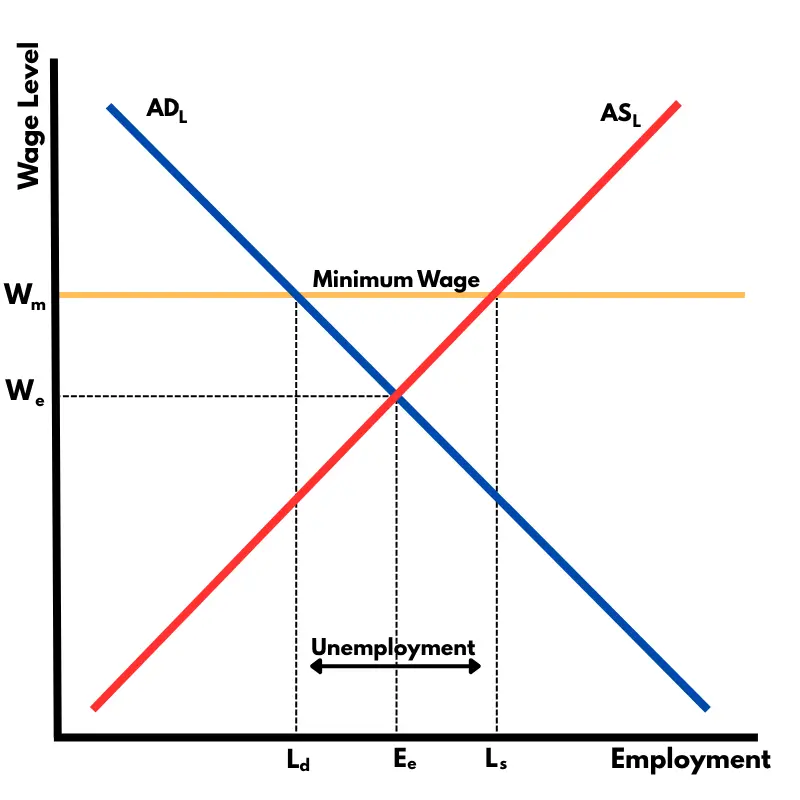
Diagram: showing minimum wage
Example 1
Explain how reducing unemployment benefits may lower unemployment.
▶️ Answer / Explanation
Lower unemployment benefits increase incentives to search for jobs.
Workers may accept employment more quickly.
This may reduce long-term unemployment.
Example 2
Evaluate the effects of abolishing minimum wages.
▶️ Answer / Explanation
Abolishing minimum wages reduces labour costs and may increase employment.
However, workers may receive very low wages.
This can increase poverty and inequality.
Thus, labour market flexibility may improve efficiency but reduce equity.
3. Incentive-Related Policies
Incentive-related policies aim to increase incentives for individuals and firms to work, save, invest, and innovate.
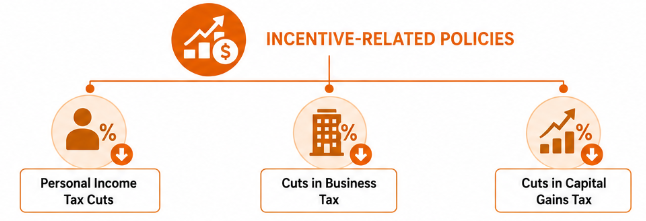
a) Personal Income Tax Cuts
Governments may reduce personal income taxes to increase incentives to work and earn income.
Lower income taxes → Higher disposable income → Greater work incentives
Explanation:
- Workers keep a larger proportion of their income.
- This encourages:
- More work effort
- Longer working hours
- Greater labour force participation
- Higher disposable income may also increase consumption and saving.
Economic Significance:
- May increase productivity and labour supply.
- Can stimulate economic growth.
- May encourage entrepreneurship and risk-taking.
Evaluation:
- Tax cuts may reduce government revenue.
- Higher-income groups often benefit more.
- Work incentives may not increase significantly for all individuals.
b) Cuts in Business Tax and Capital Gains Tax
Governments may reduce business taxes and capital gains taxes to encourage investment and innovation.
Lower business taxes → Higher profits → More investment and innovation
Explanation:
- Lower corporate taxes increase after-tax profits.
- Firms have greater incentives to:
- Invest in capital
- Expand production
- Conduct research and development (R&D)
- Lower capital gains taxes encourage investment in businesses and financial assets.
Economic Significance:
- Promotes innovation and technological progress.
- Increases productive capacity.
- Supports long-term economic growth and competitiveness.
Evaluation:
- Tax reductions may increase budget deficits.
- Firms may distribute profits rather than invest.
- Benefits may mainly go to large firms and wealthy investors.
Economic Logic:
- Incentive-related policies aim to improve supply-side performance through stronger market incentives.
- Lower taxes increase expected rewards from work and investment.
- Higher incentives may improve productivity, innovation, and growth.
Example 1
Explain how personal income tax cuts may increase labour supply.
▶️ Answer / Explanation
Lower income taxes increase disposable income.
Workers keep more of their earnings.
This may encourage people to work more or join the labour force.
Example 2
Evaluate whether cuts in business taxes always increase investment.
▶️ Answer / Explanation
Lower business taxes increase after-tax profits.
This may encourage firms to invest and innovate.
However, firms may choose to save profits instead of investing.
Thus, tax cuts encourage but do not guarantee investment.