
Meaning of Poverty
Poverty refers to a situation in which individuals or households lack sufficient income or resources to maintain an acceptable standard of living.
People living in poverty may struggle to meet basic needs such as: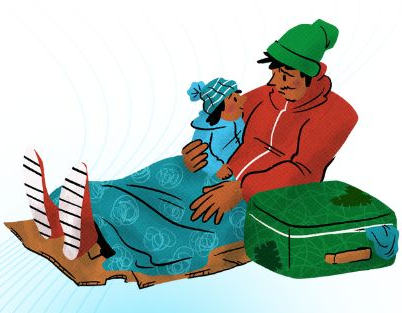
- Food
- Shelter
- Clothing
- Healthcare
- Education
- Clean water and sanitation
Poverty is both an economic and social issue because it affects living standards, opportunities, and well-being.
Main Types of Poverty
The two major forms of poverty are:
- Absolute poverty
- Relative poverty
Absolute Poverty
Absolute poverty occurs when individuals do not have enough income or resources to meet basic physical needs required for survival.
It is usually measured using a fixed minimum income or consumption level.
Characteristics of Absolute Poverty
- Focuses on basic human needs.
- Measures severe deprivation.
- Often linked to malnutrition, disease, and lack of shelter.
- Commonly associated with developing countries.
Basic Needs Included in Absolute Poverty
- Enough food and nutrition
- Safe drinking water
- Basic healthcare
- Basic housing
- Essential clothing
International Poverty Line
International organizations such as the World Bank often use an international poverty line to measure absolute poverty.
This line represents the minimum income needed to meet basic needs.
Example of Absolute Poverty
A family unable to afford enough food or safe shelter is experiencing absolute poverty.
Effects of Absolute Poverty
- Malnutrition and poor health
- Low life expectancy
- Limited access to education
- High infant mortality
- Reduced productivity
Relative Poverty
Relative poverty occurs when individuals have significantly lower income or resources compared with the average standard of living in their society.
Relative poverty is measured in comparison to others within the same country or society.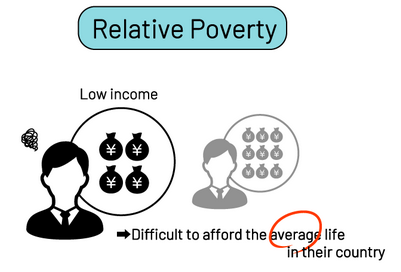
Characteristics of Relative Poverty
- Depends on social and economic context.
- Focuses on inequality and social exclusion.
- Exists even in wealthy countries.
Meaning of Relative Poverty
People in relative poverty may be able to meet basic survival needs but still:
- Cannot participate fully in normal social activities.
- Experience lower living standards compared to most people in society.
Example of Relative Poverty
A household may have enough food and housing but may not afford:
- Internet access
- Transportation
- Educational opportunities
- Participation in normal social activities
This household may experience relative poverty.
Measurement of Relative Poverty
Relative poverty is often measured using a percentage of median household income.
Example:
- People earning less than \( \mathrm{50\%} \) or \( \mathrm{60\%} \) of median income may be classified as relatively poor.
Effects of Relative Poverty
- Social exclusion
- Lower educational opportunities
- Reduced social mobility
- Psychological stress
- Reduced quality of life
Difference Between Absolute and Relative Poverty
| Aspect | Absolute Poverty | Relative Poverty |
|---|---|---|
| Meaning | Lack of basic needs for survival | Low income compared to society |
| Measurement | Fixed poverty line | Compared to average income |
| Main Focus | Physical survival | Living standards and inequality |
| Common In | Developing countries | All countries |
| Example | Lack of food and shelter | Unable to participate fully in society |
Relationship Between Poverty and Inequality
Relative poverty is closely linked to economic inequality.
High income inequality may increase relative poverty because:
- The gap between rich and poor becomes larger.
- Some groups become socially excluded.
Causes of Poverty
- Unemployment
- Low wages
- Limited education
- Discrimination
- Economic inequality
- Health problems
- Lack of opportunities
Government Policies to Reduce Poverty
- Progressive taxation
- Transfer payments
- Public healthcare and education
- Minimum wage laws
- Employment programs
- Social welfare systems
Importance of Reducing Poverty
- Improves living standards.
- Increases economic opportunities.
- Promotes social stability.
- Supports economic growth and productivity.
Key Ideas:
- Poverty refers to insufficient income or resources to maintain an acceptable standard of living.
- Absolute poverty focuses on basic survival needs.
- Relative poverty compares living standards within society.
- Relative poverty is strongly linked to inequality and social exclusion.
Example 1
Explain the difference between absolute poverty and relative poverty.
▶️ Answer / Explanation
Absolute poverty occurs when individuals cannot meet basic survival needs such as food and shelter.
Relative poverty occurs when individuals have much lower income compared to the average standard of living in society.
Absolute poverty focuses on survival, while relative poverty focuses on inequality and social participation.
Example 2
Using an example, explain why relative poverty may exist in a wealthy country.
▶️ Answer / Explanation
A person may have enough food and housing but may not afford internet access, transportation, or educational opportunities that most people in society consider normal.
Although the person is not experiencing absolute poverty, they may still experience relative poverty because their living standard is much lower than the societal average.