
Monetary Policy
Monetary policy refers to actions taken by a country’s central bank to influence:
- Money supply
- Interest rates
- Credit conditions
- Overall economic activity
The central bank uses monetary policy to help achieve important macroeconomic objectives such as: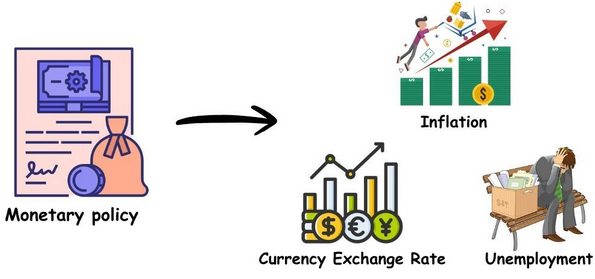
- Low and stable inflation
- Low unemployment
- Stable economic growth
- Financial stability
Role of the Central Bank
The central bank is the main monetary authority of a country.
Examples include:
- Reserve Bank of India (RBI)
- Federal Reserve (USA)
- Bank of England
- European Central Bank (ECB)
Main Functions of the Central Bank
- Control money supply
- Set interest rates
- Issue currency
- Act as lender of last resort
- Maintain financial system stability
- Regulate commercial banks
Control of Money Supply
Money supply refers to the total amount of money available in the economy.
This includes:
- Cash in circulation
- Bank deposits
- Other liquid financial assets
Why Money Supply Matters
The level of money supply affects:
- Consumer spending
- Investment
- Inflation
- Economic growth
Money supply ↑ → Spending and investment ↑
Money supply ↓ → Spending and investment ↓
Expansionary Monetary Policy
The central bank may increase money supply during periods of: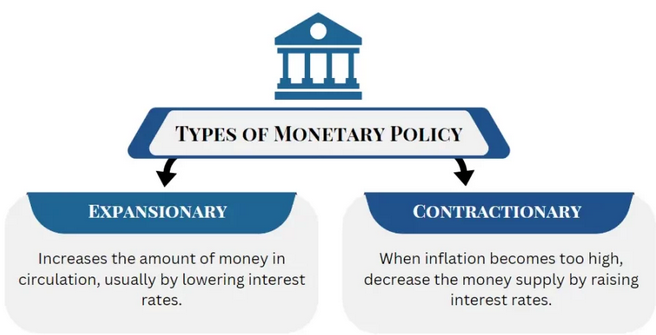
- Recession
- High unemployment
- Low economic growth
This is called expansionary monetary policy.
Effects of Increasing Money Supply
- More money becomes available for lending.
- Interest rates may decrease.
- Consumption and investment increase.
- Aggregate demand increases.
- Economic growth and employment may rise.
Contractionary Monetary Policy
The central bank may reduce money supply during periods of:
- High inflation
- Excessive aggregate demand
This is called contractionary monetary policy.
Effects of Reducing Money Supply
- Less money is available for lending.
- Interest rates may increase.
- Consumption and investment decrease.
- Aggregate demand decreases.
- Inflationary pressure may fall.
Control of Interest Rates
Interest rates represent the cost of borrowing money or the reward for saving money.
The central bank influences interest rates through monetary policy.
Policy Interest Rate
The central bank sets a key policy interest rate.
This influences:
- Commercial bank lending rates
- Mortgage rates
- Business loan rates
- Savings rates
Lower Interest Rates
When the central bank lowers interest rates:
- Borrowing becomes cheaper.
- Consumers borrow and spend more.
- Firms increase investment.
- Aggregate demand rises.
Result:
- Economic growth and employment may increase.
Higher Interest Rates
When the central bank increases interest rates:
- Borrowing becomes more expensive.
- Consumption and investment decrease.
- Savings may increase.
- Aggregate demand falls.
Result:
- Inflationary pressure may decrease.
Transmission Mechanism of Monetary Policy
Monetary policy affects the economy through several channels.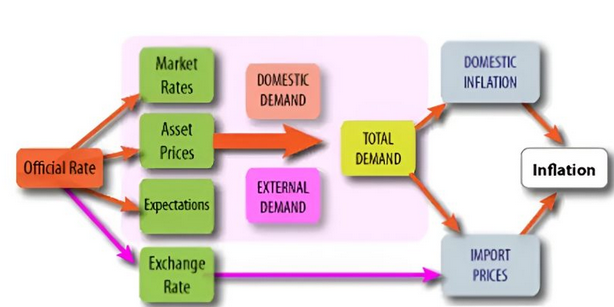
1. Interest Rate Channel
Changes in interest rates influence:
- Consumption
- Investment
- Borrowing
2. Credit Channel
Changes in money supply affect the availability of loans and credit.
3. Asset Price Channel
Lower interest rates may increase prices of:
- Shares
- Property
- Financial assets
This may increase wealth and spending.
4. Exchange Rate Channel
Lower interest rates may reduce demand for a country’s currency.
This may:
- Depreciate the currency
- Increase exports
- Reduce imports
Result:
- Aggregate demand may increase.
Objectives of Monetary Policy
| Objective | Role of Monetary Policy |
|---|---|
| Low Inflation | Reduce excessive aggregate demand |
| Economic Growth | Encourage spending and investment |
| Low Unemployment | Increase aggregate demand and output |
| Financial Stability | Maintain stable banking and financial systems |
Advantages of Monetary Policy
- Can be adjusted relatively quickly.
- Useful for controlling inflation.
- Influences consumption and investment.
- May stabilize economic fluctuations.
Limitations of Monetary Policy
- Effects may take time to appear.
- Consumers and firms may not respond strongly to interest rate changes.
- Very low interest rates may become ineffective during deep recessions.
- Inflation may still occur because of supply-side factors.
Expansionary vs Contractionary Monetary Policy
| Type | Main Action | Main Goal |
|---|---|---|
| Expansionary Monetary Policy | Increase money supply and lower interest rates | Increase AD, growth, and employment |
| Contractionary Monetary Policy | Reduce money supply and raise interest rates | Reduce inflationary pressure |
Key Ideas:
- Monetary policy is conducted by the central bank.
- The central bank controls money supply and interest rates.
- Expansionary monetary policy increases aggregate demand.
- Contractionary monetary policy reduces inflationary pressure.
- Interest rates influence borrowing, spending, investment, and economic activity.
Example 1
Explain how lowering interest rates may increase economic growth.
▶️ Answer / Explanation
Lower interest rates reduce the cost of borrowing.
Consumers may increase spending and firms may increase investment.
This increases aggregate demand, output, and employment.
As a result, economic growth may increase.
Example 2
Using an example, explain how contractionary monetary policy may reduce inflation.
▶️ Answer / Explanation
If the central bank increases interest rates, borrowing becomes more expensive.
Consumers and firms reduce spending and investment.
Aggregate demand decreases, reducing inflationary pressure in the economy.