
[Nominal] Gross Domestic Product (GDP) as a Measure of National Output
Gross Domestic Product (GDP) is the total market value of all final goods and services produced within a country’s borders during a specific period of time, usually one year.
Nominal GDP measures this value using current market prices of the year in which the output is produced.
Nominal GDP = Value of current output measured at current prices
Meaning of GDP
GDP is one of the most important indicators of economic activity because it measures the total level of production in an economy.
- Gross means depreciation is not deducted.
- Domestic means production within the country’s borders.
- Product refers to goods and services produced.
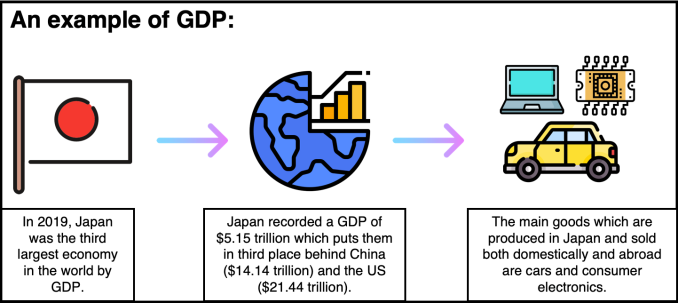
Nominal GDP
Nominal GDP is GDP measured using the prices prevailing in the current year.
- Includes changes in both output and prices.
- Can increase because:
- More goods and services are produced.
- Prices rise due to inflation.
- Does not distinguish between changes caused by output growth and inflation.
Example:
- If production remains the same but prices rise, nominal GDP increases.
GDP as a Measure of National Output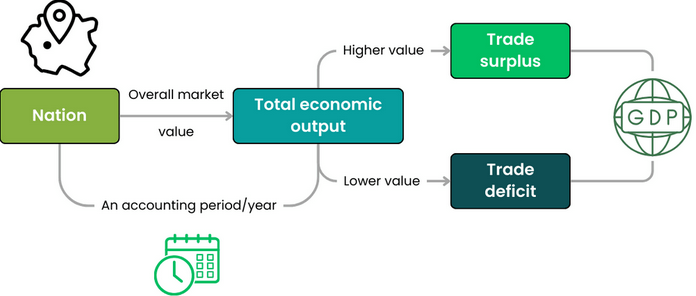
GDP measures the value of final output produced in the economy.
- Only final goods and services are included.
- Intermediate goods are excluded to avoid double counting.
- Measures production occurring within the country, regardless of ownership.
Importance of GDP:
- Indicates economic growth.
- Helps governments make policy decisions.
- Used for international comparisons.
- Provides information about business activity and employment.
The Expenditure Approach to Calculating Nominal GDP
The expenditure approach calculates GDP by measuring total spending on final goods and services in the economy.
$\mathbf{GDP = C + I + G + (X − M)}$
Components of the Formula:
Consumption (C)
- Spending by households on goods and services.
- Includes durable and non-durable goods and services.
Investment (I)
- Spending by firms on capital goods.
- Includes machinery, buildings, and inventories.
Government Spending (G)
- Government expenditure on goods and services.
- Includes spending on education, healthcare, and infrastructure.
Net Exports (X − M)
- Exports (X) are goods and services sold abroad.
- Imports (M) are goods and services purchased from abroad.
- Imports are subtracted because they are not domestically produced.
Calculation of Nominal GDP from National Income Data
Example Data:
| Component | Value ($ billion) |
|---|---|
| Consumption (C) | 500 |
| Investment (I) | 150 |
| Government Spending (G) | 200 |
| Exports (X) | 100 |
| Imports (M) | 50 |
Calculation:
- GDP = C + I + G + (X − M)
- GDP = 500 + 150 + 200 + (100 − 50)
- GDP = 500 + 150 + 200 + 50
- GDP = 900 billion
Conclusion:
- The country’s nominal GDP is $900 billion.
Advantages of Using Nominal GDP
- Simple and widely used measure of economic activity.
- Useful for comparing economic size across years.
- Provides current market value of output.
Limitations of Nominal GDP
- Affected by inflation.
- Does not show changes in real output accurately.
- Does not measure income distribution or quality of life.
- Excludes informal and non-market activities.
Key Ideas:
- Nominal GDP measures output using current prices.
- Calculated using the expenditure approach:
- C + I + G + (X − M)
- Measures economic activity and production.
- Inflation can cause nominal GDP to rise even without higher output.
Example 1
Explain why imports are subtracted when calculating GDP using the expenditure approach.
▶️ Answer / Explanation
Imports are included in consumption, investment, and government spending even though they are produced abroad.
Since GDP measures domestic production only, imports must be subtracted.
This ensures that only goods and services produced within the country are included in GDP.
Example 2
A country has the following data:
Consumption = $400 billion
Investment = $100 billion
Government Spending = $150 billion
Exports = $80 billion
Imports = $30 billion
Calculate nominal GDP using the expenditure approach.
▶️ Answer / Explanation
GDP = C + I + G + (X − M)
GDP = 400 + 100 + 150 + (80 − 30)
GDP = 400 + 100 + 150 + 50
GDP = 700 billion
Therefore, nominal GDP = $700 billion.