
[Nominal] Gross National Income (GNI) as a Measure of National Output
Gross National Income (GNI) measures the total income earned by a country’s residents and businesses, regardless of whether the production takes place domestically or abroad, during a given period of time.
Nominal GNI measures this income using current market prices.
Meaning of GNI
GNI focuses on the income earned by nationals of a country rather than the location of production.
- Gross means depreciation is not deducted.
- National refers to income earned by residents and domestic firms.
- Income includes wages, profits, rent, and interest.
Key Idea:
- GNI measures income earned by a country’s residents worldwide.
Difference Between GDP and GNI
Although GDP and GNI are closely related, they measure different things.

- GDP measures production within a country’s borders.
- GNI measures income earned by nationals.
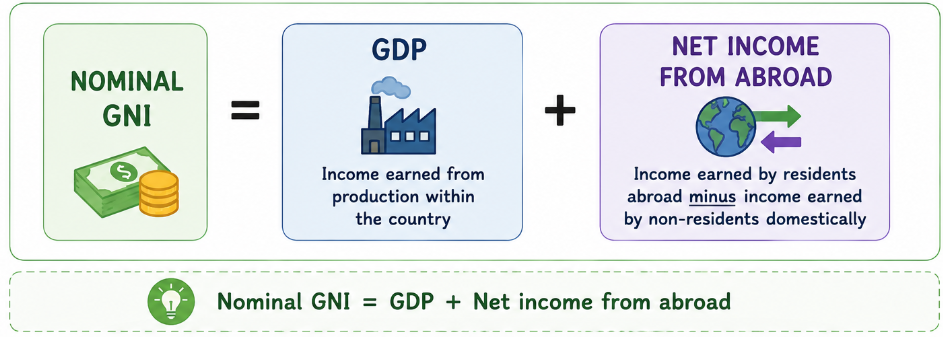
- GNI includes income earned abroad and excludes income earned domestically by foreigners.
GNI = GDP + Income earned by residents abroad − Income earned domestically by foreigners
Net Income from Abroad
Net income from abroad is the difference between:
- Income earned by domestic residents from overseas investments and work.
- Income earned by foreign residents within the domestic economy.
Examples of income from abroad:
- Profits earned by domestic companies operating overseas.
- Wages earned by citizens working abroad.
- Interest and dividends received from foreign investments.
Calculation of Nominal GNI
Formula:
GNI = GDP + Net income from abroad
Example Data:
| Item | Value ($ billion) |
|---|---|
| GDP | 900 |
| Income earned abroad by residents | 70 |
| Income earned domestically by foreigners | 20 |
Step 1: Calculate Net Income from Abroad
Net income from abroad = 70 − 20
= 50 billion
Step 2: Calculate GNI
GNI = GDP + Net income from abroad
GNI = 900 + 50
GNI = 950 billion
Conclusion:
- The country’s nominal GNI is $950 billion.
Importance of GNI
- Provides a broader measure of income than GDP.
- Useful for countries with significant overseas investments or foreign workers.
- Often used to compare living standards between countries.
- Used by international organizations such as the World Bank.
Advantages of Using GNI
- Includes overseas income earned by residents.
- Better reflects income available to citizens.
- Useful for evaluating economic welfare and national earnings.
Limitations of GNI
- Affected by inflation when measured in nominal terms.
- Does not measure income distribution.
- Ignores non-market activities and informal production.
- May not accurately reflect quality of life.
Comparison Between GDP and GNI
| Aspect | GDP | GNI |
|---|---|---|
| Measures | Domestic production | Income earned by nationals |
| Focus | Location of production | Ownership of income |
| Includes foreign income? | No | Yes |
| Includes foreign firms domestically? | Yes | No |
Key Ideas:
- Nominal GNI measures income earned by residents using current prices.
- Calculated by adding net income from abroad to GDP.
- GNI focuses on ownership of income rather than location of production.
- Useful for comparing national income and living standards.
Example 1
Explain why GNI may be higher than GDP in some countries.
▶️ Answer / Explanation
GNI may be higher than GDP if residents earn large amounts of income from abroad.
For example, domestic companies may earn high profits from overseas operations.
When this overseas income exceeds income earned domestically by foreigners, GNI becomes higher than GDP.
Example 2
A country has the following data:
GDP = $800 billion
Income earned abroad by residents = $60 billion
Income earned domestically by foreigners = $25 billion
Calculate nominal GNI.
▶️ Answer / Explanation
Step 1: Calculate net income from abroad.
Net income from abroad = 60 − 25
= 35 billion
Step 2: Calculate GNI.
GNI = GDP + Net income from abroad
GNI = 800 + 35
GNI = 835 billion
Therefore, nominal GNI = $835 billion.