
Real versus Nominal Interest Rates
Interest rates are important in determining:
- Saving
- Borrowing
- Investment
- Consumption
Economists distinguish between:
- Nominal interest rates
- Real interest rates
The difference between them is important because inflation affects the purchasing power of money.
Nominal Interest Rate
The nominal interest rate is the stated or observed interest rate before adjusting for inflation.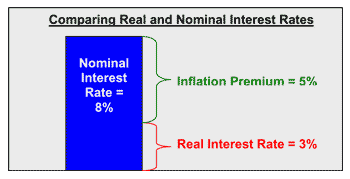
It is the rate charged on loans or paid on savings by financial institutions.
Examples of Nominal Interest Rates
- Bank loan interest rates
- Savings account interest rates
- Mortgage rates
- Bond interest rates
Limitation of Nominal Interest Rates
Nominal interest rates do not show the true increase in purchasing power because they ignore inflation.
If inflation is high, the actual gain from saving may be much lower.
Real Interest Rate
The real interest rate is the interest rate adjusted for inflation.
It measures the actual increase in purchasing power resulting from saving or lending.
Formula for Real Interest Rate
\( \mathrm{Real\ Interest\ Rate = Nominal\ Interest\ Rate – Inflation\ Rate} \)
This formula gives an approximate real interest rate.
Meaning of the Real Interest Rate
The real interest rate shows:
- The true return to savers
- The true cost of borrowing
Positive Real Interest Rates
If:
\( \mathrm{Nominal\ Interest\ Rate > Inflation\ Rate} \)
then the real interest rate is positive.
This means purchasing power increases over time.
Negative Real Interest Rates
If:
\( \mathrm{Inflation\ Rate > Nominal\ Interest\ Rate} \)
then the real interest rate becomes negative.
This means purchasing power decreases over time.
Example of a Negative Real Interest Rate
If a savings account pays:
\( \mathrm{4\%} \)
interest but inflation is:
\( \mathrm{6\%} \)
the saver loses purchasing power despite earning interest.
Importance of Real Interest Rates
Real interest rates influence:
- Saving decisions
- Borrowing decisions
- Investment decisions
- Consumer spending
Effect on Savers
Higher real interest rates encourage saving because returns are greater in real terms.
Lower or negative real interest rates discourage saving.
Effect on Borrowers
Lower real interest rates reduce the real cost of borrowing.
This may encourage:
- Consumer borrowing
- Business investment
Relationship with Monetary Policy
Central banks monitor both:
- Nominal interest rates
- Inflation rates
because real interest rates affect aggregate demand and economic activity.
Real Interest Rates During Inflation
If inflation rises rapidly while nominal interest rates remain unchanged:
- Real interest rates decrease.
- Borrowing may increase.
- Savings become less attractive.
Real Interest Rates During Deflation
If prices are falling (deflation):
- Real interest rates may become very high.
- Borrowing and spending may decrease.
Comparison Between Nominal and Real Interest Rates
| Feature | Nominal Interest Rate | Real Interest Rate |
|---|---|---|
| Definition | Observed interest rate before inflation adjustment | Interest rate adjusted for inflation |
| Includes Inflation? | No | Yes |
| Measures Purchasing Power? | No | Yes |
| Main Importance | Financial contracts and loans | Actual return or borrowing cost |
Key Point:
- Nominal interest rates do not account for inflation.
- Real interest rates measure the actual change in purchasing power.
- Real interest rate is approximately equal to nominal interest rate minus inflation rate.
- Positive real interest rates encourage saving.
- Negative real interest rates reduce the real value of savings.
Example 1
A bank offers a nominal interest rate of: \( \mathrm{8\%} \)
The inflation rate is: \( \mathrm{3\%} \)
Calculate the real interest rate.
▶️ Answer / Explanation
Step 1: Use the formula
\( \mathrm{Real\ Interest\ Rate = Nominal\ Interest\ Rate – Inflation\ Rate} \)
Step 2: Substitute values
\( \mathrm{Real\ Interest\ Rate = 8\% – 3\%} \)
Step 3: Calculate
\( \mathrm{Real\ Interest\ Rate = 5\%} \)
Final Answer:
\( \mathrm{5\%} \)
Example 2
A savings account pays a nominal interest rate of: \( \mathrm{4\%} \)
The inflation rate is: \( \mathrm{6\%} \)
Calculate the real interest rate and explain its meaning.
▶️ Answer / Explanation
Step 1: Use the formula
\( \mathrm{Real\ Interest\ Rate = 4\% – 6\%} \)
Step 2: Calculate
\( \mathrm{Real\ Interest\ Rate = -2\%} \)
Interpretation
The real interest rate is negative.
This means the saver loses purchasing power because prices are rising faster than savings growth.
Final Answer:
\( \mathrm{-2\%} \)