
Relationship Between Equality and Equity
Equality and equity are important concepts in economics and public policy.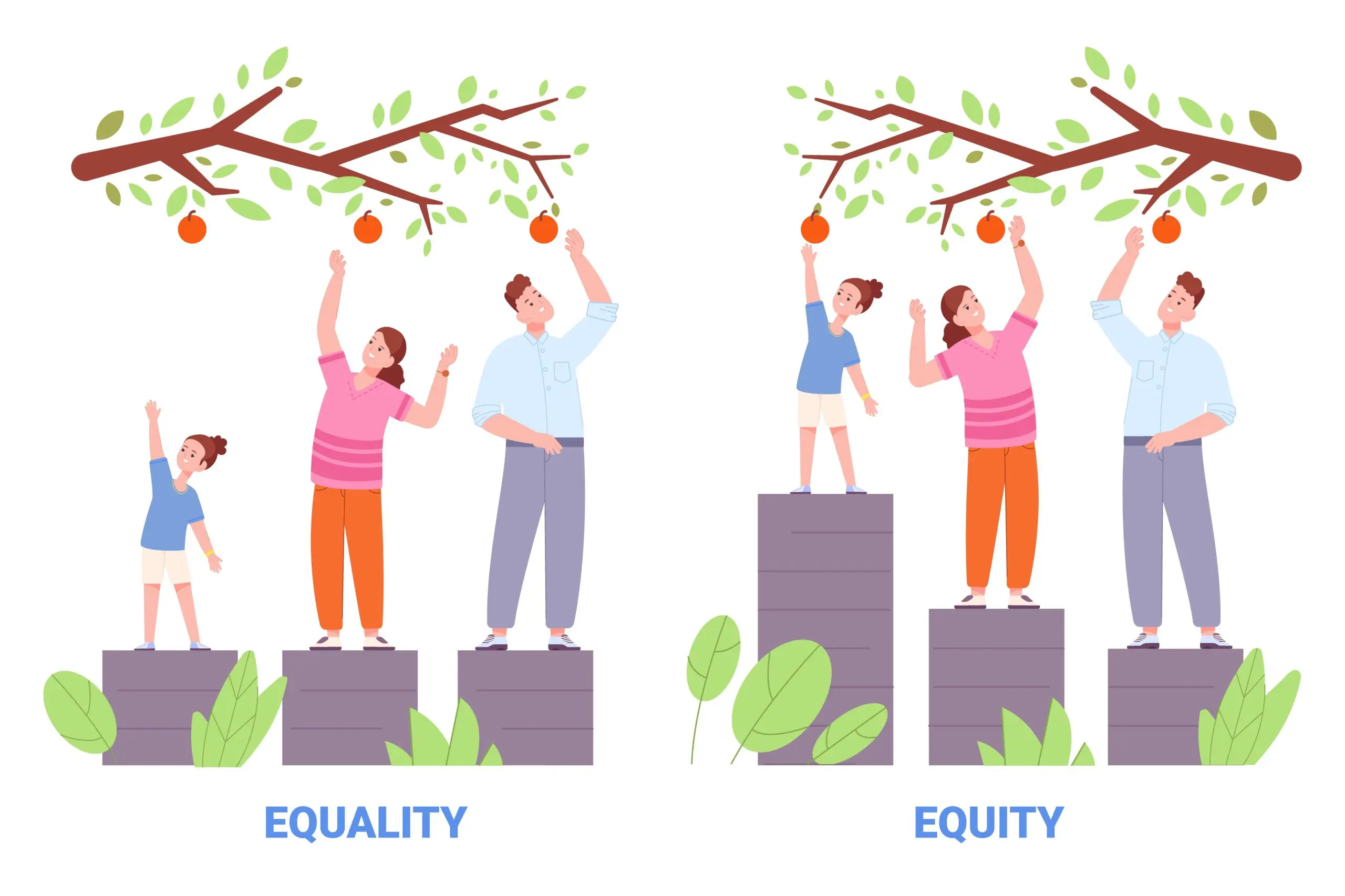
Both concepts are related to fairness, but they have different meanings.
Governments often consider equality and equity when designing policies related to:
- Income distribution
- Taxation
- Healthcare
- Education
- Social welfare
Meaning of Equality
Equality refers to treating everyone the same or providing everyone with the same resources or opportunities.
Under equality:
- People receive equal treatment.
- Resources are distributed equally.
- Everyone is subject to the same rules and conditions.
Examples of Equality
- Every student receives the same textbook.
- All citizens pay the same fixed tax amount.
- Everyone receives equal voting rights.
Advantages of Equality
- Promotes equal treatment.
- Reduces discrimination.
- May increase social cohesion.
Limitations of Equality
People do not always begin with the same circumstances or needs.
Providing identical treatment may not produce fair outcomes.
Meaning of Equity
Equity refers to fairness in the distribution of resources, opportunities, and outcomes.
Equity recognizes that different individuals may have different needs and circumstances.
Under equity:
- Resources may be distributed unequally to achieve fairness.
- Policies attempt to reduce disadvantages.
- Greater support may be given to people with greater needs.
Examples of Equity
- Providing financial aid to low-income students.
- Progressive taxation where higher-income earners pay a larger percentage of income in taxes.
- Additional healthcare support for vulnerable groups.
Advantages of Equity
- Promotes fairness.
- Reduces income inequality.
- Supports disadvantaged groups.
- May improve social mobility.
Relationship Between Equality and Equity
Equality and equity are closely related because both aim to improve fairness in society.
However, they approach fairness differently.
Key Difference
Equality → Same treatment for everyone
Equity → Fair treatment based on needs and circumstances
Why Equality May Not Always Create Equity
If people begin with unequal resources or opportunities, equal treatment may still produce unequal outcomes.
Example:
- Giving identical educational resources to all students may not help students from disadvantaged backgrounds equally.
Equity attempts to address these differences.
Equity and Income Distribution
In economics, equity is often linked to income distribution.
Governments may use redistributive policies to improve equity.
Examples:
- Progressive taxation
- Transfer payments
- Public healthcare and education
Potential Conflict Between Equality and Efficiency
Policies designed to improve equity may sometimes reduce economic efficiency.
Example:
- Very high taxes may reduce incentives to work or invest.
Governments therefore attempt to balance:
- Efficiency
- Equality
- Equity
Equality of Opportunity vs Equality of Outcome
Equality of Opportunity
Everyone has the same chances and access to opportunities.
Examples:
- Equal access to education
- Equal legal rights
Equality of Outcome
Everyone achieves similar outcomes or living standards.
Examples:
- Policies to reduce income inequality
- Redistribution of wealth
Comparison Between Equality and Equity
| Aspect | Equality | Equity |
|---|---|---|
| Meaning | Same treatment | Fair treatment |
| Resource Distribution | Equal distribution | Distribution based on need |
| Main Goal | Uniformity | Fairness |
| Policy Example | Equal tax amount | Progressive taxation |
Importance in Economic Policy
Governments consider equality and equity when designing:
- Tax systems
- Welfare policies
- Healthcare systems
- Education funding
The goal is often to create a fair society while maintaining economic efficiency and growth.
Key Ideas:
- Equality means treating everyone the same.
- Equity means treating people fairly according to their needs and circumstances.
- Equal treatment does not always produce fair outcomes.
- Governments use redistributive policies to improve equity.
Example 1
Explain the difference between equality and equity.
▶️ Answer / Explanation
Equality means giving everyone the same treatment or resources.
Equity means distributing resources according to individual needs and circumstances.
For example, giving every student the same amount of support is equality, while giving extra support to disadvantaged students is equity.
Example 2
Using an example, explain how progressive taxation promotes equity.
▶️ Answer / Explanation
Under progressive taxation, higher-income earners pay a larger percentage of income in taxes.
This allows governments to redistribute income through public services and welfare programs.
The policy aims to reduce inequality and improve fairness in income distribution.
Therefore, progressive taxation promotes equity rather than strict equality.