
The Role of Taxation in Reducing Poverty, Income and Wealth Inequalities
Governments use taxation as an important tool to reduce:
- Poverty
- Income inequality
- Wealth inequality
Tax revenue allows governments to finance:
- Healthcare
- Education
- Infrastructure
- Transfer payments
- Social welfare programs
Through redistribution, taxation can reduce differences in income and wealth across society.
How Taxation Reduces Inequality
Taxation reduces inequality mainly through:
- Collecting more revenue from higher-income groups
- Financing welfare programs for lower-income groups
- Redistributing income and wealth
Taxes collected → Government spending and transfers → Reduced inequality
Types of Taxes
Taxes can be classified as:
- Progressive taxes
- Regressive taxes
- Proportional taxes
Progressive Taxes
A progressive tax is a tax in which the percentage of income paid in tax increases as income increases.
Higher-income earners pay: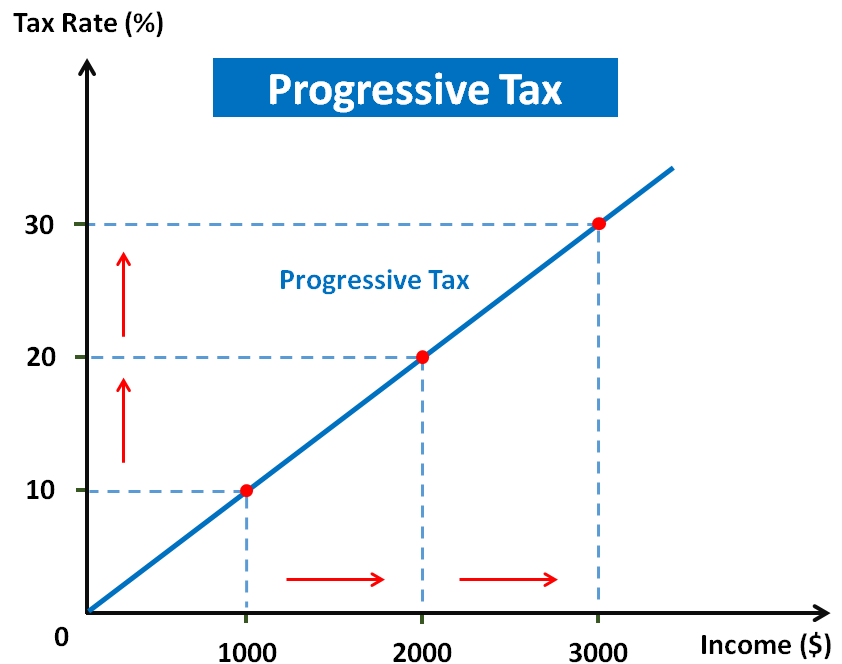
- A larger amount of tax
- A larger percentage of income in tax
How Progressive Taxes Reduce Inequality
Progressive taxes reduce disposable income differences between high-income and low-income groups.
Governments may use the tax revenue to provide:
- Healthcare
- Education
- Welfare benefits
- Housing support
This redistributes income and reduces poverty.
Examples of Progressive Taxes
- Personal income tax with rising tax brackets
- Wealth taxes in some countries
Advantages of Progressive Taxes
- Reduce income inequality
- Generate significant government revenue
- Promote equity
Possible Disadvantages
- May reduce incentives to work or invest if tax rates become very high.
- May encourage tax avoidance.
Regressive Taxes
A regressive tax is a tax in which lower-income earners pay a larger percentage of income in tax than higher-income earners.
Why Regressive Taxes Increase Inequality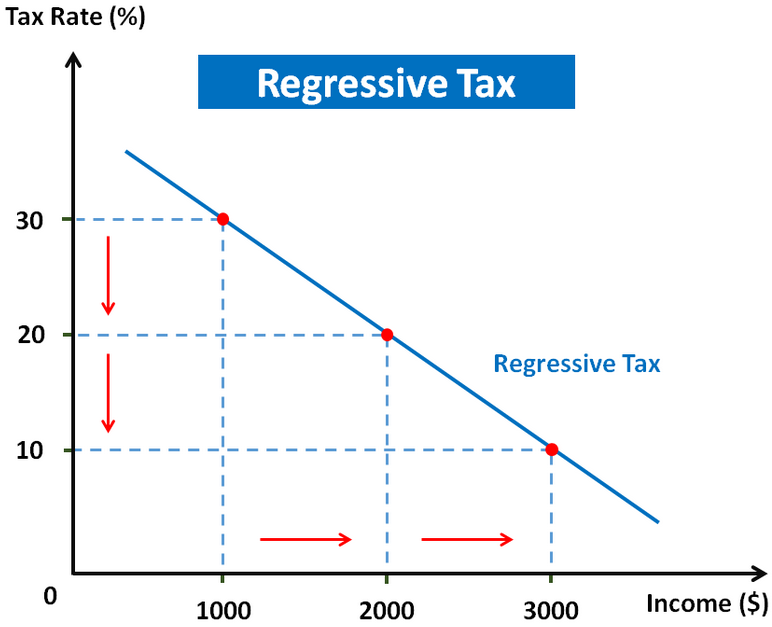
Low-income households spend a larger proportion of income on consumption.
As a result:
- Indirect taxes may place a heavier burden on poorer households.
Examples of Regressive Taxes
- Sales taxes
- Value added tax (VAT)
- Excise duties on basic goods
Effects of Regressive Taxes
- May increase poverty and inequality.
- Reduce disposable income for low-income households.
Proportional Taxes
A proportional tax is a tax in which all individuals pay the same percentage of income in tax regardless of income level.
Example of a Proportional Tax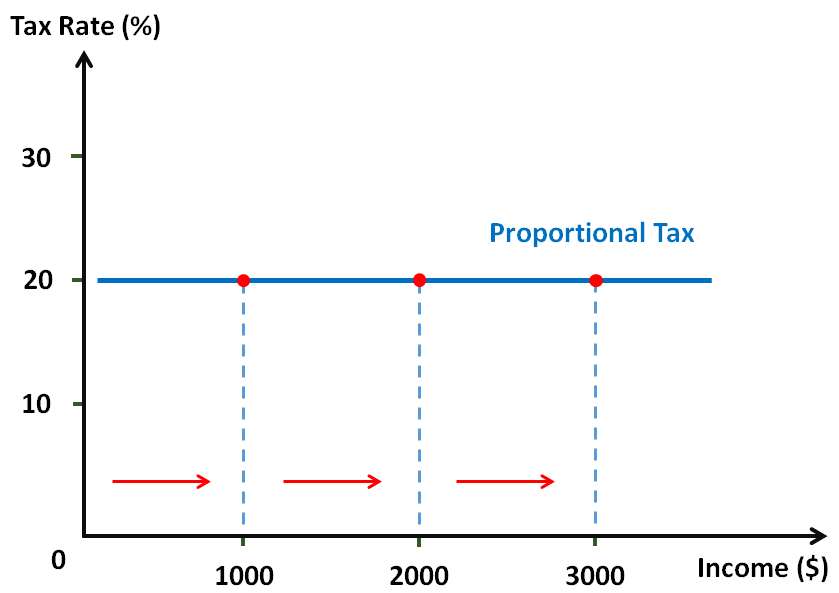
If everyone pays:
\( \mathrm{20\%} \)
of income in taxes, the tax system is proportional.
Effects of Proportional Taxes
- Less redistributive than progressive taxes.
- May be considered fair because everyone pays the same proportion.
- Usually has a smaller effect on reducing inequality.
Comparison Between Tax Types
| Tax Type | Tax Burden as Income Rises | Effect on Inequality |
|---|---|---|
| Progressive | Increases | Reduces inequality |
| Regressive | Decreases | May increase inequality |
| Proportional | Remains constant | Limited redistribution |
Average and Marginal Tax Rates (HL- Only)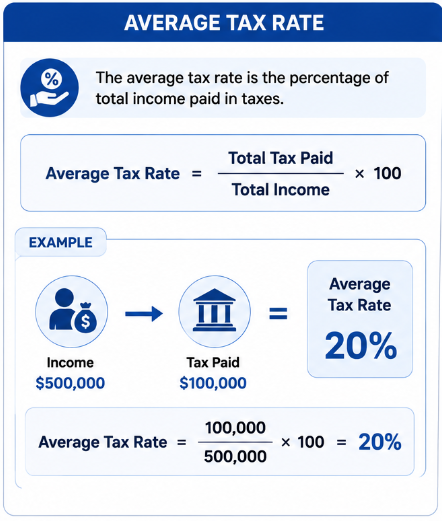
Average Tax Rate
The average tax rate is the percentage of total income paid in taxes.
\( \mathrm{Average\ Tax\ Rate = \dfrac{Total\ Tax\ Paid}{Total\ Income} \times 100} \)
Example:
If a person earns: \( \mathrm{\$500,000} \) and pays: \( \mathrm{\$100,000} \)
in taxes:
\( \mathrm{Average\ Tax\ Rate = \dfrac{100,000}{500,000} \times 100 = 20\%} \)
Marginal Tax Rate
The marginal tax rate is the tax rate applied to the next additional unit of income earned.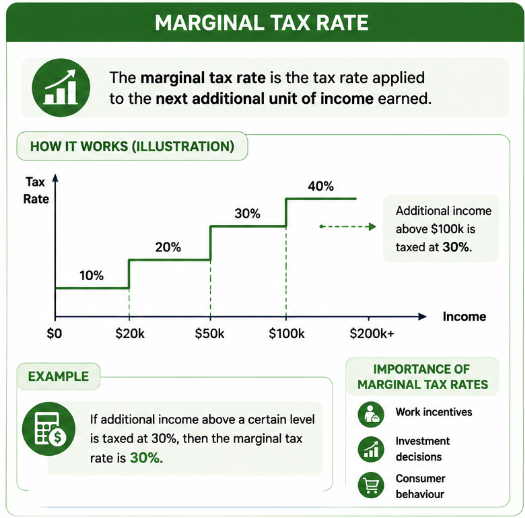
Importance of Marginal Tax Rates
Marginal tax rates influence:
- Work incentives
- Investment decisions
- Consumer behaviour
Example:
If additional income above a certain level is taxed at: \( \mathrm{30\%} \) then the marginal tax rate is: \( \mathrm{30\%} \)
Direct Taxes
Direct taxes are taxes imposed directly on income, profits, or wealth.
They are usually progressive and are important tools for redistribution.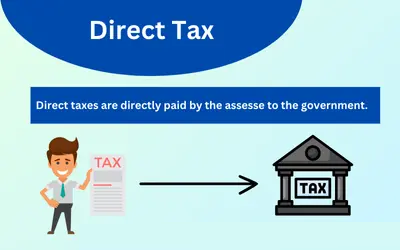
1. Personal Income Tax
Personal income tax is levied on individual earnings such as:
- Wages and salaries
- Interest
- Rent
- Investment income
Progressive personal income taxes reduce disposable income inequality.
2. Corporate Income Tax
Corporate income tax is imposed on company profits.
Governments use corporate tax revenue to finance public services and welfare programs.
3. Wealth Taxes
Wealth taxes are imposed on ownership of assets such as:
- Property
- Land
- Inheritance
- Financial assets
Wealth taxes may reduce wealth concentration and intergenerational inequality.
Indirect Taxes
Indirect taxes are taxes imposed on spending and consumption of goods and services. 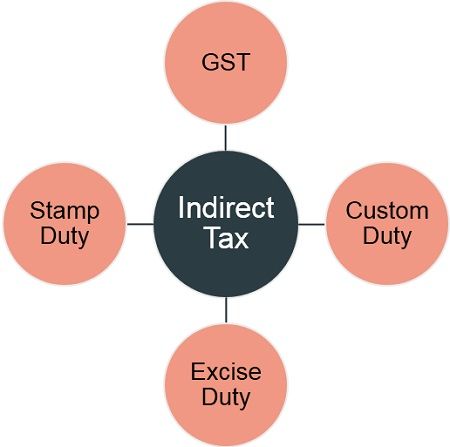
Examples include:
- Value added tax (VAT)
- Sales taxes
- Excise duties
Impact of Indirect Taxes on Inequality
Indirect taxes are often regressive because:
- Low-income households spend a larger proportion of income on consumption.
This may increase poverty and inequality if essential goods are heavily taxed.
Government Strategies to Reduce Regressive Effects
Governments may:
- Reduce taxes on essential goods
- Provide subsidies
- Use progressive direct taxes alongside indirect taxes
Importance of Taxation in Redistribution
Taxation allows governments to:
- Redistribute income and wealth
- Reduce poverty
- Finance public services
- Improve equality of opportunity
Key Ideas:
- Progressive taxes reduce inequality through redistribution.
- Regressive taxes place a heavier burden on low-income households.
- Average tax rate measures total tax paid as a percentage of income.
- Marginal tax rate measures tax on additional income earned.
- Direct taxes are usually more redistributive than indirect taxes.
Example 1
Explain how progressive taxation may reduce income inequality.
▶️ Answer / Explanation
Under progressive taxation, high-income earners pay a larger percentage of income in taxes.
The government can use this revenue to finance healthcare, education, and welfare programs for lower-income groups.
This redistributes income and reduces inequality.
Example 2
Using an example, explain why indirect taxes are often regressive.
▶️ Answer / Explanation
Low-income households spend a larger proportion of income on consumption.
If the government increases VAT on essential goods, poorer households lose a larger share of disposable income compared to wealthier households.
Therefore, indirect taxes are often regressive.
Example 3: Calculation of Indirect Tax Paid from Expenditure ( HL – Only)
A consumer spends: \( \mathrm{\$11,800} \) on a product including an indirect tax (GST) of: \( \mathrm{18\%} \)
Calculate:
- The amount of indirect tax paid
- The price before tax
▶️ Answer / Explanation
Step 1: Use the indirect tax formula
Total price includes tax.
\( \mathrm{Final\ Price = Original\ Price \times \left(1+\dfrac{Tax\ Rate}{100}\right)} \)
Substitute values:
\( \mathrm{11,800 = Original\ Price \times 1.18} \)
Step 2: Calculate original price
\( \mathrm{Original\ Price = \dfrac{11,800}{1.18}} \)
\( \mathrm{Original\ Price = \$10,000} \)
Step 3: Calculate indirect tax paid
\( \mathrm{Indirect\ Tax = Final\ Price – Original\ Price} \)
\( \mathrm{Indirect\ Tax = 11,800 – 10,000} \)
\( \mathrm{Indirect\ Tax = \$1,800} \)
Final Answers:
- Indirect tax paid = \( \mathrm{\$1,800} \)
- Price before tax = \( \mathrm{\$10,000} \)
Example 4: Calculation of Total Tax and Average Tax Rate ( HL – Only)
A person earns an annual income of: \( \mathrm{\$900,000} \)
The tax system is:
| Income Bracket | Tax Rate |
|---|---|
| \( \mathrm{0 – \$300,000} \) | \( \mathrm{10\%} \) |
| \( \mathrm{\$300,001 – \$600,000} \) | \( \mathrm{20\%} \) |
| \( \mathrm{Above\ \$600,000} \) | \( \mathrm{30\%} \) |
Calculate:
- Total tax paid
- Average tax rate
▶️ Answer / Explanation
Step 1: Calculate tax for first bracket
\( \mathrm{300,000 \times \dfrac{10}{100} = \$30,000} \)
Step 2: Calculate tax for second bracket
Income in this bracket:
\( \mathrm{600,000 – 300,000 = \$300,000} \)
Tax:
\( \mathrm{300,000 \times \dfrac{20}{100} = \$60,000} \)
Step 3: Calculate tax for third bracket
Income above:
\( \mathrm{\$600,000} \)
Amount in third bracket:
\( \mathrm{900,000 – 600,000 = \$300,000} \)
Tax:
\( \mathrm{300,000 \times \dfrac{30}{100} = \$90,000} \)
Step 4: Calculate total tax paid
\( \mathrm{Total\ Tax = 30,000 + 60,000 + 90,000} \)
\( \mathrm{Total\ Tax = \$180,000} \)
Step 5: Calculate average tax rate
\( \mathrm{Average\ Tax\ Rate = \dfrac{Total\ Tax}{Total\ Income} \times 100} \)
\( \mathrm{Average\ Tax\ Rate = \dfrac{180,000}{900,000} \times 100} \)
\( \mathrm{Average\ Tax\ Rate = 20\%} \)
Final Answers:
- Total tax paid = \( \mathrm{\$180,000} \)
- Average tax rate = \( \mathrm{20\%} \)