
Shifts of the Aggregate Demand (AD) Curve Caused by Changes in Determinants
A shift of the aggregate demand (AD) curve occurs when there is a change in one or more non-price determinants of aggregate demand.
This causes the quantity of real output demanded to change at every price level.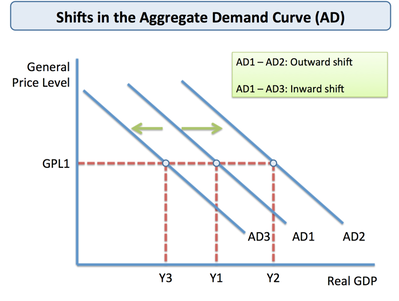
Change in AD determinant → Entire AD curve shifts
The aggregate demand curve may:
- Shift to the right → Increase in AD
- Shift to the left → Decrease in AD
Increase in Aggregate Demand
An increase in aggregate demand occurs when total spending in the economy rises.
- The AD curve shifts to the right.
- At every price level, more real output is demanded.
- Usually leads to higher output and employment in the short run.
AD increase → Rightward shift
Decrease in Aggregate Demand
A decrease in aggregate demand occurs when total spending in the economy falls.
- The AD curve shifts to the left.
- At every price level, less real output is demanded.
- May lead to recession and unemployment.
AD decrease → Leftward shift
Shifts Caused by Changes in Consumption (\( \mathrm{C} \))
Consumption is the largest component of aggregate demand in most economies. Therefore, changes in consumption strongly affect the AD curve.
1. Consumer Confidence
- Higher confidence increases spending and shifts AD right.
- Lower confidence reduces spending and shifts AD left.
Example:
- If consumers expect stable jobs and rising income, consumption rises.
2. Interest Rates
- Lower interest rates encourage borrowing and consumption.
- Higher interest rates discourage spending.
Interest rates ↓ → Consumption ↑ → AD shifts right
3. Wealth
- Higher asset values increase household wealth and spending.
- Falling wealth reduces consumption.
Example:
- Rising house prices may increase household spending.
4. Income Taxes
- Lower taxes increase disposable income and consumption.
- Higher taxes reduce spending power.
Income taxes ↓ → Consumption ↑ → AD shifts right
5. Household Indebtedness
- High debt may force households to reduce spending.
- Lower debt may support stronger consumption.
6. Expectations of Future Prices
- If consumers expect prices to rise, they spend more now.
- If they expect prices to fall, spending may decrease.
Shifts Caused by Changes in Investment (\( \mathrm{I} \))
Investment is a major source of economic fluctuations because it is highly sensitive to expectations and interest rates.
1. Interest Rates
- Lower interest rates reduce borrowing costs.
- Firms increase investment spending.
Interest rates ↓ → Investment ↑ → AD shifts right
2. Business Confidence
- Optimistic firms invest more.
- Economic uncertainty reduces investment.
3. Technology
- New technology encourages investment in capital goods.
- Firms invest to improve productivity.
4. Business Taxes
- Lower business taxes increase profitability and investment.
- Higher taxes discourage investment spending.
5. Corporate Indebtedness
- High debt burdens may reduce firms’ willingness to invest.
Shifts Caused by Changes in Government Spending (\( \mathrm{G} \))
Government spending directly affects aggregate demand.
1. Political Priorities
- Governments may increase spending on infrastructure, healthcare, or defence.
- This raises aggregate demand.
2. Economic Priorities
- During recessions, governments may use expansionary fiscal policy.
- During inflationary periods, governments may reduce spending.
Government spending ↑ → AD shifts right
Shifts Caused by Changes in Net Exports (\( \mathrm{X – M} \))
1. Income of Trading Partners
- Economic growth abroad increases demand for exports.
- Exports rise, increasing AD.
2. Exchange Rates
- Currency depreciation makes exports cheaper and imports more expensive.
- Net exports rise.
Currency depreciation → Net exports ↑ → AD shifts right
3. Trade Policies
- Export promotion policies increase AD.
- Import restrictions may reduce imports and increase net exports.
Movement Along vs Shift of the AD Curve
| Change | Cause | Effect |
|---|---|---|
| Movement Along AD Curve | Change in price level | Change in quantity of output demanded |
| Shift of AD Curve | Change in AD determinants | Change in aggregate demand |
Importance of AD Shifts
- Help explain economic expansions and recessions.
- Influence unemployment and inflation.
- Central to fiscal and monetary policy analysis.
- Important in Keynesian macroeconomics.
Summary Table of AD Determinants and Direction of Shift
| Determinant | Effect on AD |
|---|---|
| Consumer confidence ↑ | AD shifts right |
| Interest rates ↓ | AD shifts right |
| Government spending ↑ | AD shifts right |
| Business taxes ↓ | AD shifts right |
| Currency depreciation | AD shifts right |
Key Ideas:
- Shifts of the AD curve occur due to changes in AD determinants.
- Rightward shifts indicate increased spending.
- Leftward shifts indicate decreased spending.
- Changes in consumption, investment, government spending, and net exports all affect AD.
Example 1
Explain how lower income taxes may shift the aggregate demand curve.
▶️ Answer / Explanation
Lower income taxes increase disposable income available to households.
Consumers increase spending on goods and services.
This increases consumption, which is a component of aggregate demand.
As a result, the aggregate demand curve shifts to the right.
Example 2
Using an example, explain how business confidence affects aggregate demand.
▶️ Answer / Explanation
If firms become optimistic about future economic growth, they may increase investment spending.
For example, firms may build new factories or purchase machinery.
This increases investment, causing aggregate demand to rise.
Therefore, the AD curve shifts to the right.