
Shifts of the Aggregate Supply (AS) Curve in the Long Run
In both the Monetarist/New Classical and Keynesian approaches, the economy’s long-run productive capacity can change over time.
When the economy’s ability to produce goods and services changes, the long-run aggregate supply (LRAS) curve or the long-term aggregate supply position shifts.
These shifts represent changes in potential output.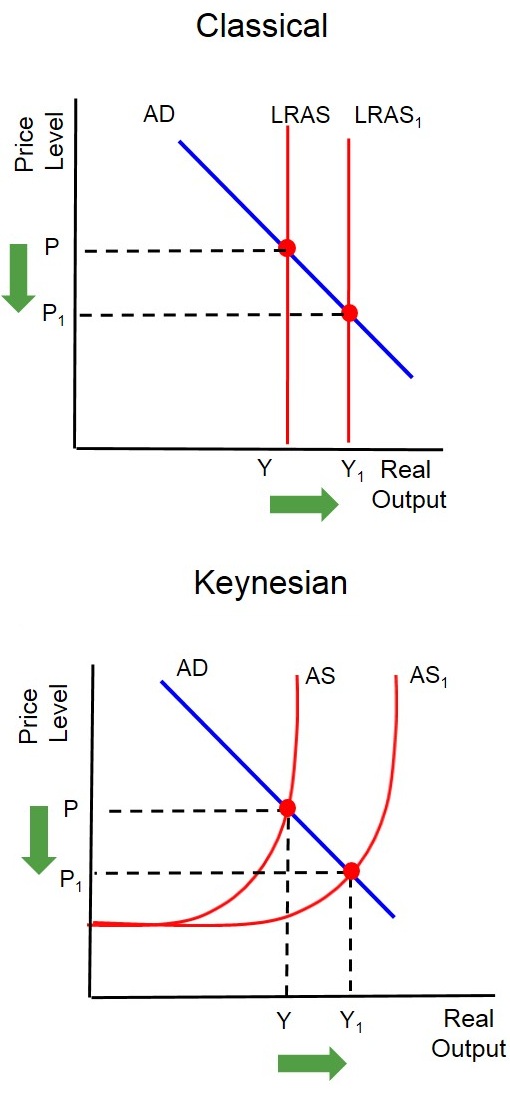
- Increase in productive capacity → Long-run AS shifts right
- Decrease in productive capacity → Long-run AS shifts left
1. Changes in the Quantity and/or Quality of Factors of Production
The economy’s productive capacity depends heavily on the availability and quality of the factors of production.
The four factors of production are:
- Land
- Labour
- Capital
- Entrepreneurship
Changes in either the quantity or quality of these factors affect long-run aggregate supply.
Increase in the Quantity of Factors of Production
If the economy has access to more productive resources, it can produce more output.
Examples:
- Population growth increases labour supply.
- Discovery of natural resources increases land resources.
- Investment increases the capital stock.
- More entrepreneurs increase business activity.
Effect on AS:
- Potential output increases.
- The LRAS curve shifts to the right.
- The economy can produce more without inflationary pressure.
Quantity of resources ↑ → LRAS shifts right
Decrease in the Quantity of Factors of Production
If productive resources decrease, the economy’s productive capacity falls.
Examples:
- Emigration reduces labour supply.
- Natural disasters destroy capital.
- Resource depletion reduces natural resources.
Effect on AS:
- Potential output decreases.
- The LRAS curve shifts to the left.
Improvement in the Quality of Factors of Production
Even if the quantity of resources remains unchanged, improvements in quality can increase productivity.
Examples:
- Better education and training improve labour skills.
- Improved machinery increases capital quality.
- Better management improves entrepreneurship.
Effect on AS:
- Resources become more productive.
- Potential output increases.
- The LRAS curve shifts right.
Quality of resources ↑ → Productivity ↑ → LRAS shifts right
Importance of Factor Improvements
- Increase sustainable economic growth.
- Raise living standards over time.
- Improve efficiency and competitiveness.
2. Improvements in Technology
Technology refers to the methods, knowledge, and innovations used in production.
Technological progress is one of the most important causes of long-run economic growth.
How Technology Improves Aggregate Supply
- Increases productivity.
- Reduces production costs.
- Allows firms to produce more output using the same resources.
- Improves efficiency and quality of production.
Examples of Technological Improvements:
- Automation and robotics
- Artificial intelligence
- Improved communication systems
- Advanced manufacturing techniques
- Digital technology and software
Effect on Long-Run Aggregate Supply
- Firms become more efficient.
- More output can be produced at lower costs.
- Potential output increases.
- The LRAS curve shifts to the right.
Technology improvement → Productivity ↑ → LRAS shifts right
Technology and Economic Growth
Technological progress contributes to:
- Higher real GDP
- Improved living standards
- Greater international competitiveness
- Long-term economic development
Possible Limitations of Technological Change
- Some workers may lose jobs due to automation.
- High investment costs may be required.
- Benefits may not be equally distributed.
Comparison of the Two Determinants
| Determinant | How It Affects AS |
|---|---|
| Quantity/quality of factors | Increases productive capacity and efficiency |
| Technology improvements | Raises productivity and lowers costs |
Key Ideas:
- Long-run AS shifts when productive capacity changes.
- More or better-quality resources increase potential output.
- Technological progress is a major source of long-run growth.
- Rightward shifts of LRAS represent sustainable economic growth.
Example 1
Explain how improvements in education may affect long-run aggregate supply.
▶️ Answer / Explanation
Better education improves the quality and skills of labour.
Workers become more productive and efficient.
Firms can produce more output using the same resources.
As a result, potential output increases and the LRAS curve shifts to the right.
Example 2
Using an example, explain how technological progress may increase long-run aggregate supply.
▶️ Answer / Explanation
If firms introduce automation and robotics, production becomes faster and more efficient.
Output can increase without requiring proportionally more labour.
Production costs may also decrease.
Therefore, potential output rises and the LRAS curve shifts to the right.
3. Increases in Efficiency
Efficiency refers to the ability of an economy or firms to use resources in the most productive way possible, producing maximum output from available inputs.
When efficiency increases, the economy can produce more goods and services using the same quantity of resources.
This increases potential output and shifts the long-run aggregate supply curve to the right.
Efficiency ↑ → Productivity ↑ → LRAS shifts right
Types of Efficiency That Affect AS
1. Productive Efficiency
- Occurs when firms produce at the lowest possible cost.
- Resources are used without waste.
- Lower unit costs increase productive capacity.
2. Allocative Efficiency
- Resources are allocated according to consumer preferences.
- Economy produces the goods and services most demanded by society.
3. Dynamic Efficiency
- Occurs when firms innovate and improve production methods over time.
- Encourages research, development, and technological progress.
Causes of Increased Efficiency
- Better management techniques
- Improved worker training
- Specialization and division of labour
- Improved infrastructure
- Competition between firms
- Efficient allocation of resources
Effect on Long-Run Aggregate Supply
- Firms produce more output from existing resources.
- Production costs decrease.
- Economic growth becomes more sustainable.
- The LRAS curve shifts right.
Importance of Efficiency Improvements
- Increase economic growth.
- Improve competitiveness of firms.
- Raise living standards.
- Reduce inflationary pressure by lowering costs.
4. Changes in Institutions
Institutions are the laws, organizations, systems, and rules that influence economic activity in a country.
Strong institutions improve the functioning of markets and increase economic efficiency and productivity.
Examples of Economic Institutions
- Legal systems
- Property rights protection
- Banking and financial systems
- Government effectiveness
- Education systems
- Political stability
- Regulatory systems
How Institutional Changes Affect AS
Better institutions improve confidence, efficiency, and investment.
Examples:
- Strong property rights encourage investment and entrepreneurship.
- Efficient banking systems improve access to credit.
- Political stability encourages domestic and foreign investment.
- Reduced corruption improves resource allocation.
Positive Institutional Changes
- Improve business confidence.
- Increase productivity and efficiency.
- Encourage innovation and investment.
- Increase long-run productive capacity.
Effect on AS:
- LRAS shifts to the right.
Better institutions → Efficiency and investment ↑ → LRAS shifts right
Negative Institutional Changes
Weak institutions reduce economic efficiency and growth.
Examples:
- Political instability
- Corruption
- Weak legal systems
- Poor financial systems
Effect on AS:
- Investment and productivity decrease.
- Potential output falls.
- LRAS shifts to the left.
Importance of Institutional Quality
- Important for long-term economic development.
- Encourages sustainable economic growth.
- Supports stable and efficient markets.
- Attracts foreign direct investment.
Comparison of the Two Determinants
| Determinant | How It Affects AS |
|---|---|
| Efficiency increases | Allows more output from existing resources |
| Institutional improvements | Improve investment, confidence, and productivity |
Key Ideas:
- Efficiency improvements increase productivity and potential output.
- Strong institutions support investment and economic growth.
- Both determinants shift LRAS to the right when improved.
- Long-run AS growth is essential for sustainable development.
Example 1
Explain how specialization may increase long-run aggregate supply.
▶️ Answer / Explanation
Specialization allows workers and firms to focus on specific tasks.
This improves productivity and reduces wasted time and resources.
Firms can produce more output efficiently.
As a result, potential output increases and the LRAS curve shifts to the right.
Example 2
Using an example, explain how improved institutions may affect long-run aggregate supply.
▶️ Answer / Explanation
If a country strengthens property rights and reduces corruption, firms may feel more confident investing.
Higher investment increases productive capacity and economic efficiency.
This raises potential output.
Therefore, the LRAS curve shifts to the right.