
Short-Run Aggregate Supply (SRAS) Curve
Short-run aggregate supply (SRAS) refers to the total quantity of goods and services that firms in an economy are willing and able to produce at different general price levels during a given period of time, while some production costs remain fixed.
The SRAS curve shows the relationship between the general price level and the quantity of real output supplied in the short run.
Meaning of the SRAS Curve
In the short run, firms respond to changes in the price level by adjusting output.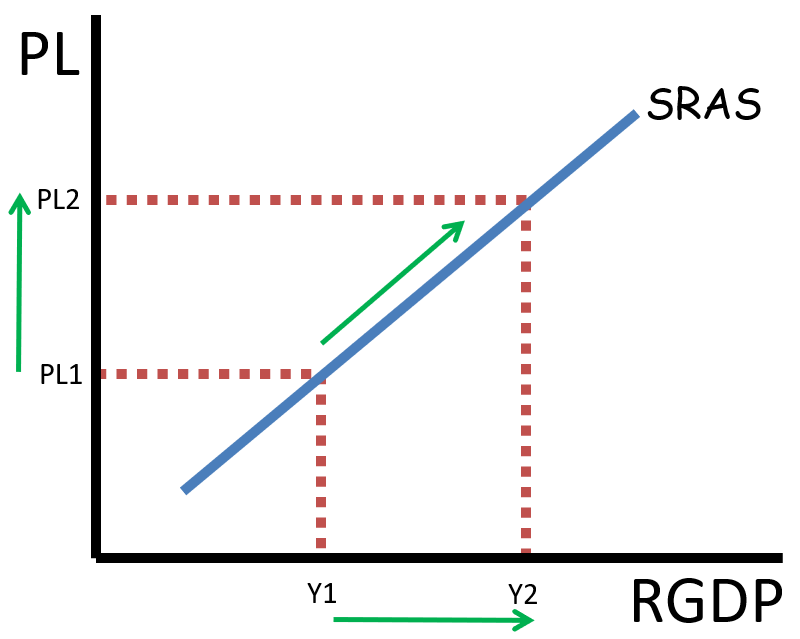
- Higher prices may increase firms’ profits and encourage more production.
- Lower prices may reduce profitability and output.
- Some costs of production, such as wages and rents, may not change immediately in the short run.
Key Idea:
- Short-run aggregate supply focuses on temporary changes in production levels.
Shape of the SRAS Curve
The SRAS curve is usually drawn as upward sloping from left to right.
- As the price level rises, firms are willing to supply more output.
- As the price level falls, firms reduce output.
Higher price level → Higher profits → More output supplied
Why the SRAS Curve Slopes Upward
The SRAS curve slopes upward because some production costs are fixed in the short run.
- If output prices rise while wages and other costs remain temporarily unchanged, profits increase.
- Firms respond by increasing production.
- When prices fall, profitability decreases and firms reduce output.
Determinants of the SRAS Curve
The SRAS curve shifts when production costs or supply conditions change.
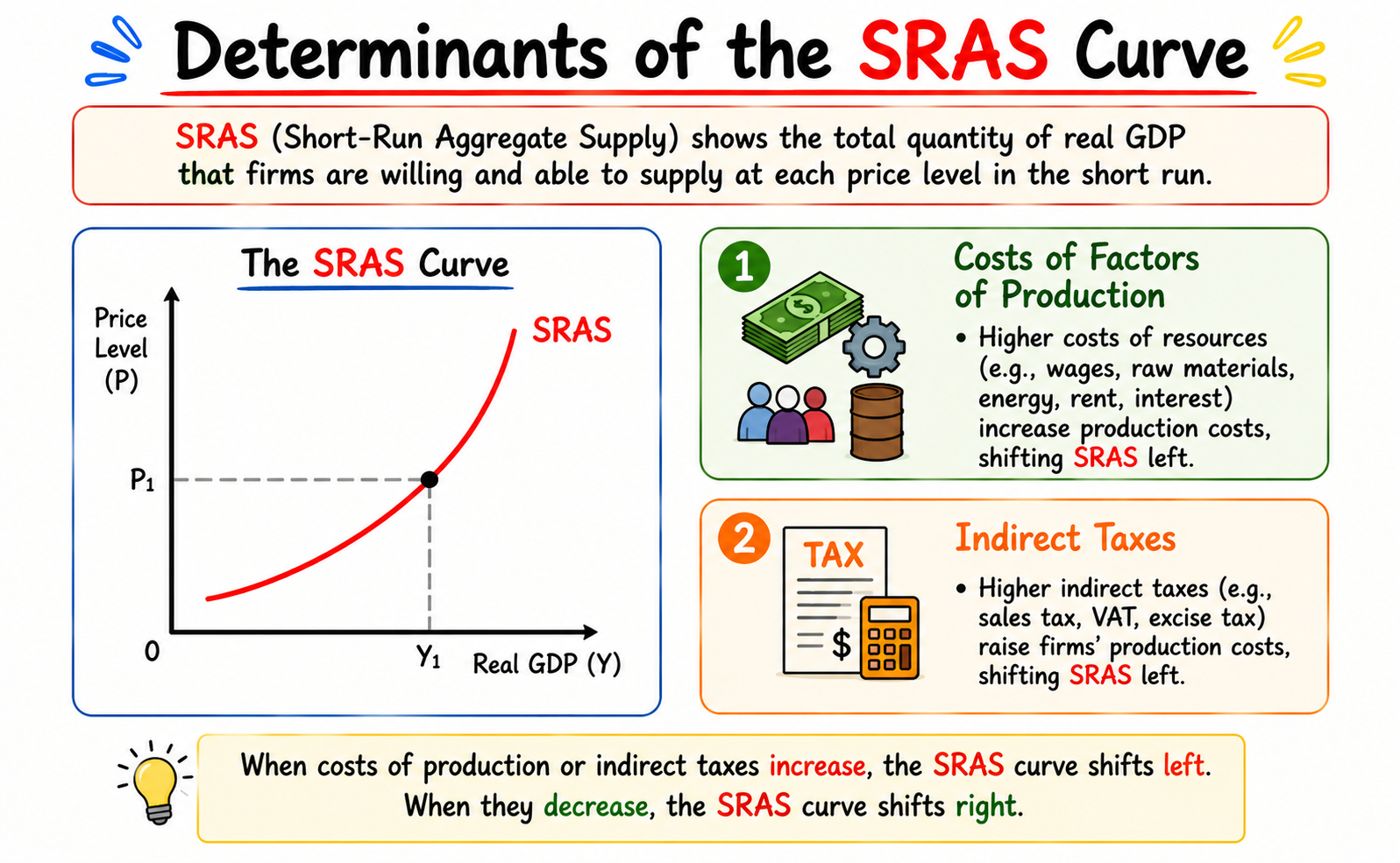
Main determinants:
- Costs of factors of production
- Indirect taxes
1. Costs of Factors of Production
Factors of production include land, labour, capital, and entrepreneurship.
Changes in the costs of these factors affect firms’ production costs and therefore aggregate supply.
Increase in Factor Costs
- Higher wages increase labour costs.
- Higher raw material prices increase production costs.
- Higher energy costs raise business expenses.
Effect on SRAS:
- Firms become less profitable at each price level.
- Output supplied decreases.
- The SRAS curve shifts to the left.
Production costs ↑ → SRAS shifts left
Decrease in Factor Costs
- Lower wages reduce labour costs.
- Cheaper raw materials reduce production expenses.
- Lower energy prices reduce operating costs.
Effect on SRAS:
- Production becomes more profitable.
- Firms increase output.
- The SRAS curve shifts to the right.
Production costs ↓ → SRAS shifts right
Examples of Factor Cost Changes
- Increase in oil prices increases transportation and energy costs.
- Rise in minimum wages increases labour costs.
- Improved productivity may reduce unit labour costs.
2. Indirect Taxes
Indirect taxes are taxes imposed on goods and services, such as sales taxes and excise duties.
Indirect taxes increase firms’ production costs.
Increase in Indirect Taxes
- Firms face higher costs of production.
- Profit margins decrease.
- Firms reduce supply at each price level.
Effect on SRAS:
- The SRAS curve shifts to the left.
Indirect taxes ↑ → SRAS shifts left
Decrease in Indirect Taxes
- Production costs decrease.
- Firms become more profitable.
- Output supplied increases.
Effect on SRAS:
- The SRAS curve shifts to the right.
Indirect taxes ↓ → SRAS shifts right
Movement Along the SRAS Curve vs Shift of SRAS
| Change | Cause | Effect |
|---|---|---|
| Movement Along SRAS Curve | Change in price level | Change in quantity of output supplied |
| Shift of SRAS Curve | Change in production costs | Change in aggregate supply |
Importance of SRAS
- Helps explain inflation and unemployment.
- Used to analyse cost-push inflation.
- Shows how firms respond to changes in production costs.
- Important in macroeconomic policy analysis.
Summary Table of Determinants of SRAS
| Determinant | Effect on SRAS |
|---|---|
| Factor costs increase | SRAS shifts left |
| Factor costs decrease | SRAS shifts right |
| Indirect taxes increase | SRAS shifts left |
| Indirect taxes decrease | SRAS shifts right |
Key Ideas:
- The SRAS curve is upward sloping.
- Changes in production costs shift the SRAS curve.
- Higher costs reduce aggregate supply.
- Indirect taxes increase firms’ costs and reduce SRAS.
Example 1
Explain how an increase in oil prices may affect the SRAS curve.
▶️ Answer / Explanation
Oil is an important input for transportation and production.
If oil prices rise, firms face higher production costs.
At each price level, firms are willing to supply less output.
Therefore, the SRAS curve shifts to the left.
Example 2
Using an example, explain how lower indirect taxes may affect aggregate supply.
▶️ Answer / Explanation
If the government reduces sales taxes on firms, production costs decrease.
Firms become more profitable and increase output.
As a result, short-run aggregate supply increases and the SRAS curve shifts to the right.