
Strengths of Fiscal Policy
Fiscal policy can be a powerful tool for managing the economy, especially during periods of economic instability. Governments can directly influence aggregate demand through taxation and spending policies.
1. Targeting of Specific Economic Sectors
A major strength of fiscal policy is that governments can target specific sectors or groups within the economy.
Targeted spending → Support for key sectors → Greater effectiveness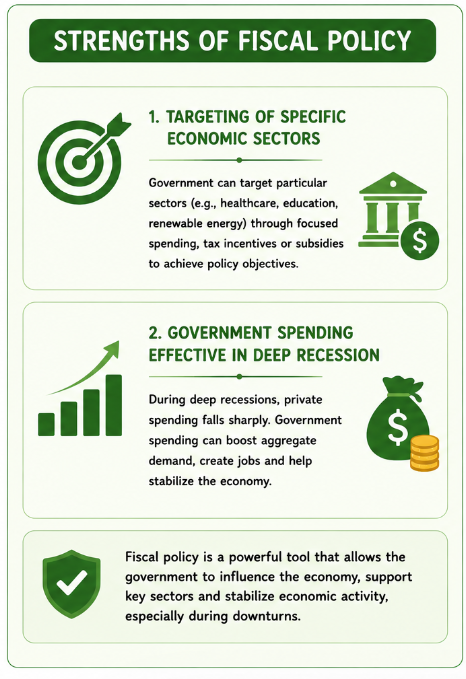
Explanation:
- Governments can direct spending toward sectors facing difficulties.
- Tax policies and subsidies can support strategic industries.
- Resources can be allocated where they are most needed.
Examples:
- Subsidies for renewable energy
- Infrastructure spending in underdeveloped regions
- Support for agriculture or healthcare sectors
Economic Significance:
- Helps correct sector-specific problems.
- Protects employment in important industries.
- Encourages long-term development and structural change.
Evaluation:
- Governments may incorrectly identify sectors needing support.
- Political influence may lead to inefficient allocation of resources.
- Targeted support may reduce competition.
2. Government Spending Effective in Deep Recession
Fiscal policy is especially effective during a deep recession when private sector spending is weak.
Recession → Weak private demand → Government spending stimulates economy
Explanation:
- During severe recessions, households and firms reduce spending and investment.
- Monetary policy may become less effective if interest rates are already very low.
- Government spending directly increases aggregate demand.
Multiplier Effect:
- Government spending creates income and employment.
- This generates further rounds of spending through the Keynesian multiplier.
- The final increase in GDP can be larger than the initial injection.
Economic Significance:
- Reduces unemployment.
- Supports businesses and consumer confidence.
- Helps economies recover from recession.
Evaluation:
- Large government spending may increase public debt.
- Time lags may delay impact.
- Effectiveness depends on the size of the multiplier.
Economic Logic :
- Fiscal policy is particularly useful when private demand collapses.
- Direct government spending can quickly raise aggregate demand.
- Targeted policies allow governments to address structural weaknesses.
Example 1
Explain why fiscal policy can effectively support specific industries.
▶️ Answer / Explanation
Governments can direct spending and subsidies toward selected sectors.
This supports production and employment.
It helps industries facing economic difficulties.
Example 2
Evaluate why fiscal policy may be effective during a deep recession.
▶️ Answer / Explanation
Government spending directly increases aggregate demand.
The multiplier effect further increases GDP and employment.
However, increased borrowing may raise public debt.
Thus, fiscal policy is effective but may create long-term costs.
Automatic Stabilizers (HL Only)
Automatic stabilizers are features of the government budget that automatically help stabilize the economy without requiring new government action or policy changes.
Economic fluctuations → Automatic response → Greater stability
Explanation:
- Automatic stabilizers work through existing tax and welfare systems.
- They reduce the severity of recessions and inflationary booms.
- No new legislation is required.
How Automatic Stabilizers Work: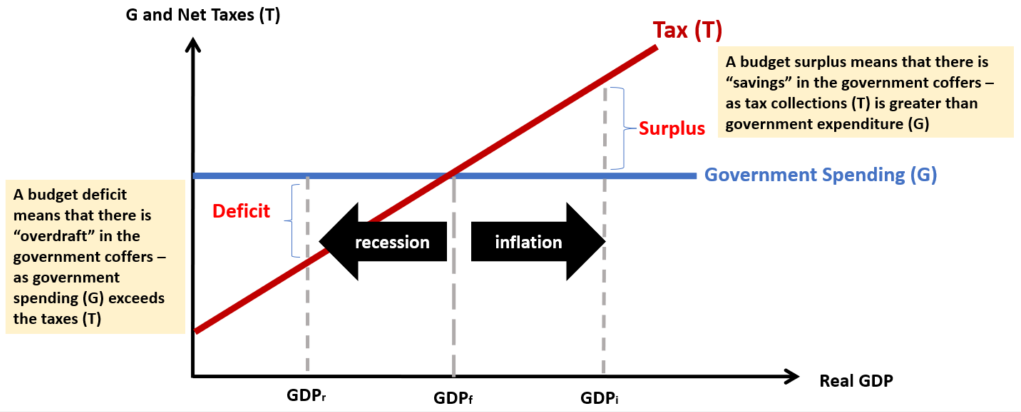
- During economic expansion:
- Tax revenue rises
- Government welfare spending falls
- Aggregate demand is reduced automatically
- During recession:
- Tax revenue falls
- Government welfare spending rises
- Aggregate demand is supported automatically
1. Progressive Taxes
Progressive taxes are taxes where higher-income earners pay a larger percentage of their income in tax.
Higher income → Higher tax proportion
Role as an Automatic Stabilizer:
- During economic growth, incomes rise.
- People move into higher tax brackets.
- Tax payments increase automatically.
- This reduces disposable income and limits excessive aggregate demand.
During Recession:
- Incomes fall.
- Tax payments decrease automatically.
- Disposable income falls less sharply.
- This supports consumption and aggregate demand.
Economic Significance:
- Helps reduce inflationary pressure during booms.
- Supports spending during recessions.
- Reduces fluctuations in the business cycle.
2. Unemployment Benefits
Unemployment benefits are transfer payments made to unemployed individuals.
Higher unemployment → Higher benefits → Support for AD
Role as an Automatic Stabilizer:
- During recession, unemployment rises.
- Government spending on benefits increases automatically.
- This provides income to households.
- Consumption falls less sharply.
During Economic Expansion:
- Unemployment falls.
- Government spending on benefits decreases automatically.
- This helps reduce excessive aggregate demand.
Economic Significance:
- Protects living standards during unemployment.
- Maintains consumer spending.
- Stabilizes economic activity.
Economic Logic (HL Insight):
- Automatic stabilizers smooth business cycle fluctuations.
- They reduce the need for discretionary fiscal policy.
- They work continuously and automatically.
Evaluation:
- Automatic stabilizers may not be strong enough during severe recessions.
- Large welfare spending may increase budget deficits.
- High taxes may reduce work incentives.
Example 1
Explain how progressive taxes act as an automatic stabilizer.
▶️ Answer / Explanation
During economic growth, incomes rise and tax payments increase automatically.
This reduces disposable income and limits excessive demand.
During recession, tax payments fall and support consumption.
Example 2
Evaluate the importance of unemployment benefits during recession.
▶️ Answer / Explanation
Unemployment benefits provide income to unemployed workers.
This supports consumption and aggregate demand.
However, higher welfare spending may increase government deficits.
Thus, unemployment benefits stabilize the economy but may be costly.
Strengths and Limitations of Fiscal Policy in Promoting Growth, Low Unemployment, and Low and Stable Inflation
Fiscal policy refers to the use of government spending and taxation to influence economic activity and achieve macroeconomic objectives.
Governments use fiscal policy to promote: 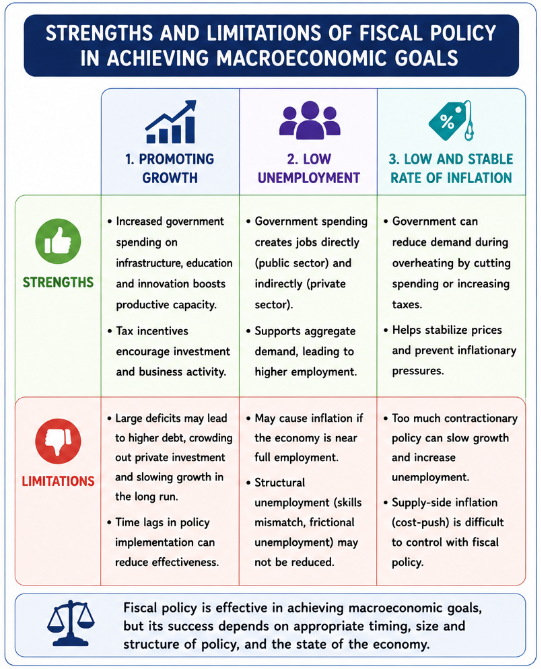
- Economic growth
- Low unemployment
- Low and stable inflation
Fiscal policy can be:
- Expansionary → Higher government spending or lower taxes
- Contractionary → Lower government spending or higher taxes
Key Ideas:
- Fiscal policy directly affects aggregate demand.
- It is especially important during recessions and economic instability.
- Fiscal policy may create trade-offs between inflation, growth, and unemployment.
- The effectiveness of fiscal policy depends on economic conditions and policy implementation.
Strengths of Fiscal Policy
1. Promoting Economic Growth
Expansionary fiscal policy increases aggregate demand through:
- Higher government spending
- Lower taxes
Higher AD → Higher output → Economic growth
Economic Significance:
- Raises real GDP.
- Stimulates business activity.
- Supports recovery during recession.
Multiplier Effect:
- Government spending creates income.
- Income creates further rounds of spending.
- The final increase in GDP may exceed the initial injection.
2. Reducing Unemployment
Higher aggregate demand increases demand for labor.
Effects:
- Firms increase production.
- Employment rises.
- Cyclical unemployment decreases.
Higher AD → Higher employment → Lower cyclical unemployment
Targeted Government Spending:
Governments can support sectors or regions with high unemployment through:
- Infrastructure projects
- Public sector employment
- Training and education programs
3. Maintaining Low and Stable Inflation
Contractionary fiscal policy can reduce excessive aggregate demand.
Methods:
- Increasing taxes
- Reducing government spending
Effects:
- Aggregate demand decreases.
- Demand-pull inflationary pressure falls.
Lower AD → Lower inflationary pressure
Automatic Stabilizers:
Progressive taxes and unemployment benefits automatically help stabilize inflation and economic fluctuations.
4. Targeting Specific Sectors
Fiscal policy allows governments to direct spending toward important sectors.
Examples:
- Healthcare
- Education
- Renewable energy
- Transport infrastructure
Economic Significance:
- Supports long-run development.
- Improves productivity and human capital.
- Encourages structural change.
Limitations of Fiscal Policy
1. Time Lags
Fiscal policy may take time to implement and affect the economy.
Types of Lags:
- Recognition lag
- Decision-making lag
- Implementation lag
Effect:
Policies may become effective after economic conditions have already changed.
2. Inflationary Pressure
Expansionary fiscal policy may create excessive aggregate demand.
Possible Effects:
- Demand-pull inflation
- Rising wages and prices
- Loss of purchasing power
This is more likely when the economy is close to full employment.
3. Increased Government Debt
Large government spending may require borrowing.
Possible Consequences:
- Higher public debt
- Higher debt-servicing costs
- Reduced confidence among investors
Future tax increases may be required to repay debt.
4. Crowding Out
Government borrowing may increase interest rates.
Effects:
- Private investment may decrease.
- Economic growth may slow.
Government borrowing ↑ → Interest rates ↑ → Private investment ↓
5. Less Effective Against Structural Unemployment
Fiscal policy mainly reduces cyclical unemployment.
Structural unemployment caused by:
- Skill mismatches
- Technological change
- Industrial decline
may not be solved simply by increasing aggregate demand.
6. Political Constraints
Governments may avoid unpopular policies such as:
- Tax increases
- Spending cuts
This may reduce the effectiveness of fiscal policy.
7. Limited Effectiveness Against Cost-Push Inflation
Fiscal policy is less effective against inflation caused by:
- Higher oil prices
- Supply shocks
- Rising production costs
Reducing aggregate demand may worsen unemployment and growth.
Comparison of Strengths and Limitations of Fiscal Policy:
| Objective | Strengths | Limitations |
|---|---|---|
| Economic Growth | Boosts AD and multiplier effect | Public debt and crowding out |
| Low Unemployment | Creates jobs and increases demand | Less effective for structural unemployment |
| Low Inflation | Reduces excessive AD | Limited effect on cost-push inflation |
Short Run versus Long Run Effects:
| Time Period | Main Fiscal Policy Impact |
|---|---|
| Short Run | Changes aggregate demand and employment |
| Long Run | Infrastructure and human capital improve productivity |
Evaluation
- Fiscal policy is particularly effective during deep recessions when private demand is weak.
- Expansionary fiscal policy may significantly reduce cyclical unemployment.
- However, excessive fiscal expansion may increase inflation and public debt.
- Fiscal policy may be less effective when structural problems exist in the economy.
- Governments often combine fiscal policy with monetary and supply-side policies to achieve macroeconomic stability.
Example 1
Explain how expansionary fiscal policy may promote economic growth and reduce unemployment.
▶️ Answer / Explanation
Expansionary fiscal policy increases aggregate demand through higher government spending or lower taxes.
Higher aggregate demand increases production and real GDP.
Firms hire more workers to increase output.
This reduces cyclical unemployment and promotes economic growth.
The multiplier effect may further increase GDP and employment.
Example 2
Evaluate one limitation of using fiscal policy to maintain low inflation.
▶️ Answer / Explanation
Contractionary fiscal policy reduces aggregate demand by increasing taxes or reducing government spending.
This may lower demand-pull inflation.
However, lower aggregate demand may also reduce economic growth and increase unemployment.
Fiscal policy is also less effective against cost-push inflation caused by supply-side factors such as rising energy prices.
Therefore, controlling inflation through fiscal policy may involve economic trade-offs.