
Supply-Side Effects of Fiscal Policies
Although fiscal policy is mainly used as a demand-side policy to influence aggregate demand (AD), it can also create important supply-side effects by affecting the economy’s productive capacity and long-run aggregate supply (LRAS).
Fiscal policy → Better productivity and capacity → Increase in LRAS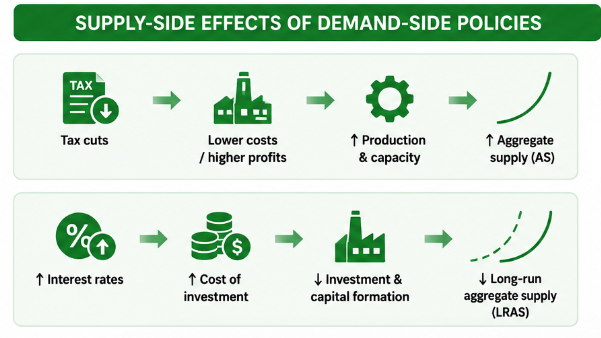
Explanation:
- Government spending and taxation policies can influence:
- Productivity
- Efficiency
- Labour supply
- Investment
- These changes affect the economy’s ability to produce goods and services in the long run.
1. Government Spending on Education and Training
- Fiscal policy can increase spending on education and skills training.
- This improves human capital and labour productivity.
- Workers become more skilled and adaptable.
Better education → Higher productivity → Higher LRAS
Economic Significance:
- Reduces structural unemployment.
- Improves long-term economic growth.
- Increases international competitiveness.
2. Government Spending on Infrastructure
- Fiscal policy may finance infrastructure projects such as:
- Roads
- Ports
- Electricity systems
- Communication networks
- Efficient infrastructure lowers business costs and improves productivity.
Better infrastructure → Lower costs → Greater productive capacity
Economic Significance:
- Encourages investment.
- Improves efficiency and mobility.
- Supports long-term growth.
3. Government Spending on Healthcare
- Healthcare spending improves the quality of the labour force.
- Healthy workers are more productive and absent less often.
- Increases labour force participation.
Better healthcare → Healthier workforce → Higher productivity
4. Tax Policies Affecting Incentives
- Lower personal income taxes may encourage greater work effort.
- Lower business taxes may increase investment and innovation.
- Tax incentives can stimulate entrepreneurship and R&D.
Lower taxes → Greater incentives → More investment and productivity
5. Fiscal Policy and Long-Run Aggregate Supply (LRAS)
- When fiscal policy improves productivity and productive capacity, LRAS shifts to the right.
- This increases potential output without necessarily causing inflation.
Improved productive capacity → Rightward shift of LRAS
Economic Significance:
- Promotes sustainable economic growth.
- Improves living standards.
- Helps reduce inflationary pressure through greater productive capacity.
Evaluation:
- Supply-side effects often take a long time to occur.
- Government spending may increase public debt.
- Poorly targeted spending may waste resources.
- Tax cuts may reduce government revenue.
Economic Logic:
- Fiscal policy affects not only AD but also LRAS.
- Investment in human and physical capital improves productivity.
- Supply-side effects are mainly long term.
Example 1
Explain how fiscal policy can increase long-run aggregate supply.
▶️ Answer / Explanation
Government spending on education and infrastructure improves productivity.
This increases productive capacity.
As a result, LRAS shifts to the right.
Example 2
Evaluate the effectiveness of tax cuts as a supply-side fiscal policy.
▶️ Answer / Explanation
Tax cuts may increase incentives to work and invest.
This can improve productivity and economic growth.
However, tax cuts may reduce government revenue and increase deficits.
Thus, effectiveness depends on economic conditions and policy design.