
Sustainable Level of Government (National) Debt (HL Only)
Government debt, also called national debt, refers to the total amount of money owed by a government because of past borrowing.

Governments borrow money when government spending exceeds government revenue.
Government spending > Government revenue → Budget deficit → Government borrowing
A sustainable level of government debt means that the government can continue servicing and repaying its debt without creating major economic instability.
Measurement of Government (National) Debt as a Percentage of GDP
Government debt is commonly measured relative to the size of the economy using the debt-to-GDP ratio.
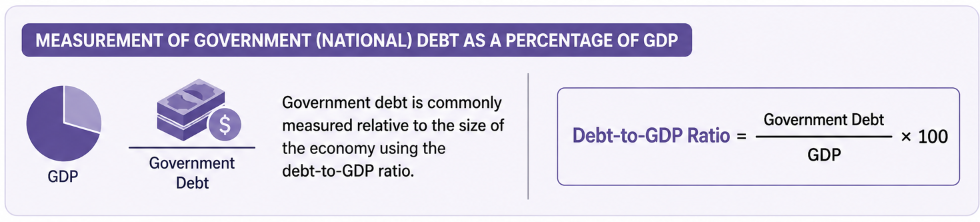
This ratio compares total government debt with annual national output.
\( \mathrm{Debt\text{-}to\text{-}GDP\ Ratio = \dfrac{Government\ Debt}{GDP} \times 100} \)
Meaning of the Debt-to-GDP Ratio
- A higher ratio means government debt is large relative to the economy.
- A lower ratio suggests debt is easier to manage.
- The ratio helps assess whether debt is sustainable.
Example of Debt-to-GDP Ratio Calculation
If:
- Government debt = \( \mathrm{900\ billion} \)
- GDP = \( \mathrm{1500\ billion} \)
Then:
\( \mathrm{Debt\text{-}to\text{-}GDP\ Ratio = \dfrac{900}{1500} \times 100} \)
\( \mathrm{= 60\%} \)
The debt-to-GDP ratio is \( \mathrm{60\%} \).
Why GDP Is Used in the Ratio
- GDP measures the economy’s income and productive capacity.
- A larger economy can usually manage more debt.
- The ratio shows the government’s relative ability to repay debt.
Relationship Between a Budget Deficit and Government Debt
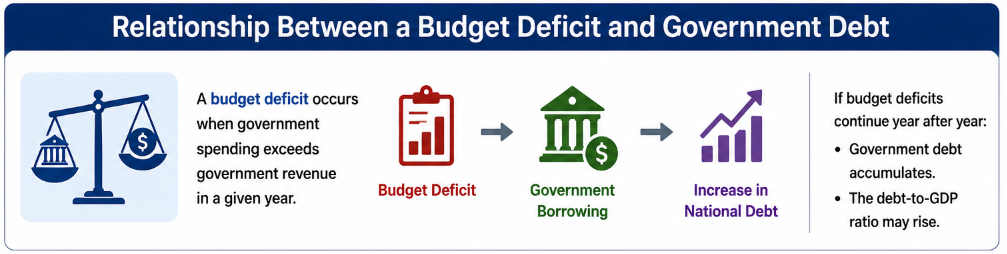
A budget deficit occurs when government spending exceeds government revenue in a given year.
To finance the deficit, governments borrow money.
This borrowing adds to government debt.
Relationship Explained
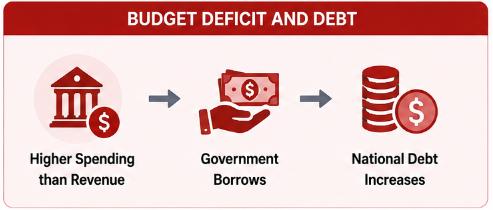
Budget deficit → Government borrowing → Increase in national debt
If budget deficits continue year after year:
- Government debt accumulates.
- The debt-to-GDP ratio may rise.
Budget Surplus and Debt
A budget surplus occurs when government revenue exceeds spending.
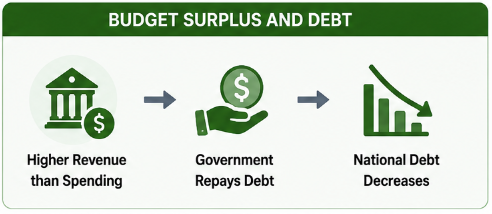
In this case:
- The government may repay existing debt.
- Government debt may decrease.
Difference Between Deficit and Debt
| Concept | Meaning |
|---|---|
| Budget Deficit | Annual excess of spending over revenue |
| Government Debt | Total accumulated borrowing over time |
Why Governments Borrow
Governments may borrow to:
- Finance infrastructure projects
- Support the economy during recessions
- Fund healthcare, education, and public services
- Respond to emergencies or crises
Borrowing is not always harmful if debt remains manageable and supports economic growth.
Costs of a High Government (National) Debt
Although borrowing may support economic activity, excessively high government debt can create serious problems.
1. Debt Servicing Costs
Debt servicing refers to paying interest and repaying borrowed funds.
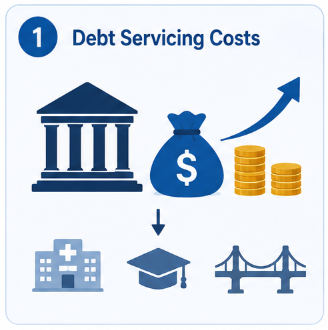
- High debt increases interest payments.
- Governments may spend a large share of revenue servicing debt.
Effect:
- Less government spending available for healthcare, education, and infrastructure.
2. Credit Ratings
Credit rating agencies evaluate governments’ ability to repay debt.
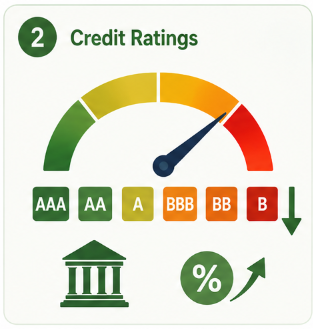
If debt becomes excessively high:
- Credit ratings may fall.
- Investors may view government borrowing as risky.
Effect:
- Governments may face higher borrowing costs and interest rates.
3. Impact on Future Taxation
Governments may increase taxes to repay debt.

- Higher taxes may reduce household disposable income.
- Business investment incentives may decrease.
4. Impact on Government Spending
High debt may force governments to reduce spending.
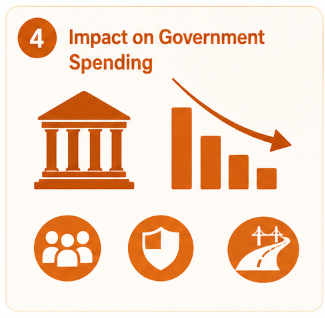
- Public services and welfare programs may be cut.
- Infrastructure investment may decrease.
This is sometimes called austerity.
5. Crowding Out Effect
Large government borrowing may increase interest rates.
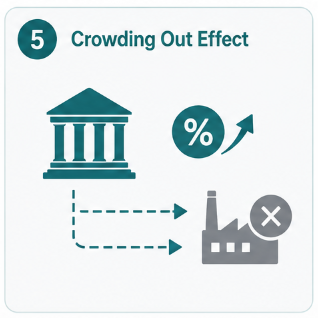
- Private firms may borrow less because borrowing becomes more expensive.
- Private investment may decrease.
6. Risk of Debt Crisis
If debt becomes unsustainable:
- The government may struggle to repay debt.
- Financial instability may occur.
- International lenders may lose confidence.
When Government Debt May Be Sustainable
Government debt may remain sustainable if:
- Economic growth is strong
- Interest rates remain low
- Borrowing finances productive investment
- Debt grows more slowly than GDP
Potential Benefits of Moderate Government Borrowing
- Supports economic recovery during recessions.
- Allows investment in infrastructure and education.
- Can increase future productive capacity.
Comparison Between Sustainable and Unsustainable Debt
| Aspect | Sustainable Debt | Unsustainable Debt |
|---|---|---|
| Debt Servicing | Manageable | Very costly |
| Investor Confidence | Stable | Weak |
| Economic Impact | Supports growth | May reduce growth |
| Government Flexibility | Maintained | Limited |
Key Ideas:
- Government debt is measured using the debt-to-GDP ratio.
- Budget deficits increase government debt over time.
- High debt creates debt servicing costs and may reduce economic confidence.
- Moderate borrowing may support economic growth if debt remains sustainable.
Example 1
Calculate the debt-to-GDP ratio if government debt is \( \mathrm{1200\ billion} \) and GDP is \( \mathrm{2000\ billion} \).
▶️ Answer / Explanation
\( \mathrm{Debt\text{-}to\text{-}GDP\ Ratio = \dfrac{1200}{2000} \times 100} \)
\( \mathrm{= 60\%} \)
The debt-to-GDP ratio is \( \mathrm{60\%} \).
Example 2
Using an example, explain how persistent budget deficits may increase national debt.
▶️ Answer / Explanation
If a government spends more than it collects in taxes every year, it must borrow money to finance the deficit.
Each year of borrowing adds to total national debt.
Over time, persistent budget deficits cause the debt-to-GDP ratio to rise.