
The Process of Money Creation by Commercial Banks
Commercial banks play an important role in creating money within the economy.
Money creation occurs mainly through the process of: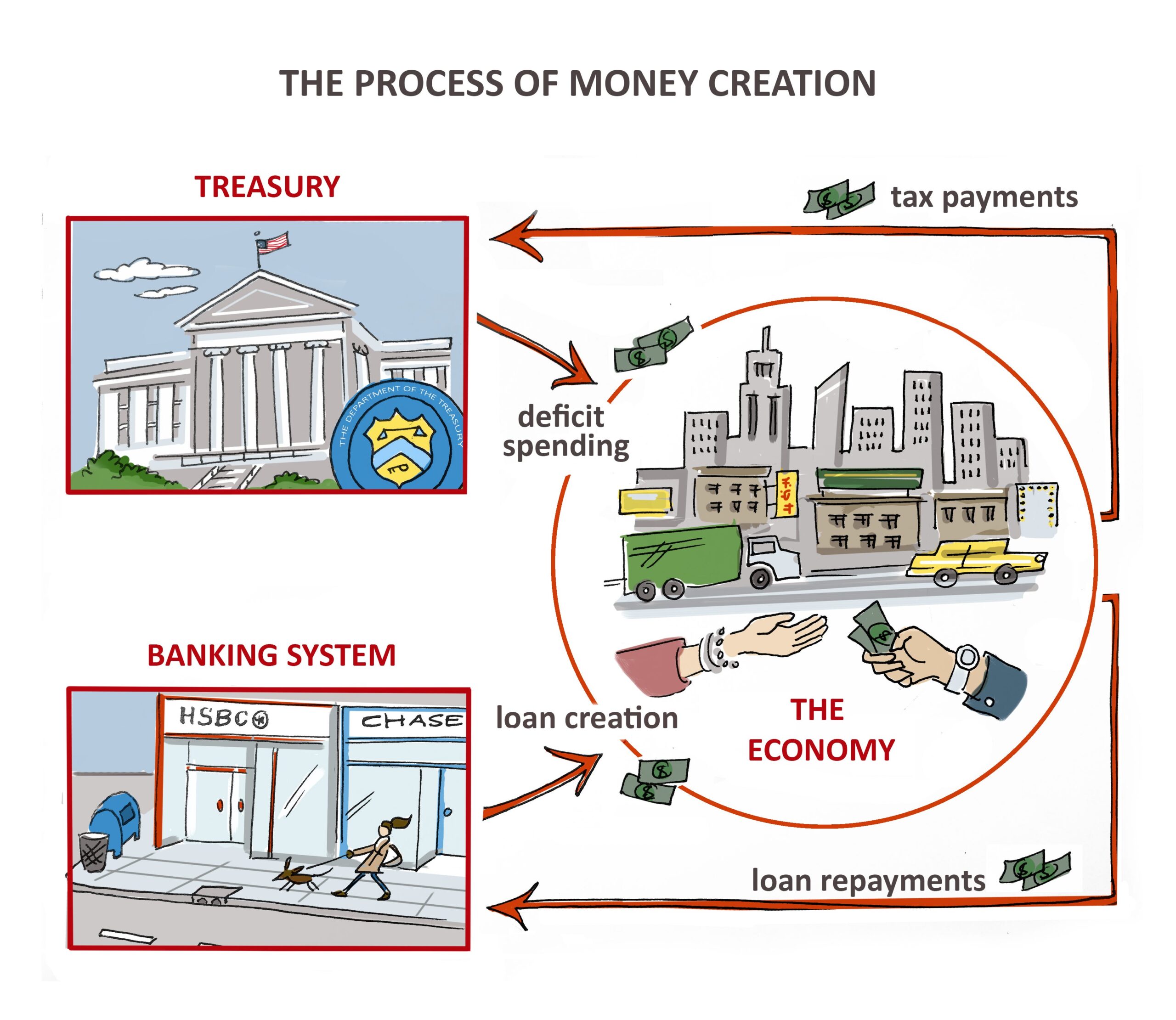
- Accepting deposits
- Making loans
When banks provide loans, they create additional deposits in the banking system, increasing the money supply.
Role of Commercial Banks
Commercial banks perform several important functions:
- Accept deposits from customers
- Provide loans to households and firms
- Facilitate payments
- Create credit
The ability to create credit allows banks to expand the money supply.
Fractional Reserve Banking System
The process of money creation operates through the fractional reserve banking system.
Under this system:
- Banks keep only a fraction of deposits as reserves.
- The remaining funds are loaned out.
Reserves
Reserves are funds banks keep:
- As cash in the bank
- As deposits with the central bank
Reserves help banks meet withdrawal demands from customers.
Reserve Ratio
The reserve ratio is the percentage of deposits banks must keep as reserves.
\( \mathrm{Reserve\ Ratio = \dfrac{Reserves}{Deposits} \times 100} \)
Example of a Reserve Ratio
If a bank receives: \( \mathrm{\$10,000} \)
in deposits and the reserve ratio is:
\( \mathrm{10\%} \)
the bank must keep:
\( \mathrm{\$1,000} \)
as reserves and may lend:
\( \mathrm{\$9,000} \)
How Money Creation Occurs
Money creation occurs because loans made by banks are usually deposited back into the banking system.
These deposits then become the basis for further lending.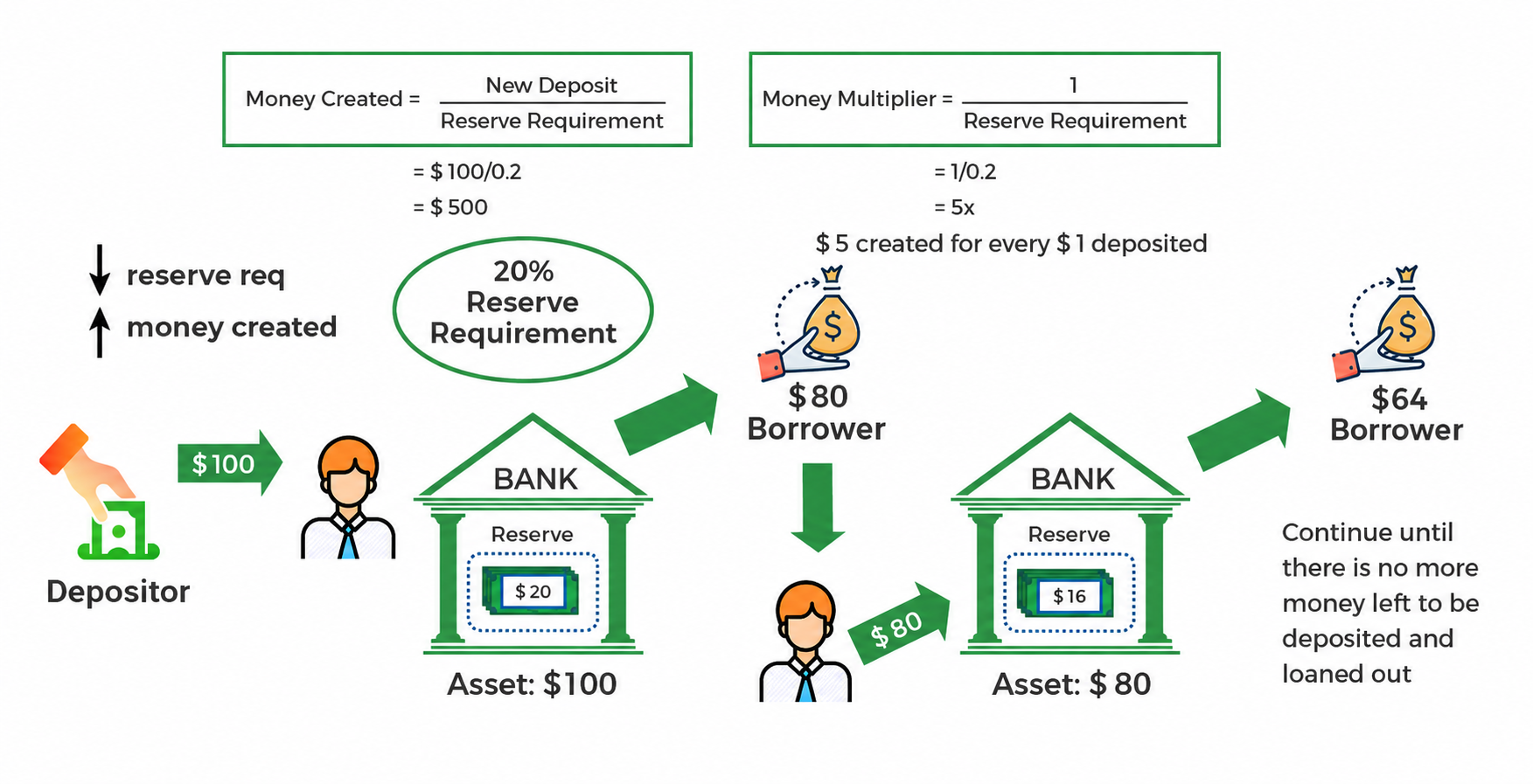
Step-by-Step Process of Money Creation
Step 1: Initial Deposit
A customer deposits:
\( \mathrm{\$10,000} \)
into Bank A.
If the reserve ratio is:
\( \mathrm{10\%} \)
Bank A keeps:
\( \mathrm{\$1,000} \)
as reserves.
The bank can lend:
\( \mathrm{\$9,000} \)
Step 2: Loan Becomes New Deposit
The borrower spends the:
\( \mathrm{\$9,000} \)
and the money is deposited into Bank B.
Bank B keeps:
\( \mathrm{10\% \times 9,000 = \$900} \)
as reserves and lends:
\( \mathrm{\$8,100} \)
Step 3: Repeated Lending Process
The process continues throughout the banking system.
Each bank:
- Keeps a fraction as reserves
- Lends the remainder
This repeatedly expands deposits and money supply.
Money Multiplier
The total increase in money supply depends on the money multiplier.
\( \mathrm{Money\ Multiplier = \dfrac{1}{Reserve\ Ratio}} \)
The reserve ratio must be written as a decimal.
Example of the Money Multiplier
If the reserve ratio is:
\( \mathrm{10\% = 0.10} \)
then:
\( \mathrm{Money\ Multiplier = \dfrac{1}{0.10} = 10} \)
This means the banking system can potentially create up to:
\( \mathrm{10 \times} \)
the original deposit in total money supply.
Maximum Money Creation
The maximum increase in money supply can be calculated using:
\( \mathrm{Maximum\ Money\ Creation = Initial\ Deposit \times Money\ Multiplier} \)
Example:
Initial deposit:
\( \mathrm{\$10,000} \)
Reserve ratio:
\( \mathrm{10\%} \)
Money multiplier:
\( \mathrm{10} \)
Maximum money creation:
\( \mathrm{\$10,000 \times 10 = \$100,000} \)
Important Assumptions of the Money Multiplier Process
The theoretical maximum money creation assumes:
- All excess reserves are loaned out.
- All loans are redeposited into banks.
- Banks lend all available excess reserves.
- No cash leakages occur.
Leakages in the Money Creation Process
In reality, money creation is usually smaller because of leakages.
Examples of Leakages
- People may keep cash instead of redepositing money.
- Banks may hold excess reserves.
- Borrowers may not spend all borrowed funds immediately.
These leakages reduce the actual multiplier effect.
Role of the Central Bank
The central bank influences money creation through:
- Reserve requirements
- Interest rates
- Monetary policy
Higher Reserve Ratios
If the central bank increases reserve requirements:
- Banks lend less.
- Money creation decreases.
Lower Reserve Ratios
If reserve requirements decrease:
- Banks can lend more.
- Money creation increases.
Importance of Money Creation
Money creation supports:
- Economic growth
- Investment
- Consumption
- Business activity
However, excessive money creation may contribute to inflation.
Advantages of Commercial Bank Money Creation
- Provides funds for investment and consumption
- Supports economic growth
- Improves liquidity in the economy
Potential Risks
- Excessive lending may create inflation.
- Risky lending may create financial instability.
- Bank failures may reduce confidence in the financial system.
Summary of the Money Creation Process
| Step | Process |
|---|---|
| 1 | Deposits enter the banking system |
| 2 | Banks keep required reserves |
| 3 | Remaining funds are loaned out |
| 4 | Loans become new deposits |
| 5 | Process repeats, increasing money supply |
Key Ideas:
- Commercial banks create money through lending.
- The process operates through fractional reserve banking.
- The reserve ratio determines the size of the money multiplier.
- Loans create new deposits and expand money supply.
- The central bank influences money creation through monetary policy and reserve requirements.
Example 1
A bank receives a deposit of: \( \mathrm{\$20,000} \) The reserve ratio is: \( \mathrm{20\%} \)
Calculate:
- The reserves kept by the bank
- The maximum loan the bank can make
- The money multiplier
▶️ Answer / Explanation
Step 1: Calculate reserves
\( \mathrm{20\% \times 20,000 = \$4,000} \)
Step 2: Calculate maximum loan
\( \mathrm{20,000 – 4,000 = \$16,000} \)
Step 3: Calculate money multiplier
\( \mathrm{Money\ Multiplier = \dfrac{1}{0.20} = 5} \)
Final Answers:
- Reserves = \( \mathrm{\$4,000} \)
- Maximum loan = \( \mathrm{\$16,000} \)
- Money multiplier = \( \mathrm{5} \)
Example 2
An initial deposit of: \( \mathrm{\$50,000} \) enters the banking system.
The reserve ratio is: \( \mathrm{10\%} \)
Calculate the maximum possible increase in money supply.
▶️ Answer / Explanation
Step 1: Calculate money multiplier
\( \mathrm{Money\ Multiplier = \dfrac{1}{0.10} = 10} \)
Step 2: Calculate maximum money creation
\( \mathrm{Maximum\ Money\ Creation = 50,000 \times 10} \)
\( \mathrm{= \$500,000} \)
Final Answer:
\( \mathrm{\$500,000} \)