
Tools of Monetary Policy
Central banks use several tools to influence:
- Money supply
- Interest rates
- Bank lending
- Aggregate demand
These tools help the central bank achieve macroeconomic objectives such as:
- Low and stable inflation
- Low unemployment
- Stable economic growth
- Financial stability
The main tools of monetary policy are:
- Open market operations
- Minimum reserve requirements
- Changes in the central bank minimum lending rate
- Quantitative easing
1. Open Market Operations
Open market operations (OMO) refer to the buying and selling of government securities (bonds) by the central bank in financial markets.
OMO directly affects:
- Bank reserves
- Money supply
- Interest rates
Expansionary Open Market Operations
To increase money supply, the central bank buys government securities from commercial banks or the public.
How Buying Securities Increases Money Supply
When the central bank purchases bonds:
- Commercial banks receive additional reserves.
- Banks gain greater ability to lend.
- Money supply increases.
Central bank buys bonds → Bank reserves increase → Lending increases → Money supply increases
Effects of Expansionary OMO
- Interest rates tend to fall.
- Borrowing and investment increase.
- Aggregate demand increases.
- Economic growth and employment may rise.
Contractionary Open Market Operations
To reduce money supply, the central bank sells government securities.
How Selling Securities Reduces Money Supply
When banks and investors buy government securities:
- Money leaves the banking system.
- Bank reserves decrease.
- Lending decreases.
Central bank sells bonds → Bank reserves decrease → Lending decreases → Money supply decreases
Effects of Contractionary OMO
- Interest rates tend to rise.
- Borrowing and spending decrease.
- Aggregate demand decreases.
- Inflationary pressure may fall.
Advantages of Open Market Operations
- Flexible and widely used.
- Can be implemented quickly.
- Allows precise control over liquidity.
Possible Limitations
- Commercial banks may not increase lending even with higher reserves.
- Effectiveness may weaken during severe recessions.
2. Minimum Reserve Requirements
Minimum reserve requirements are regulations requiring commercial banks to keep a certain percentage of deposits as reserves.
The reserve requirement influences the ability of banks to create money through lending.
Higher Reserve Requirements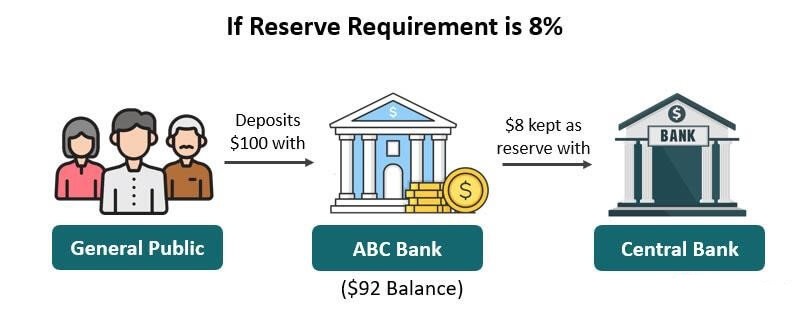
If the central bank increases reserve requirements:
- Banks must keep more funds as reserves.
- Banks have less money available for lending.
- Money creation decreases.
Result:
- Money supply decreases.
- Aggregate demand may decrease.
- Inflationary pressure may fall.
Lower Reserve Requirements
If reserve requirements decrease:
- Banks can lend more money.
- Money creation increases.
- Money supply expands.
Result:
- Aggregate demand may increase.
- Economic growth and employment may rise.
Effect on the Money Multiplier
The reserve requirement directly affects the money multiplier.
\( \mathrm{Money\ Multiplier = \dfrac{1}{Reserve\ Ratio}} \)
Higher reserve ratios reduce the money multiplier.
Lower reserve ratios increase the money multiplier.
Advantages of Reserve Requirement Changes
- Strong influence on money creation.
- Directly affects bank lending capacity.
Possible Limitations
- Large changes may disrupt banking operations.
- Rarely adjusted frequently in many economies.
3. Changes in the Central Bank Minimum Lending Rate
The central bank sets a key interest rate known as the: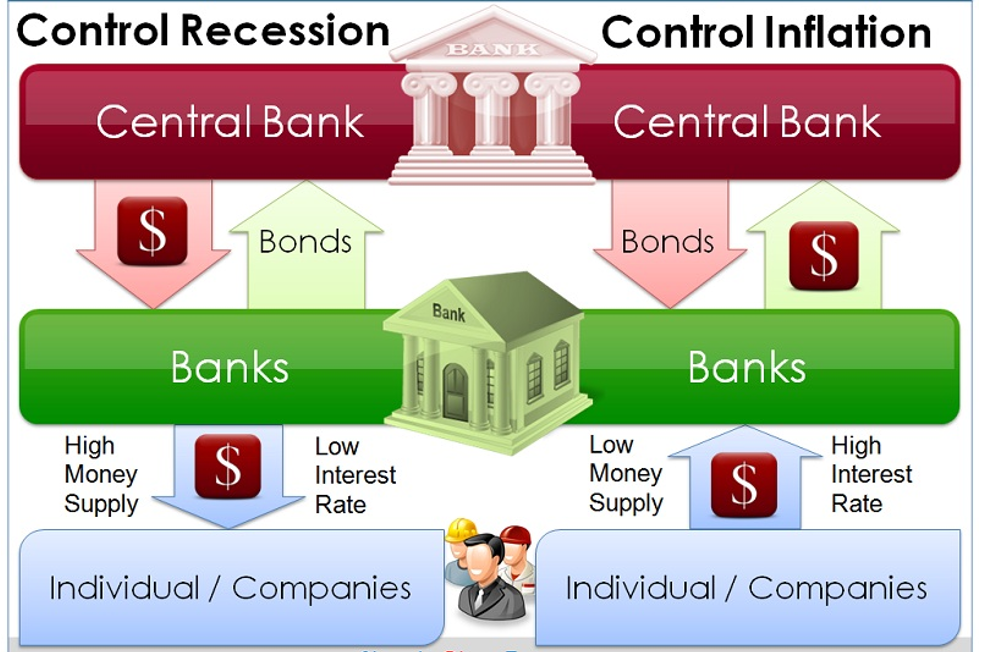
- Base rate
- Discount rate
- Refinancing rate
This is the rate at which commercial banks borrow from the central bank.
Lowering the Lending Rate
When the central bank lowers the lending rate:
- Commercial banks can borrow more cheaply.
- Commercial lending rates usually decrease.
- Borrowing by households and firms increases.
Effects of Lower Interest Rates
- Consumption increases.
- Investment increases.
- Aggregate demand rises.
- Economic growth and employment may increase.
Raising the Lending Rate
When the central bank raises the lending rate:
- Borrowing becomes more expensive.
- Commercial banks increase lending rates.
- Consumption and investment decrease.
Effects of Higher Interest Rates
- Aggregate demand decreases.
- Inflationary pressure may decrease.
- Economic growth may slow.
Transmission Mechanism
Changes in policy interest rates affect the economy through:
- Borrowing costs
- Savings behaviour
- Investment decisions
- Exchange rates
Advantages of Interest Rate Changes
- Widely used and flexible.
- Strong influence on aggregate demand.
- Clear signalling effect for markets.
Possible Limitations
- Effects may take time to occur.
- Consumers and firms may not respond strongly during recessions.
4. Quantitative Easing (QE)
Quantitative easing (QE) is an unconventional monetary policy used mainly during severe recessions or financial crises.
QE involves large-scale purchases of financial assets by the central bank.
Purpose of Quantitative Easing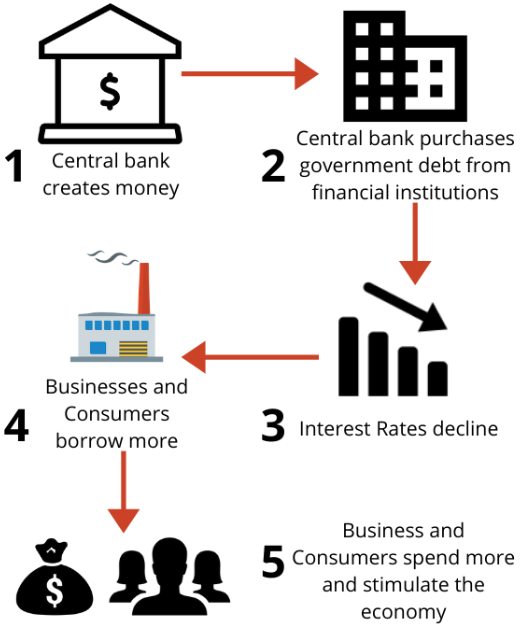
QE is used when:
- Interest rates are already very low.
- Traditional monetary policy becomes less effective.
The goal is to increase liquidity and stimulate economic activity.
How Quantitative Easing Works
The central bank creates new electronic money and uses it to buy:
- Government bonds
- Financial assets
This increases money supply and reserves in the banking system.
Effects of Quantitative Easing
- Interest rates may decrease further.
- Bank lending may increase.
- Asset prices may rise.
- Investment and spending may increase.
- Aggregate demand may rise.
Wealth and Confidence Effects
Higher asset prices may increase:
- Household wealth
- Business confidence
This may encourage greater spending and investment.
Advantages of Quantitative Easing
- Provides liquidity during crises.
- Supports economic recovery.
- May prevent deflation.
Possible Risks and Limitations
- May increase inflation if excessive.
- May increase asset price bubbles.
- Benefits may mainly go to wealthier asset owners.
- Banks may still lend cautiously.
Comparison of Monetary Policy Tools
| Tool | Main Mechanism | Main Effect |
|---|---|---|
| Open Market Operations | Buying and selling government securities | Changes bank reserves and money supply |
| Reserve Requirements | Changing required reserves | Changes lending capacity |
| Interest Rate Changes | Changing policy interest rates | Influences borrowing and spending |
| Quantitative Easing | Large-scale asset purchases | Increases liquidity and money supply |
Expansionary vs Contractionary Use of Monetary Tools
| Expansionary Monetary Policy | Contractionary Monetary Policy |
|---|---|
| Buy securities | Sell securities |
| Lower reserve requirements | Increase reserve requirements |
| Lower interest rates | Raise interest rates |
| Use quantitative easing | Reduce liquidity |
Key Ideas:
- Central banks use several tools to influence money supply and interest rates.
- Open market operations affect bank reserves through bond transactions.
- Reserve requirements influence the money multiplier and lending capacity.
- Interest rate changes influence borrowing, spending, and investment.
- Quantitative easing is used during severe recessions when traditional policies become less effective.
Example 1
Explain how open market operations may increase money supply.
▶️ Answer / Explanation
If the central bank buys government securities, commercial banks receive additional reserves.
Banks can then increase lending and create more deposits.
As a result, money supply increases.
Example 2
Using an example, explain how quantitative easing may stimulate economic activity.
▶️ Answer / Explanation
During a recession, the central bank may buy large amounts of government bonds using newly created money.
This increases liquidity in the banking system and may lower interest rates further.
Commercial banks may increase lending, leading to higher investment and aggregate demand.