
Absolute and Comparative Advantage (HL Only)
International trade is based on the idea that countries benefit when they specialize in producing certain goods and services and trade with other countries. Two important concepts explaining this specialization are absolute advantage and comparative advantage.
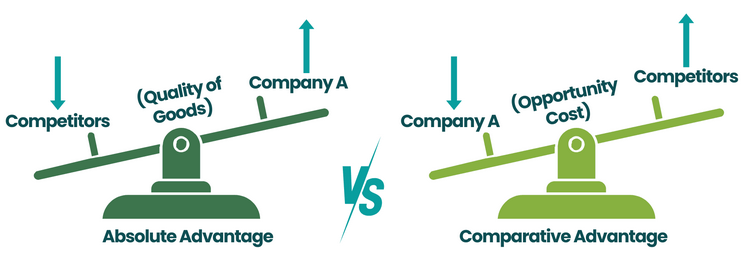
Absolute advantage exists when a country can produce a good using fewer resources or at a lower cost than another country.
Comparative advantage exists when a country can produce a good at a lower opportunity cost than another country, even if it does not have an absolute advantage.
Comparative advantage is more important in explaining why trade occurs because countries can still gain from trade even if one country is more efficient in producing all goods.
Key Ideas:
- Trade allows countries to specialize according to comparative advantage.
- Specialization increases global output and efficiency.
- Comparative advantage depends on opportunity cost, not absolute productivity.
- Countries gain from trade when they focus on goods with lower opportunity costs.
Absolute Advantage vs Comparative Advantage:
| Aspect | Absolute Advantage | Comparative Advantage |
|---|---|---|
| Meaning | Ability to produce more using fewer resources. | Ability to produce at lower opportunity cost. |
| Basis | Productivity or efficiency. | Opportunity cost. |
| Importance | Explains production efficiency. | Explains gains from trade. |
| Trade Possible? | Not always. | Yes, if opportunity costs differ. |
| Focus | Lower resource use. | Lower sacrifice of alternatives. |
Gains from Trade
Gains from trade refer to the benefits that countries obtain when they specialize according to comparative advantage and engage in international trade.
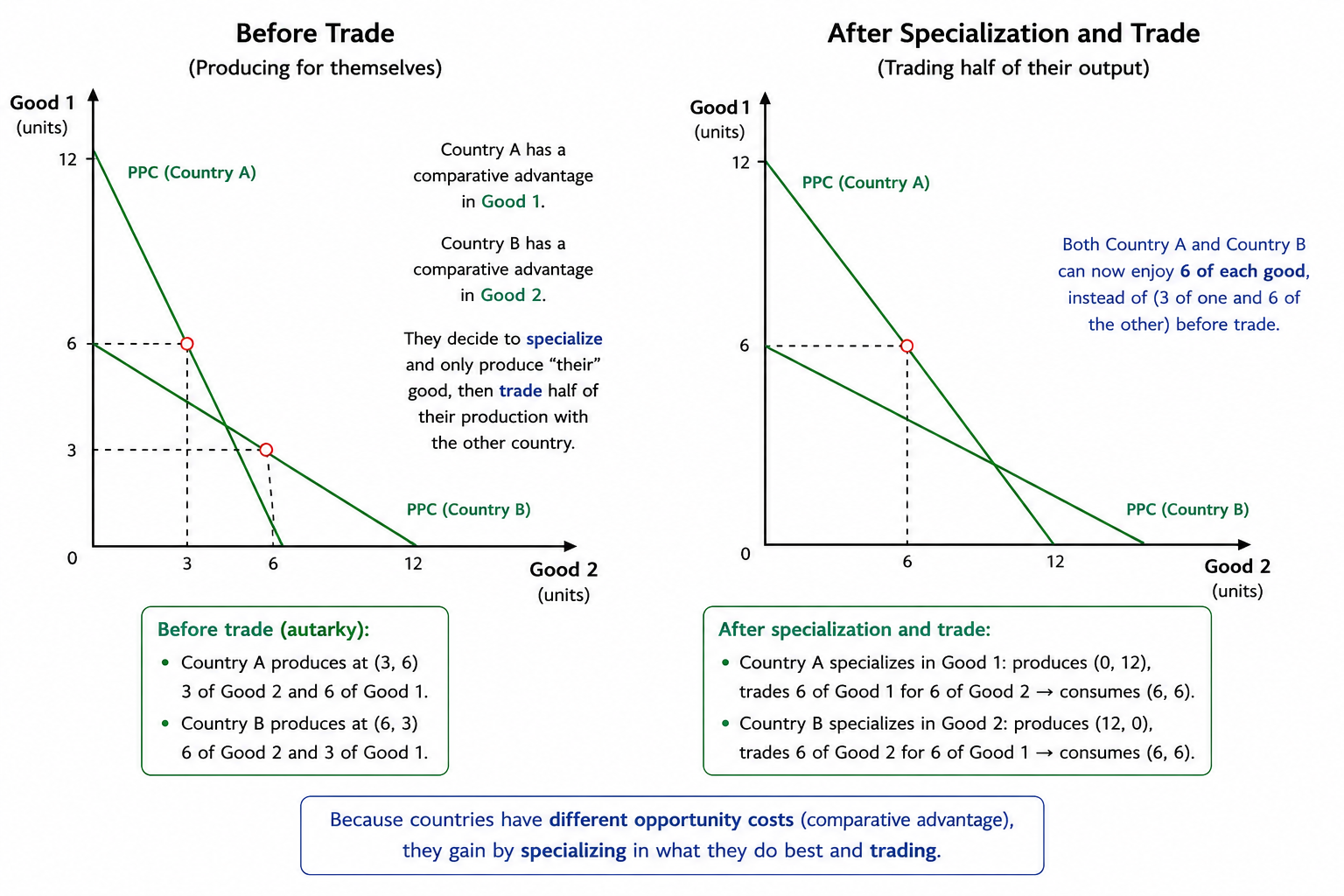
When countries specialize, total world production increases because resources are allocated more efficiently. Trade then allows countries to consume beyond their own production possibilities.
Main gains from trade include:
- Higher global output due to specialization.
- Lower production costs from efficient resource use.
- Greater consumption possibilities for trading countries.
- Improved efficiency and productivity.
- Access to goods unavailable domestically.
Specialization + Trade → Greater total output and consumption
Sources of Comparative Advantage
Comparative advantage arises because countries differ in their availability of resources, technology, and production conditions.
Main sources of comparative advantage include:
- Natural Resources — Some countries possess abundant oil, minerals, or fertile land.
- Climate — Climate affects agricultural production and resource availability.
- Labor Force — Differences in labor skills, education, and wages influence production costs.
- Capital Availability — Access to machinery, infrastructure, and investment affects productivity.
- Technology — Advanced technology improves production efficiency.
- Entrepreneurship and Innovation — Efficient management and innovation improve competitiveness.
These differences create variations in opportunity costs between countries, leading to comparative advantage.
Opportunity Costs
Opportunity cost is the next best alternative that must be sacrificed when a choice is made. In international trade, opportunity cost measures how much of one good must be given up to produce another.

Comparative advantage depends entirely on comparing opportunity costs between countries.
- Lower opportunity cost → comparative advantage.
- Countries specialize in goods with the lowest opportunity costs.
- Opportunity cost explains why mutually beneficial trade is possible.
Comparative Advantage = Lower Opportunity Cost
Relationship Between the Concepts:
| Concept | Economic Significance |
|---|---|
| Absolute Advantage | Shows which country is more productive. |
| Comparative Advantage | Determines specialization and trade patterns. |
| Opportunity Cost | Measures sacrifice involved in production decisions. |
| Gains from Trade | Result from specialization and efficient allocation. |
Example 1
Explain why comparative advantage is more important than absolute advantage in international trade.
▶️ Answer / Explanation
Absolute advantage refers to producing goods using fewer resources, while comparative advantage depends on lower opportunity cost.
A country may have an absolute advantage in producing all goods, but trade can still benefit both countries if opportunity costs differ.
For example, if Country A sacrifices fewer units of cloth to produce wine than Country B, Country A has a comparative advantage in wine production.
By specializing according to comparative advantage and trading, both countries can consume more than before specialization.
Therefore, comparative advantage explains the basis of mutually beneficial trade more effectively than absolute advantage.
Example 2
Using an example, explain how opportunity cost determines comparative advantage.
▶️ Answer / Explanation
Opportunity cost measures the amount of one good that must be sacrificed to produce another good.
Suppose Country X gives up 2 units of wheat to produce 1 unit of steel, while Country Y gives up 5 units of wheat for 1 unit of steel.
Country X has the lower opportunity cost in steel production and therefore has a comparative advantage in steel.
Country Y should specialize in the good for which it has the lower opportunity cost.
This specialization allows both countries to gain from trade through more efficient resource allocation.
Example 3 (HL)
Using the data below, calculate the opportunity costs for each country and identify the comparative advantage.
| Country | Maximum Output of Wheat | Maximum Output of Cars |
|---|---|---|
| Country A | 100 units | 50 units |
| Country B | 80 units | 40 units |
▶️ Answer / Explanation
Step 1: Calculate Opportunity Cost of 1 Car
Country A:
If all resources are used for wheat → 100 wheat
If all resources are used for cars → 50 cars
Opportunity cost of 1 car:
100 ÷ 50 = 2 units of wheat
So, producing 1 car costs Country A 2 units of wheat.
Country B:
Opportunity cost of 1 car:
80 ÷ 40 = 2 units of wheat
So, producing 1 car costs Country B 2 units of wheat.
Step 2: Calculate Opportunity Cost of 1 Wheat
Country A:
50 ÷ 100 = 0.5 cars
Opportunity cost of 1 wheat = 0.5 cars.
Country B:
40 ÷ 80 = 0.5 cars
Opportunity cost of 1 wheat = 0.5 cars.
Step 3: Identify Comparative Advantage
Comparative advantage exists when a country has a lower opportunity cost.
In this example, both countries have the same opportunity costs.
Therefore:
- Neither country has a comparative advantage.
- There is no basis for mutually beneficial specialization.
Conclusion:
Countries gain from trade only when opportunity costs differ. Since the opportunity costs are identical here, neither country benefits from specializing based on comparative advantage.