
Advantages of Trading Blocs
Trading blocs promote economic integration by reducing or removing trade barriers between member countries. By encouraging freer trade and cooperation, trading blocs can generate economic, political, and social benefits for member nations.
The advantages of trading blocs increase as the level of integration becomes deeper.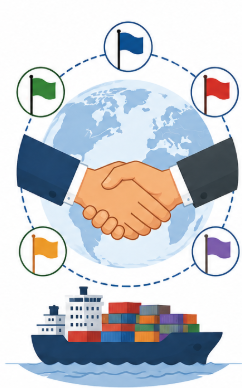
Important Point:
- Trading blocs increase trade and market integration.
- Member countries may benefit from larger markets and specialization.
- Economic cooperation may strengthen political relationships.
- Integration may improve efficiency and economic growth.
Trade Creation (HL Only)
Trade creation occurs when membership in a trading bloc causes countries to replace higher-cost domestic production with lower-cost imports from member countries.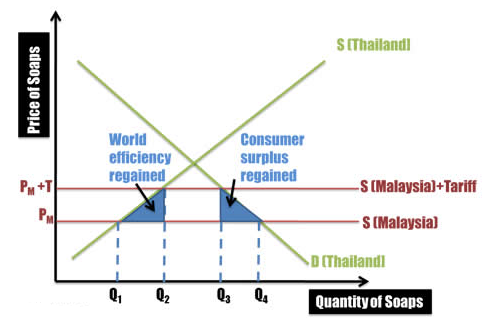
This increases economic efficiency because production shifts toward more efficient producers within the bloc.
- Consumers gain access to lower-priced goods.
- Resources are allocated more efficiently.
- Consumer welfare increases.
- Total trade within the bloc expands.
Trade creation → Replacement of inefficient domestic production with efficient imports
Trade creation is considered one of the major economic benefits of regional integration.
In the diagram, when Thailand and Malaysia form a trading bloc, Thailand will remove tariffs from Malaysian imports. Trade will go to more efficient Malaysian producers. The blue shaded regions shows that world efficiency wil be regained as now more efficient producer is producing the good and there are lower prices which lead to regaining of consumer surplus.
Greater Access to Markets and Economies of Scale
Trading blocs create larger integrated markets by reducing barriers between member countries.
- Firms gain access to a larger customer base.
- Production can occur on a larger scale.
- Average production costs may decrease.
- Firms become more internationally competitive.
Larger markets encourage specialization, investment, and economic growth.
Greater Employment Opportunities Through Freedom of Labour
In deeper forms of integration such as common markets, workers can move freely between member countries.
- Workers can seek jobs in countries with higher demand for labor.
- Unemployment may decrease in member countries.
- Labor shortages can be reduced.
- Workers may gain access to higher wages and better living standards.
Free movement of labor improves flexibility in the labor market.
Stronger Bargaining Power in Multilateral Negotiations
Countries within a trading bloc often negotiate collectively in international trade discussions.
- Large blocs have greater influence in global trade negotiations.
- Member countries gain stronger negotiating power.
- Collective bargaining may improve trade agreements.
- Smaller countries benefit from negotiating as part of a larger group.
This can improve the bloc’s position in organizations such as the :contentReference[oaicite:0]{index=0}.
Greater Political Stability and Cooperation
Trading blocs may strengthen political relationships and reduce conflict between member countries.
- Economic cooperation encourages peaceful relations.
- Countries become more economically interdependent.
- Regional cooperation may improve policy coordination.
- Political stability may encourage investment and growth.
Economic integration often increases diplomatic and institutional cooperation.
Summary of Advantages of Trading Blocs:
| Advantage | Main Benefit |
|---|---|
| Trade Creation | More efficient allocation of resources |
| Larger Markets | Economies of scale and growth |
| Freedom of Labour | Greater employment opportunities |
| Stronger Bargaining Power | Better international negotiation position |
| Political Stability | Improved cooperation and reduced conflict |
Evaluation
- The benefits of trading blocs depend on the level of economic integration.
- Larger blocs may achieve greater economies of scale and bargaining power.
- Trade creation improves efficiency, but benefits may not be equally distributed.
- Political and economic cooperation may strengthen long-term regional stability.
Example 1
Explain how trading blocs can create economies of scale.
▶️ Answer / Explanation
Trading blocs reduce trade barriers between member countries, creating a larger integrated market.
Firms can therefore sell to more consumers across multiple countries.
As production increases, firms spread fixed costs over a larger output, reducing average production costs.
This creates economies of scale and improves international competitiveness.
Therefore, access to larger markets is a major advantage of trading blocs.
Example 2
Using an example, explain how trade creation improves economic efficiency.
▶️ Answer / Explanation
Trade creation occurs when countries import goods from more efficient producers within a trading bloc instead of producing them domestically at higher cost.
For example, after joining a trading bloc, a country may import cheaper agricultural products from another member country instead of producing them inefficiently at home.
This allows resources to shift toward industries where the country has comparative advantage.
Consumers benefit from lower prices, and overall allocative efficiency increases.
Therefore, trade creation is an important economic benefit of trading blocs.
Disadvantages of Trading Blocs
Although trading blocs promote economic integration and increase trade between member countries, they may also create economic and political disadvantages.
Deeper integration may reduce national independence, distort trade patterns, and create challenges for global trade cooperation.
Important Point:
- Trading blocs may benefit members at the expense of non-members.
- Economic integration can reduce national policy independence.
- Trade diversion may reduce global efficiency.
- Regional agreements may weaken multilateral free trade efforts.
Trade Diversion (HL Only)
Trade diversion occurs when membership in a trading bloc causes countries to replace lower-cost imports from non-member countries with higher-cost imports from member countries.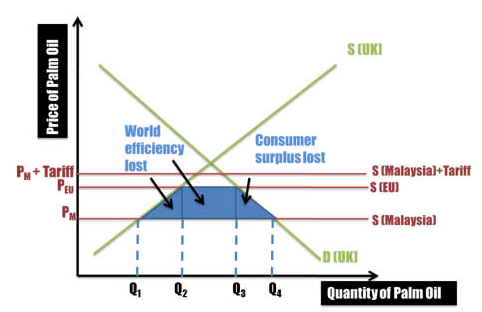
This happens because trade barriers remain against non-members, even if they are more efficient producers.
- Resources may be allocated less efficiently.
- Consumers may pay higher prices than under global free trade.
- Global welfare may decrease.
- Non-member countries may lose export opportunities.
Trade diversion → Replacement of efficient non-member imports with less efficient member imports
Trade diversion is considered one of the major disadvantages of regional trade agreements.
In the diagram, once the UK joined the EU, it had to place tariffs on the Palm Oil that it used to import from Malaysia at lower prices. The trade now is diverted to EU nations inspite of the fact that they are inefficient in producing palm oil.
The blue shaded regions show a loss in efficiency due production by inefficienty Europeon producers. Morever, the prices for consumers have increased from from Pm to Peu which results in loss of consumer surplus.
Loss of Sovereignty
Membership in trading blocs, especially customs unions and common markets, may reduce a country’s control over economic policies.
- Countries may lose control over trade policy.
- Members may need to follow common regulations and standards.
- National governments may have less policy flexibility.
- Economic decisions may be influenced by larger member countries.
Deeper integration often requires countries to share decision-making authority.
Challenge to Multilateral Trading Negotiations
Trading blocs may weaken efforts to promote global free trade through multilateral agreements.
- Regional agreements may discriminate against non-members.
- Countries may prioritize regional interests over global cooperation.
- Complex overlapping agreements may increase trade tensions.
- Global trade negotiations may become more difficult.
This may reduce progress toward broader international free trade.
Other Possible Disadvantages
- Economic benefits may not be shared equally among members.
- Smaller economies may become dependent on stronger member countries.
- Economic problems in one member country may spread to others.
- Migration pressures may increase in common markets.
Therefore, integration may create economic and social challenges alongside its benefits.
Summary of Disadvantages of Trading Blocs:
| Disadvantage | Main Economic Effect |
|---|---|
| Trade Diversion | Reduced global efficiency |
| Loss of Sovereignty | Reduced national policy control |
| Challenges to Multilateral Negotiations | Weakens global trade cooperation |
| Unequal Benefits | Some members gain more than others |
| Economic Dependence | Smaller countries rely on larger economies |
Evaluation
- The disadvantages of trading blocs become larger as economic integration deepens.
- Trade diversion may reduce some benefits of free trade.
- Loss of sovereignty may create political resistance among member countries.
- Despite disadvantages, many countries continue joining trading blocs because of the potential economic benefits.
Example 1
Explain how trade diversion may reduce economic efficiency.
▶️ Answer / Explanation
Trade diversion occurs when a country imports goods from a higher-cost producer within a trading bloc instead of a lower-cost producer outside the bloc.
For example, after joining a customs union, a country may import cars from a member country because tariffs on non-members increase the price of cheaper foreign cars.
Although trade within the bloc increases, resources are not allocated to the most efficient producers globally.
This reduces allocative efficiency and may increase prices for consumers.
Therefore, trade diversion is a major disadvantage of trading blocs.
Example 2
Using an example, explain why trading blocs may reduce national sovereignty.
▶️ Answer / Explanation
In deeper forms of integration such as customs unions and common markets, member countries must follow common trade rules and policies.
For example, countries in a customs union may be required to adopt a common external tariff on imports from non-member countries.
This limits the ability of individual governments to set independent trade policies.
As a result, countries lose some economic sovereignty in exchange for greater regional integration.
Therefore, loss of sovereignty is an important political disadvantage of trading blocs.