
Arguments Against Trade Protection / Disadvantages of Trade Protection
Trade protection involves government policies such as tariffs, quotas, subsidies, and administrative barriers that restrict international trade. Although protectionism may support domestic industries in the short run, it also creates several economic disadvantages.
Trade protection often reduces efficiency, increases prices, and limits the benefits of free trade for consumers and producers.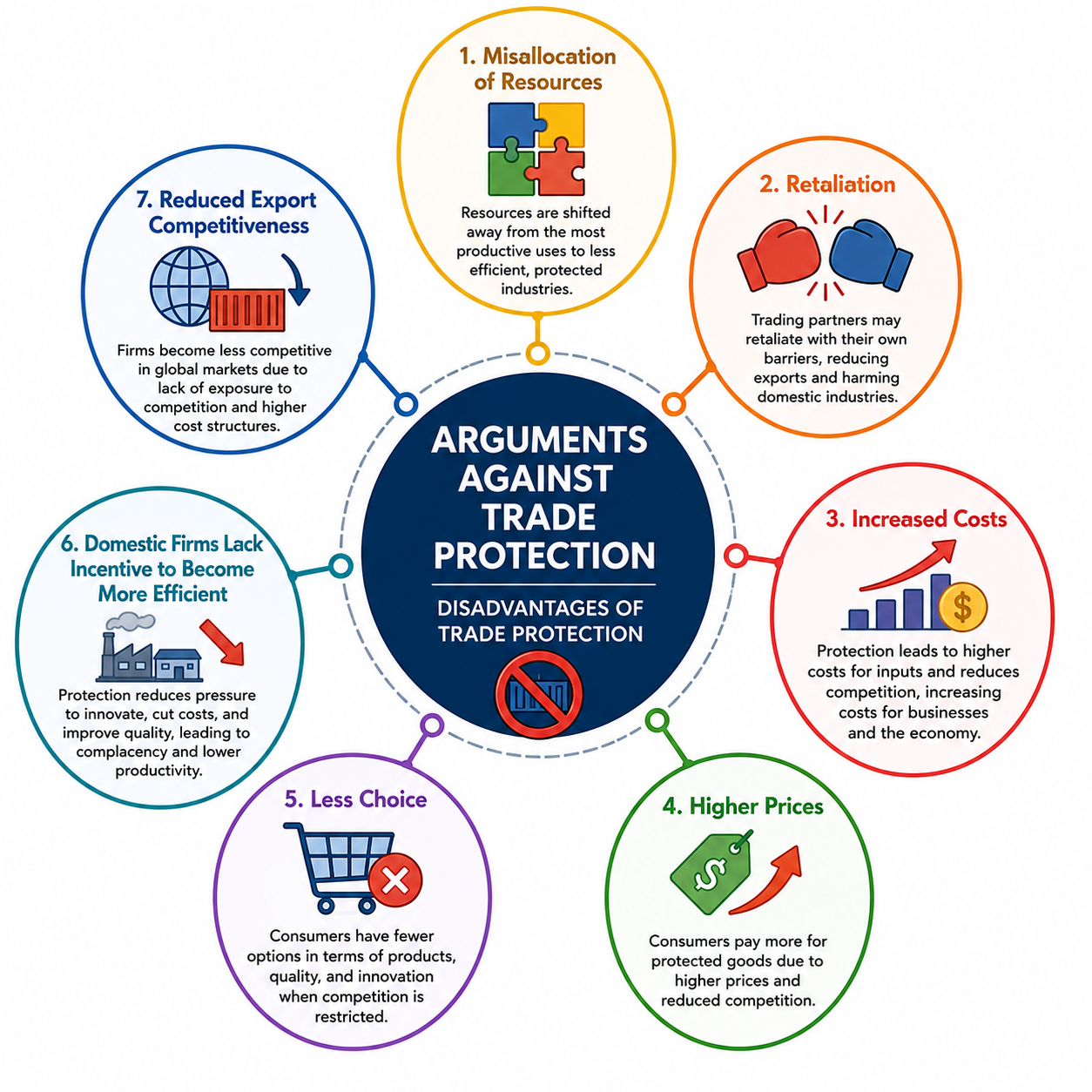
Important Point:
- Protectionism reduces the benefits of specialization and comparative advantage.
- Consumers usually face higher prices and less choice.
- Domestic firms may become inefficient due to reduced competition.
- Trade restrictions can lead to international trade conflicts.
Misallocation of Resources
Trade protection may cause resources to move toward industries that are less efficient compared to foreign producers.
- Resources are not allocated according to comparative advantage.
- Less efficient domestic firms continue operating.
- Overall economic welfare decreases.
- Allocative efficiency is reduced.
This leads to inefficient production and lower global output.
Retaliation
Countries affected by protectionist policies may respond with their own trade restrictions.
- Other countries may impose tariffs or quotas in response.
- Export industries may suffer.
- International trade disputes may increase.
- Global trade growth may slow.
Retaliation can escalate into trade wars that harm multiple economies.
Increased Costs
Trade protection often increases production and business costs.
- Domestic firms may use higher-cost inputs.
- Imported raw materials and components become more expensive.
- Businesses face reduced efficiency.
- Production costs may rise across industries.
Higher costs reduce competitiveness and productivity.
Higher Prices
Trade barriers reduce foreign competition and restrict imports, leading to higher prices for consumers.
- Consumers pay more for goods and services.
- Purchasing power decreases.
- Consumer surplus falls.
- Inflationary pressures may increase.
Consumers are usually among the main losers from protectionism.
Less Choice
Trade protection reduces the variety of goods and services available in domestic markets.
- Fewer imported products are available.
- Consumers have limited product variety.
- Access to innovative or specialized goods decreases.
Reduced choice may lower consumer satisfaction and welfare.
Domestic Firms Lack Incentive to Become More Efficient
Protection from foreign competition may reduce pressure on domestic firms to improve efficiency.
- Firms may become complacent.
- Innovation and productivity growth may slow.
- Production costs may remain high.
- Dynamic efficiency decreases.
Long-term protection may therefore weaken competitiveness.
Reduced Export Competitiveness
Protectionist policies may reduce the international competitiveness of domestic firms.
- Higher production costs reduce export competitiveness.
- Retaliation from other countries may reduce export demand.
- Domestic firms may fail to meet international standards.
This may weaken long-term export growth and economic development.
Summary of Disadvantages of Trade Protection:
| Disadvantage | Main Economic Effect |
|---|---|
| Misallocation of Resources | Reduced allocative efficiency |
| Retaliation | Trade conflicts and reduced exports |
| Increased Costs | Higher production costs |
| Higher Prices | Reduced consumer welfare |
| Less Choice | Reduced product variety |
| Lack of Efficiency Incentives | Slower innovation and productivity growth |
| Reduced Export Competitiveness | Weaker export performance |
Overall Economic Impact of Trade Protection:
| Economic Area | Possible Negative Effect |
|---|---|
| Consumers | Higher prices and less choice |
| Domestic Firms | Reduced efficiency and innovation |
| Export Industries | Retaliation and lower competitiveness |
| Economy | Lower efficiency and welfare loss |
Example 1
Explain why trade protection may lead to higher prices and reduced consumer welfare.
▶️ Answer / Explanation
Trade protection reduces imports through tariffs, quotas, or administrative barriers.
As foreign competition decreases, domestic firms gain greater market power and may raise prices.
Consumers must therefore pay more for goods and services and may also face reduced product variety.
This decreases consumer surplus and lowers overall consumer welfare.
Therefore, protectionism often benefits producers at the expense of consumers.
Example 2
Using an example, explain how trade protection may reduce efficiency and export competitiveness.
▶️ Answer / Explanation
A country may impose tariffs on imported steel to protect domestic steel producers.
Because domestic firms face less competition, they may have less incentive to reduce costs or improve productivity.
Over time, production costs may remain high, reducing international competitiveness.
Other countries may also retaliate with tariffs on exports from the protecting country.
As a result, exports may decrease and long-term efficiency may decline.