
Arguments for Trade Protection / Advantages of Trade Protection
Trade protection refers to government policies that restrict free international trade in order to protect domestic industries and achieve economic or social objectives.
Governments use protectionist measures such as tariffs, quotas, subsidies, and administrative barriers to reduce foreign competition and support domestic producers.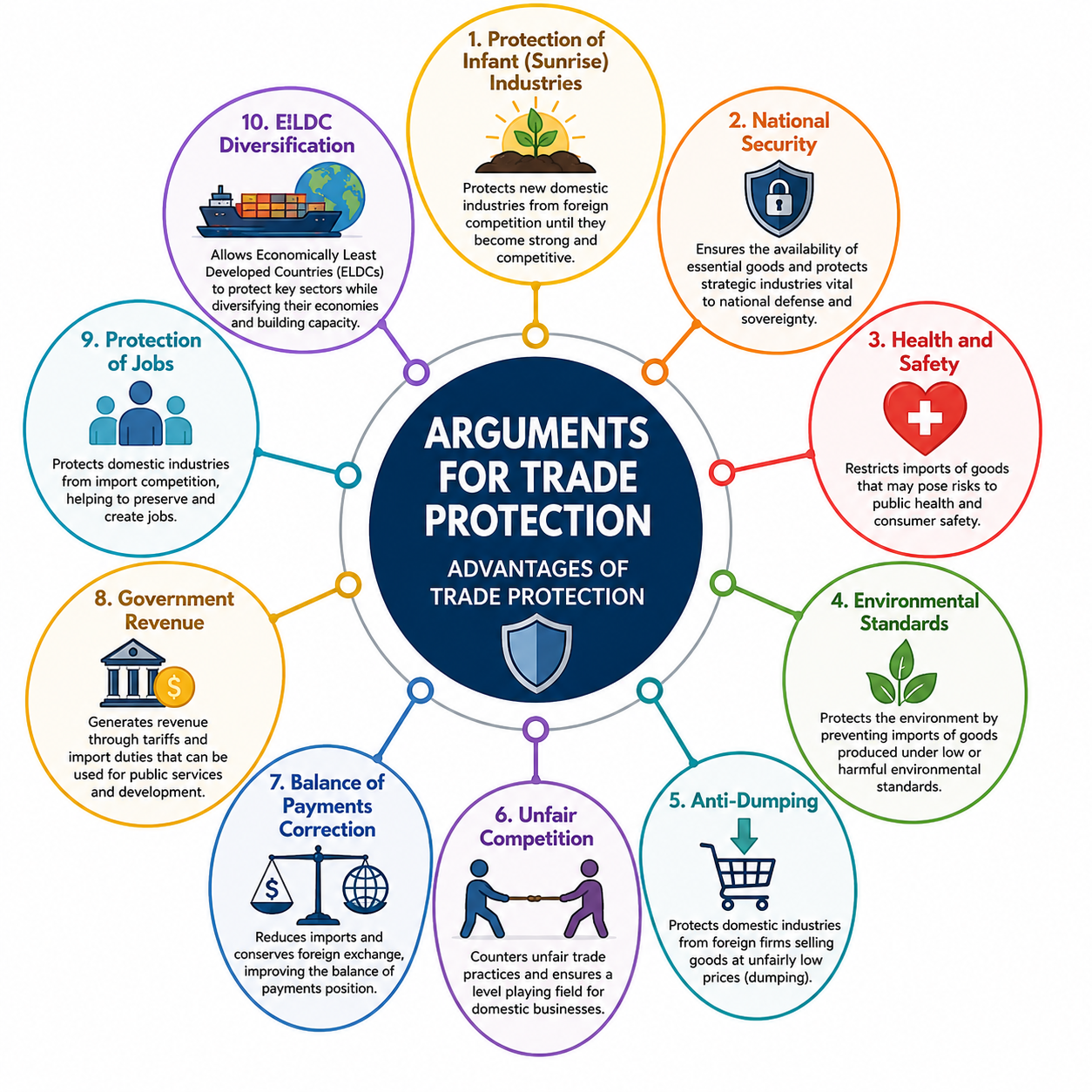
Although free trade increases efficiency and global welfare, countries may still adopt protectionist policies for several economic, political, and social reasons.
Important Point:
- Trade protection aims to support domestic industries and employment.
- Protection may correct market failures or unfair trade practices.
- Governments often balance efficiency against national objectives.
- Protectionism may create both benefits and costs.
Protection of Infant (Sunrise) Industries
New or developing industries may initially be unable to compete with established foreign firms. Trade protection allows these industries time to grow, achieve economies of scale, and become internationally competitive.
- Supports industrial development.
- Allows firms to gain experience and improve efficiency.
- May promote future economic growth and diversification.
- Common in developing economies.
However, industries may become dependent on long-term protection.
National Security
Governments may protect industries considered essential for national security and strategic independence.
- Includes defense, energy, food, and technology industries.
- Reduces dependence on foreign countries during conflicts or crises.
- Ensures stable domestic supply of essential goods.
Protection is often justified even if domestic production is less efficient.
Health and Safety
Trade protection may be used to prevent unsafe or low-quality products from entering domestic markets.
- Protects consumers from harmful products.
- Maintains product quality standards.
- Applies to food, medicine, and consumer goods.
Standards and regulations are commonly used for this purpose.
Environmental Standards
Governments may restrict imports produced using environmentally harmful methods.
- Protects natural resources and ecosystems.
- Prevents “pollution havens” where firms relocate to countries with weak regulations.
- Encourages sustainable production practices.
Environmental protection may justify limiting certain imports.
Anti-Dumping
Dumping occurs when foreign firms sell goods in another country at prices below production cost or below domestic prices.
- Protects domestic firms from unfair pricing practices.
- Prevents foreign firms from driving domestic competitors out of the market.
- Anti-dumping tariffs may restore fair competition.
Without protection, domestic industries may collapse due to predatory pricing.
Unfair Competition
Foreign firms may benefit from subsidies, weak labor laws, or lower environmental standards, creating unfair competition.
- Protects domestic firms operating under stricter regulations.
- Maintains fair competitive conditions.
- Supports domestic employment and wages.
Governments may intervene to reduce disadvantages faced by domestic producers.
Balance of Payments Correction
Trade protection may reduce imports and improve the balance of payments position.
- Helps reduce trade deficits.
- Supports domestic production instead of imports.
- May stabilize exchange rates and foreign reserves.
Protectionist measures are sometimes used during balance of payments crises.
Government Revenue
Tariffs and import duties generate revenue for governments.
- Important source of revenue in some developing countries.
- Can finance infrastructure and public services.
- Provides funds without direct domestic taxation.
Revenue depends on the level of imports and tariff rates.
Protection of Jobs
Trade protection may preserve employment in domestic industries facing foreign competition.
- Protects workers from import competition.
- Reduces unemployment in vulnerable industries.
- Supports income stability and social welfare.
However, protected industries may become less efficient over time.
Economically Least Developed Country (ELDC) Diversification
Many economically least developed countries (ELDCs) depend heavily on a small number of primary products for export earnings. Trade protection may support diversification into manufacturing and other industries.
- Reduces dependence on primary commodity exports.
- Supports industrialization and structural change.
- Promotes long-term economic development.
- Reduces vulnerability to commodity price fluctuations.
Diversification may improve economic stability and growth opportunities.
Summary of Arguments for Trade Protection:
| Argument | Main Objective |
|---|---|
| Infant Industries | Allow new industries to develop |
| National Security | Protect strategic industries |
| Health and Safety | Protect consumers |
| Environmental Standards | Promote sustainability |
| Anti-Dumping | Prevent unfair pricing |
| Unfair Competition | Protect domestic firms |
| Balance of Payments | Reduce trade deficits |
| Government Revenue | Generate income for government |
| Protection of Jobs | Reduce unemployment |
| ELDC Diversification | Support industrial development |
Example 1
Explain why governments may protect infant industries.
▶️ Answer / Explanation
Infant industries are new domestic industries that may not initially compete effectively with established foreign firms.
Governments may impose tariffs or provide subsidies to protect these industries during their early stages of development.
This allows firms time to achieve economies of scale, improve productivity, and become internationally competitive.
For example, a developing country may protect its domestic automobile industry until it becomes efficient enough to compete globally.
Therefore, protection can support industrial development and long-term economic growth.
Example 2
Using an example, explain how trade protection may help correct a balance of payments deficit.
▶️ Answer / Explanation
A country experiencing a large trade deficit may impose tariffs or quotas to reduce imports.
For example, higher tariffs on imported electronics increase domestic prices of foreign goods, reducing import demand.
As imports decrease, the current account deficit may improve.
Domestic consumers may also switch toward locally produced goods, increasing domestic production and employment.
Therefore, trade protection may help improve the balance of payments position in the short run.