
Balance of Payments (BOP)
The balance of payments (BOP) is a record of all economic transactions between residents of a country and the rest of the world over a period of time.
It shows the flow of money into and out of a country through trade, investment, income, and financial transfers. The balance of payments helps economists and governments understand a country’s international economic position.
Balance of payments = Record of all transactions between a country and the rest of the world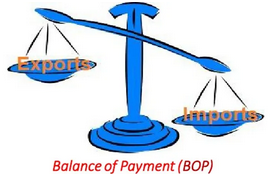
- The BOP records international payments and receipts.
- Transactions are recorded as credits or debits.
- The BOP consists of different accounts.
- Surpluses and deficits show whether more money enters or leaves the country.
Main Accounts of the Balance of Payments
The balance of payments is divided into major accounts:
- Current account
- Capital account
- Financial account
Each account records different types of international transactions.
Credit and Debit Items
Every international transaction is recorded either as a credit item or a debit item.
Credit Items
Credit items are transactions that bring money into the country. 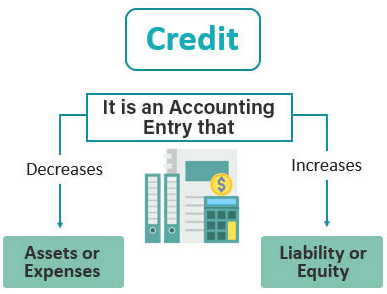
They are recorded with a positive value.
Examples of Credit Items:
- Exports of goods and services.
- Foreign tourists spending money in the country.
- Income received from investments abroad.
- Foreign direct investment entering the country.
Credits increase the inflow of foreign currency.
Debit Items
Debit items are transactions that send money out of the country.
They are recorded with a negative value.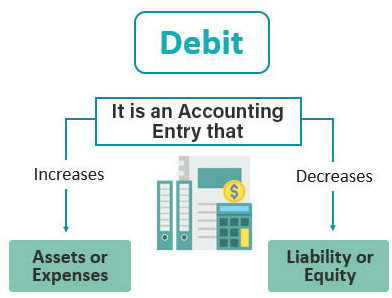
Examples of Debit Items:
- Imports of goods and services.
- Residents travelling abroad.
- Income paid to foreign investors.
- Investment abroad by domestic firms.
Debits increase the outflow of foreign currency.
Current Account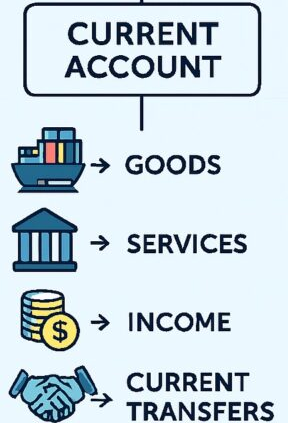
The current account records trade in goods and services, income flows, and current transfers.
Main Components:
- Trade in goods (exports and imports).
- Trade in services.
- Primary income (interest, profits, wages).
- Secondary income/transfers (foreign aid, remittances).
Surplus on the Current Account
A current account surplus occurs when credit items exceed debit items.
Exports and inflows > Imports and outflows
Possible Effects: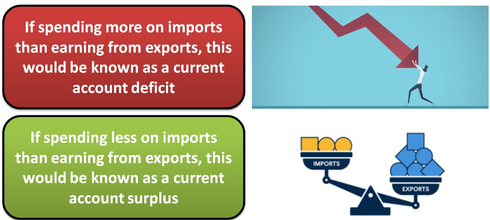
- Increase in foreign exchange reserves.
- Potential appreciation of the currency.
- Higher national income and employment.
Deficit on the Current Account
A current account deficit occurs when debit items exceed credit items.
Imports and outflows > Exports and inflows
Possible Effects:
- Increase in foreign borrowing.
- Possible depreciation of the currency.
- Pressure on foreign exchange reserves.
Capital Account
The capital account records transfers of non-produced and non-financial assets.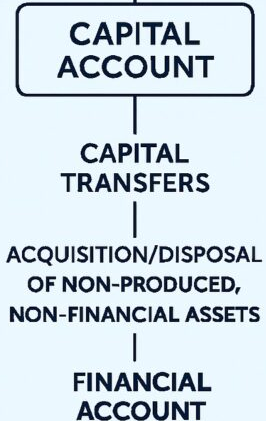
Examples:
- Debt forgiveness.
- Transfer of ownership of fixed assets.
The capital account is usually relatively small.
Financial Account
The financial account records investment flows between countries.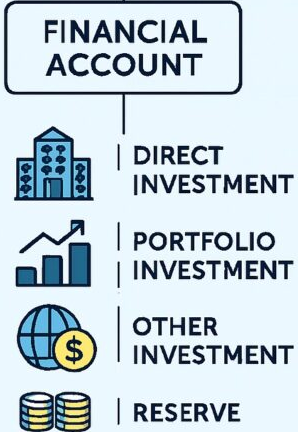
Main Components:
- Foreign direct investment (FDI).
- Portfolio investment.
- Changes in foreign exchange reserves.
- Loans and banking flows.
Financial inflows and outflows help finance current account deficits or surpluses.
Relationship Between the Accounts
In theory, the total balance of payments should balance because every transaction has two sides.
For example:
- A current account deficit may be financed by financial account inflows.
- A current account surplus may lead to financial outflows or reserve accumulation.
The accounts are therefore interconnected.
Summary of Credit and Debit Items:
| Item Type | Effect | Examples |
|---|---|---|
| Credit Item | Money enters the country | Exports, tourism receipts, inward FDI |
| Debit Item | Money leaves the country | Imports, overseas travel, outward investment |
Summary of Surplus and Deficit:
| Condition | Meaning | Possible Consequences |
|---|---|---|
| Surplus | Credits > Debits | Currency appreciation, higher reserves |
| Deficit | Debits > Credits | Currency depreciation, foreign borrowing |
Evaluation
- A current account deficit is not always harmful if financed sustainably through investment inflows.
- Persistent large deficits may create debt and currency problems.
- Current account surpluses may indicate strong export competitiveness but may also reduce domestic consumption.
- The significance of surpluses and deficits depends on economic conditions and financing methods.
Example 1
Explain why exports are recorded as credit items in the balance of payments.
▶️ Answer / Explanation
Exports involve selling goods and services to foreign buyers.
Foreign customers pay domestic firms, causing money to flow into the country.
This increases foreign currency inflows and national income.
Because exports bring money into the country, they are recorded as credit items in the balance of payments.
Example 2
Using an example, explain how a current account deficit may occur.
▶️ Answer / Explanation
A current account deficit occurs when imports and other outflows exceed exports and inflows.
For example, if a country imports large amounts of machinery, oil, and consumer goods while exporting relatively few products, import spending may exceed export earnings.
This creates a net outflow of money from the country.
As a result, debit items become larger than credit items.
Therefore, the country experiences a current account deficit.
Example 3
A country reports the following balance of payments data for one year (in billions of dollars):
| Item | Value ($ billion) |
|---|---|
| Exports of goods | 520 |
| Imports of goods | 610 |
| Exports of services | 180 |
| Imports of services | 140 |
| Income received from abroad | 75 |
| Income paid abroad | 95 |
| Current transfers received | 30 |
| Current transfers paid | 20 |
| FDI inflows | 110 |
| Portfolio investment outflows | 40 |
Calculate:
- Balance of trade in goods
- Balance of trade in services
- Net income
- Net current transfers
- Current account balance
- Financial account balance (considering only the data provided)
▶️ Answer / Explanation
Step 1: Calculate balance of trade in goods
Balance of trade in goods = Exports of goods − Imports of goods
\( \mathrm{520 – 610 = -90} \)
Balance of trade in goods = −$90 billion
The country has a trade deficit in goods.
Step 2: Calculate balance of trade in services
Balance of trade in services = Exports of services − Imports of services
\( \mathrm{180 – 140 = 40} \)
Balance of trade in services = +$40 billion
The country has a trade surplus in services.
Step 3: Calculate net income
Net income = Income received − Income paid
\( \mathrm{75 – 95 = -20} \)
Net income = −$20 billion
Step 4: Calculate net current transfers
Net current transfers = Transfers received − Transfers paid
\( \mathrm{30 – 20 = 10} \)
Net current transfers = +$10 billion
Step 5: Calculate current account balance
Current account balance =
Balance of trade in goods + Balance of trade in services + Net income + Net current transfers
\( \mathrm{-90 + 40 – 20 + 10 = -60} \)
Current account balance = −$60 billion
The country has a current account deficit.
Step 6: Calculate financial account balance
Financial account balance = FDI inflows − Portfolio investment outflows
\( \mathrm{110 – 40 = 70} \)
Financial account balance = +$70 billion
The country has a financial account surplus.
Interpretation:
The country has a persistent deficit in trade in goods, but this is partly offset by a surplus in services.
The current account deficit is financed through financial account inflows such as FDI.