
Benefits of International Trade
International trade refers to the exchange of goods and services between countries. It allows countries to specialize in the production of goods and services in which they have a comparative advantage and trade for others.
International trade plays an important role in increasing economic efficiency, improving consumer welfare, and promoting economic growth.
Key Point:
- Trade allows countries to specialize according to comparative advantage.
- Consumers benefit from lower prices and greater variety.
- Firms gain access to larger markets and higher revenues.
- Trade improves global efficiency and resource allocation.
Increased Competition
International trade increases competition because domestic firms must compete with foreign producers. This encourages firms to improve quality, reduce costs, and become more innovative. 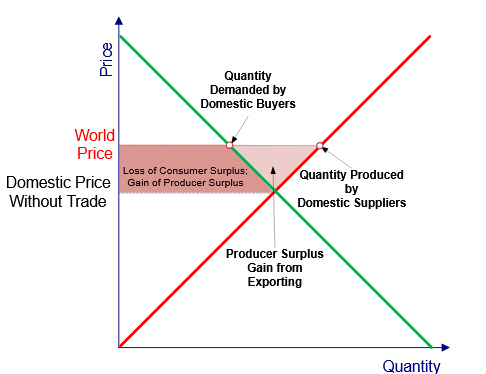
- Reduces monopoly power of domestic firms.
- Encourages innovation and efficiency.
- Improves product quality for consumers.
Lower Prices
Trade allows countries to import goods from producers with lower production costs. Increased competition and access to cheaper imports often reduce prices for consumers.
- Consumers gain higher purchasing power.
- Imports may be cheaper than domestically produced goods.
- Competition discourages excessive pricing.
Greater Choice
International trade provides consumers and firms with access to a wider variety of goods and services from around the world.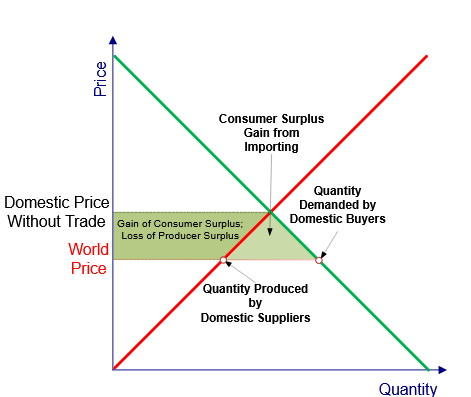
- Consumers enjoy more product diversity.
- Firms gain access to specialized inputs and technology.
- Improves consumer satisfaction and living standards.
Acquisition of Resources
Countries can obtain resources that are unavailable or limited domestically through imports.
- Includes natural resources, raw materials, labor, and technology.
- Allows production even when domestic resources are scarce.
- Supports industrial development and economic growth.
More Foreign Exchange Earnings
Exports generate foreign exchange earnings, which countries can use to pay for imports, repay debt, or build foreign reserves.
- Improves balance of payments position.
- Provides funds for development projects.
- Supports currency stability.
Access to Larger Markets
International trade allows firms to sell products beyond domestic markets, increasing potential demand and revenue.
- Increases sales opportunities for firms.
- Encourages business expansion.
- Supports employment and economic growth.
Economies of Scale
Access to larger international markets allows firms to produce on a larger scale, reducing average costs of production.
- Large-scale production improves efficiency.
- Lower average costs may reduce prices.
- Increases competitiveness of firms.
More Efficient Resource Allocation
International trade encourages countries to allocate resources toward industries where they are relatively more efficient.
- Resources move toward productive industries.
- Supports specialization based on comparative advantage.
- Increases overall economic welfare.
More Efficient Production
Exposure to international competition encourages firms to adopt better production methods and technologies.
- Improves productivity.
- Encourages technological advancement.
- Reduces waste and production inefficiencies.
Summary of Benefits of International Trade:
| Benefit | Main Economic Effect |
|---|---|
| Increased Competition | Improves efficiency and quality |
| Lower Prices | Improves consumer welfare |
| Greater Choice | Increases product variety |
| Acquisition of Resources | Provides access to scarce resources |
| Foreign Exchange Earnings | Supports imports and development |
| Access to Larger Markets | Raises sales and economic growth |
| Economies of Scale | Reduces average costs |
| Efficient Resource Allocation | Promotes specialization |
| Efficient Production | Improves productivity and innovation |
Example 1
Explain how international trade can lead to lower prices and greater consumer choice.
▶️ Answer / Explanation
International trade allows countries to import goods from foreign producers who may produce at lower costs.
This increases competition in domestic markets, forcing firms to lower prices to remain competitive.
At the same time, imports provide consumers with access to a wider variety of products from different countries.
Therefore, international trade improves consumer welfare through lower prices and greater choice.
Example 2
Using an example, explain how international trade can create economies of scale.
▶️ Answer / Explanation
International trade gives firms access to larger global markets, increasing demand for their products.
For example, a car manufacturer exporting vehicles worldwide can produce on a much larger scale than if it sold only domestically.
Large-scale production lowers average costs because fixed costs are spread over more units.
This creates economies of scale, improving efficiency and competitiveness.
Example 3 (HL)
The diagram below shows the domestic market for Good X in a small open economy that trades at the world price.
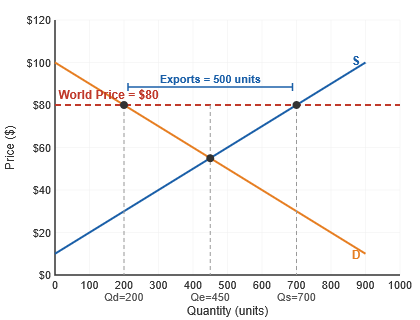
Using the diagram, calculate:
(a) The quantity of exports and quantity of imports.
(b) Export revenue earned by domestic producers.
(c) Import expenditure paid by domestic consumers.
(d) Identify whether this economy is a net exporter or net importer at the world price, and explain why.
▶️ Answer / Explanation
Reading key values from the diagram
| Variable | Value |
|---|---|
| Domestic equilibrium price (no trade) | $60 |
| World price | $80 |
| Qty supplied domestically at world price (Qs) | 700 units |
| Qty demanded domestically at world price (Qd) | 200 units |
(a) Quantity of Exports & Imports
Since the world price ($80) is above the domestic equilibrium price ($60), domestic producers supply more than consumers demand — the economy exports the surplus.
- Quantity of exports = Qs − Qd = 700 − 200 = 500 units
- Quantity of imports = 0 (this is an exporting economy at the world price)
(b) Export Revenue
Export revenue is the total value earned by domestic producers from selling goods abroad:
Export Revenue = World Price × Quantity Exported
= $80 × 500 = $40,000
This is represented on the diagram by the rectangle: world price × export quantity (the area to the right of Qd up to Qs, at the world price).
(c) Import Expenditure
Since this economy exports (Qs > Qd at the world price), there are no imports and therefore:
Import Expenditure = $0
Had the world price been below the domestic equilibrium, imports would occur and import expenditure = World Price × (Qd − Qs).
(d) Net Exporter or Net Importer?
This economy is a net exporter. Because the world price ($80) exceeds the domestic equilibrium price ($60), domestic producers are incentivised to produce more (700 units) than domestic consumers are willing to buy (300 units). The surplus of 400 units is sold on the world market. The economy earns export revenue rather than spending on imports.
Key rule: World price > domestic equilibrium price → exports. World price < domestic equilibrium price → imports.