
Changes in Demand and Supply for a Currency
In a floating exchange rate system, the value of a currency is determined by the forces of demand and supply in the foreign exchange market.
Changes in economic conditions, trade flows, investment flows, and market expectations can increase or decrease demand and supply for a currency, causing the exchange rate to change
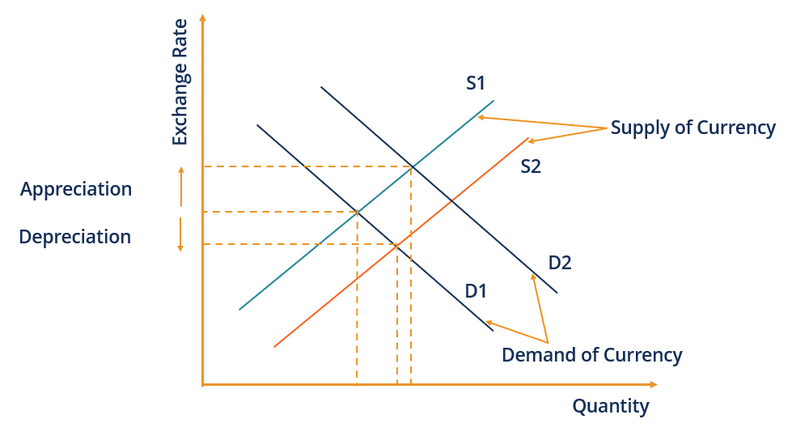
- If demand for a currency increases relative to supply, the currency tends to appreciate.
- If supply of a currency increases relative to demand, the currency tends to depreciate.
Foreign Demand for Exports
When foreign consumers buy more exports from a country, they need that country’s currency to make payments.
- Demand for the currency increases.
- The currency tends to appreciate.
- Export growth strengthens exchange rate demand.
Higher exports therefore increase demand for the domestic currency.
Domestic Demand for Imports
When domestic consumers buy more imported goods and services, they need foreign currencies to make payments.
- Supply of the domestic currency increases.
- The currency tends to depreciate.
- Import growth increases currency outflows.
Higher imports therefore increase supply of the domestic currency.
Inward Foreign Direct Investment (FDI)
Inward FDI occurs when foreign firms invest in businesses or production facilities within a country.
- Foreign investors need domestic currency.
- Demand for the currency increases.
- The currency may appreciate.
Strong investment inflows therefore strengthen the currency.
Outward Foreign Direct Investment (FDI)
Outward FDI occurs when domestic firms invest abroad.
- Domestic firms need foreign currency.
- Supply of the domestic currency increases.
- The currency may depreciate.
Capital outflows therefore weaken the domestic currency.
Inward Portfolio Investment
Portfolio investment refers to investment in financial assets such as stocks and bonds.
When foreign investors buy domestic financial assets:
- Demand for domestic currency increases.
- The currency may appreciate.
- Higher interest rates often attract portfolio investment.
Financial inflows strengthen currency demand.
Outward Portfolio Investment
When domestic investors purchase foreign financial assets:
- Supply of domestic currency increases.
- Demand for foreign currencies rises.
- The domestic currency may depreciate.
Financial outflows therefore weaken the domestic currency.
Remittances
Remittances are transfers of money by workers living abroad to people in their home country.
- Inward remittances increase demand for the domestic currency.
- Outward remittances increase supply of the domestic currency.
- Large remittance inflows may strengthen exchange rates.
Remittance flows therefore influence currency demand and supply.
Speculation
Speculators buy or sell currencies based on expectations about future exchange rate movements.
- If investors expect appreciation, demand increases.
- If investors expect depreciation, supply increases.
- Speculation may cause rapid exchange rate fluctuations.
Expectations can therefore strongly influence currency values.
Relative Inflation Rates
If a country has higher inflation than its trading partners:
- Exports become less competitive.
- Imports become relatively cheaper.
- Demand for the currency decreases.
- The currency may depreciate.
Lower inflation tends to strengthen a currency.
Relative Interest Rates
Higher interest rates usually attract foreign investment.
- Foreign investors seek higher returns.
- Demand for the currency increases.
- The currency tends to appreciate.
Lower interest rates may cause capital outflows and depreciation.
Relative Growth Rates
Economic growth affects imports, exports, and investment flows.
- Strong growth may attract investment inflows.
- However, growth may also increase imports.
- The effect on exchange rates depends on overall demand and supply changes.
Growth can therefore either strengthen or weaken a currency.
Central Bank Intervention
Central banks may intervene in foreign exchange markets to influence exchange rates.
- Buying domestic currency increases demand and supports appreciation.
- Selling domestic currency increases supply and supports depreciation.
- Central banks may use foreign exchange reserves for intervention.
Governments may intervene to stabilize exchange rates or improve trade competitiveness.
Summary of Factors Affecting Demand and Supply for a Currency:
| Factor | Main Effect on Currency |
|---|---|
| Higher Exports | Increase demand → Appreciation |
| Higher Imports | Increase supply → Depreciation |
| Inward FDI / Portfolio Investment | Increase demand → Appreciation |
| Outward Investment | Increase supply → Depreciation |
| Higher Interest Rates | Attract investment → Appreciation |
| Higher Inflation | Reduce competitiveness → Depreciation |
| Speculation | Can increase demand or supply rapidly |
| Central Bank Intervention | Influences exchange rate directly |
Example 1
Explain how higher interest rates may cause appreciation of a currency.
▶️ Answer / Explanation
Higher interest rates increase the returns available on domestic financial assets such as bonds and savings accounts.
Foreign investors may therefore move funds into the country to earn higher returns.
To invest, they must buy the domestic currency, increasing demand in the foreign exchange market.
As demand rises, the currency appreciates.
Therefore, higher interest rates may strengthen a country’s exchange rate.
Example 2
Using an example, explain how higher inflation may lead to depreciation of a currency.
▶️ Answer / Explanation
If a country experiences higher inflation than its trading partners, domestic goods become relatively more expensive.
Exports may decrease because foreign consumers switch to cheaper alternatives from other countries.
At the same time, imports may increase because foreign goods become relatively cheaper.
This decreases demand and increases supply of the domestic currency in the foreign exchange market.
As a result, the currency may depreciate.
Example 3
The exchange rate changes from: \( \mathrm{1\ USD = 75\ INR} \) to \( \mathrm{1\ USD = 80\ INR} \)
Calculate the percentage change in the value of the Indian rupee (INR).
▶️ Answer / Explanation
Step 1: Identify the original and new exchange rates.
Original rate \( \mathrm{= 75\ INR} \)
New rate \( \mathrm{= 80\ INR} \)
Step 2: Determine what happened to the currency.
The number of rupees needed to buy 1 USD increased from 75 to 80.
This means the Indian rupee depreciated.
Step 3: Use the percentage change formula.
\( \mathrm{\%\ Change = \dfrac{New\ Rate – Original\ Rate}{Original\ Rate} \times 100} \)
Step 4: Substitute the values.
\( \mathrm{\%\ Change = \dfrac{80 – 75}{75} \times 100} \)
\( \mathrm{= \dfrac{5}{75} \times 100} \)
\( \mathrm{= 6.67\%} \)
Final Answer:
The Indian rupee depreciated by approximately \( \mathrm{6.67\%} \).