
Components of the Balance of Payments
The balance of payments (BOP) records all economic transactions between residents of a country and the rest of the world over a period of time.
The BOP is divided into three major accounts:
- Current account
- Capital account
- Financial account
Each account records different types of international transactions and helps explain the flow of money into and out of a country.
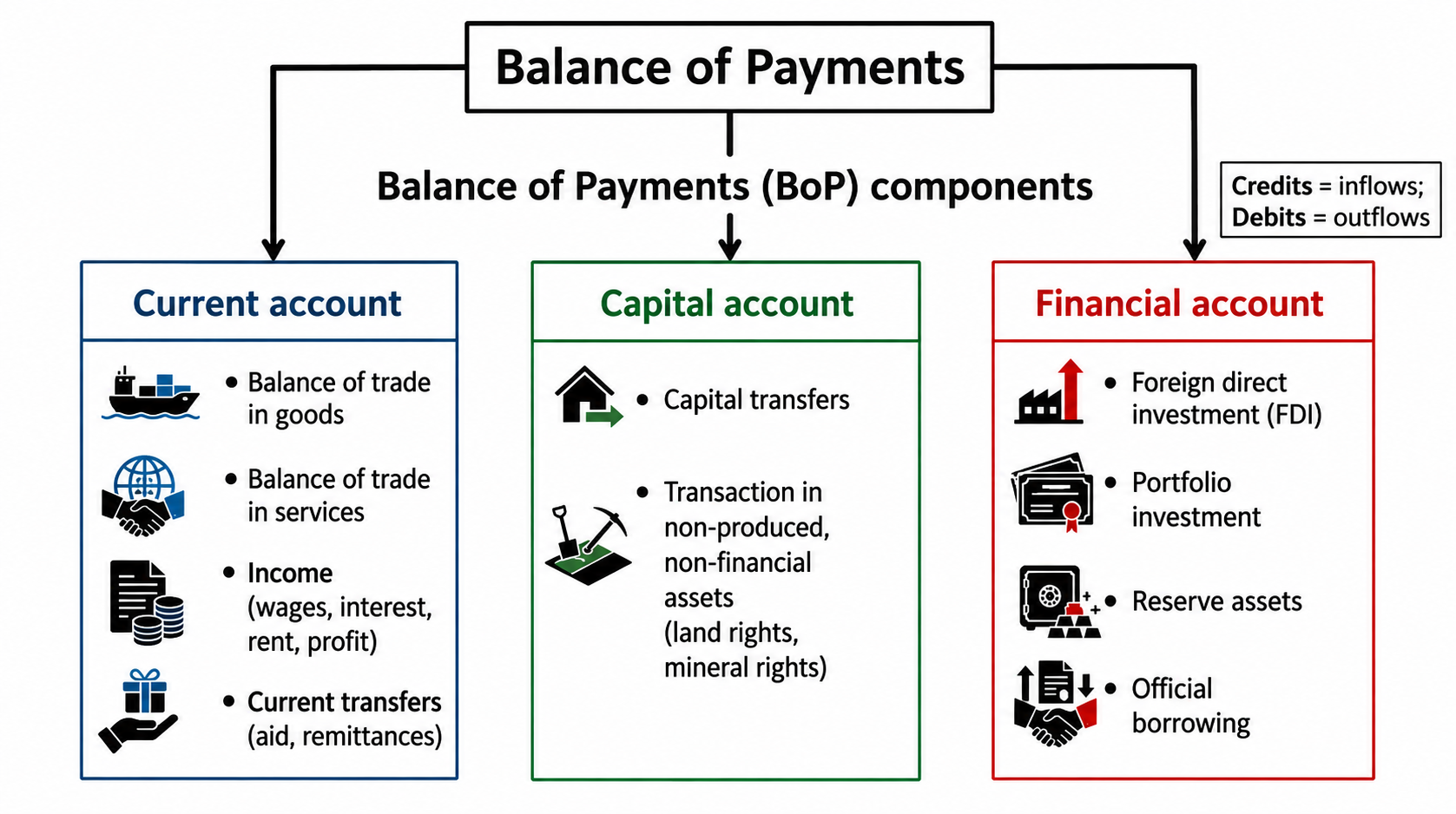
- The current account records trade and income flows.
- The capital account records transfers of assets and capital.
- The financial account records investment and financial flows.
- The accounts are interconnected and together form the balance of payments.
Current Account
The current account records transactions involving goods, services, income, and current transfers.
The current account is often considered the most important part of the balance of payments because it reflects a country’s international trade position.
Balance of Trade in Goods
This records exports and imports of physical goods.
Examples of Goods:
- Machinery
- Cars
- Food products
- Raw materials
Trade Surplus in Goods:
Exports of goods > Imports of goods
Trade Deficit in Goods:
Imports of goods > Exports of goods
Importance:
- Influences national income and employment.
- Affects exchange rates and foreign reserves.
- Reflects international competitiveness.
Balance of Trade in Services
This records exports and imports of services.
Examples of Services:
- Tourism
- Banking and financial services
- Transport services
- Insurance and consulting
Importance:
- Service exports generate foreign exchange earnings.
- Some economies depend heavily on tourism or financial services.
- Strong service sectors may improve the current account balance.
Income
The income component records income earned from factors of production.
Examples:
- Interest on investments.
- Profits from overseas businesses.
- Dividends.
- Wages earned abroad.
Credit Items:
- Income received from abroad.
Debit Items:
- Income paid to foreign investors.
Current Transfers
Current transfers involve one-way transfers where no good or service is exchanged.
Examples:
- Foreign aid.
- Remittances sent by workers abroad.
- Pensions and gifts.
Importance:
- Remittances may be important sources of income for developing countries.
- Transfers can influence living standards and consumption.
Capital Account
The capital account records transfers of capital and transactions involving non-produced, non-financial assets.
The capital account is usually much smaller than the current and financial accounts.
Capital Transfers
Capital transfers involve transfers of ownership of fixed assets or debt forgiveness.
Examples:
- Debt cancellation.
- Transfer of ownership of infrastructure assets.
- Investment grants.
Importance:
- May reduce debt burdens.
- Support development projects and investment.
Transactions in Non-Produced, Non-Financial Assets
These transactions involve intangible assets.
Examples:
- Patents
- Copyrights
- Licenses
- Brand names
These assets may generate international payments and receipts.
Financial Account
The financial account records investment flows and financial transactions between countries.
It shows how current account deficits or surpluses are financed.
Foreign Direct Investment (FDI)
FDI occurs when foreign firms invest directly in businesses or production facilities.
Examples:
- Building factories.
- Purchasing businesses abroad.
- Opening retail branches in another country.
Importance:
- Creates employment and investment.
- Transfers technology and skills.
- Increases productive capacity.
Portfolio Investment
Portfolio investment involves buying financial assets such as shares and bonds without controlling the business.
Examples:
- Foreign purchases of stocks.
- Government bond purchases.
Importance:
- Provides finance for businesses and governments.
- Increases capital inflows.
Limitation:
- Portfolio flows may be volatile and leave quickly during crises.
Reserve Assets
Reserve assets are foreign currency reserves held by the central bank.
Examples:
- Foreign currencies.
- Gold reserves.
- Special Drawing Rights (SDRs).
Importance:
- Used to influence exchange rates.
- Help finance balance of payments deficits.
- Increase confidence in the economy.
Official Borrowing
Official borrowing occurs when governments borrow from foreign governments or international organizations.
Examples:
- Loans from the IMF or World Bank.
- Foreign government loans.
Importance:
- Provides funds during financial difficulties.
- Helps finance deficits and development projects.
Limitation:
- May increase national debt and repayment burdens.
Summary of the Components of the Balance of Payments:
| Account | Main Components |
|---|---|
| Current Account | Goods, services, income, current transfers |
| Capital Account | Capital transfers, non-produced assets |
| Financial Account | FDI, portfolio investment, reserves, borrowing |
Evaluation
- A current account deficit may be sustainable if financed through productive investment inflows.
- Heavy reliance on volatile portfolio investment may create financial instability.
- Reserve assets improve economic security but may be costly to maintain.
- The balance of payments provides important information about international competitiveness and economic stability.
Example 1
Explain how foreign direct investment appears in the balance of payments.
▶️ Answer / Explanation
Foreign direct investment is recorded in the financial account of the balance of payments.
For example, if a foreign company builds a factory in a country, money flows into the domestic economy.
This is recorded as a financial account credit item.
FDI increases investment, employment, and productive capacity.
Therefore, FDI represents an inflow of financial capital into the country.
Example 2
Using an example, explain the role of current transfers in the current account.
▶️ Answer / Explanation
Current transfers involve one-way transfers where no good or service is exchanged.
For example, workers living abroad may send remittances back to their families.
These remittances increase household income and foreign currency inflows.
As a result, they are recorded as credit items in the current account.
Therefore, current transfers can improve living standards and influence the current account balance.