
Composite Indicators of Economic Development
Composite indicators combine multiple individual indicators into a single measure to provide a broader understanding of economic development and well-being. Because development is multidimensional, composite indicators include economic, social, and sometimes environmental factors rather than focusing on only one aspect such as income.
Composite indicators help compare levels of development between countries more effectively than single indicators alone.
- Composite indicators combine several measures into one index.
- They provide a broader view of development.
- Different indexes focus on different dimensions of well-being.
- Each indicator has strengths and limitations.
Human Development Index (HDI)
The Human Development Index (HDI) was created by the (UNDP).
The HDI measures development using three key dimensions of human well-being: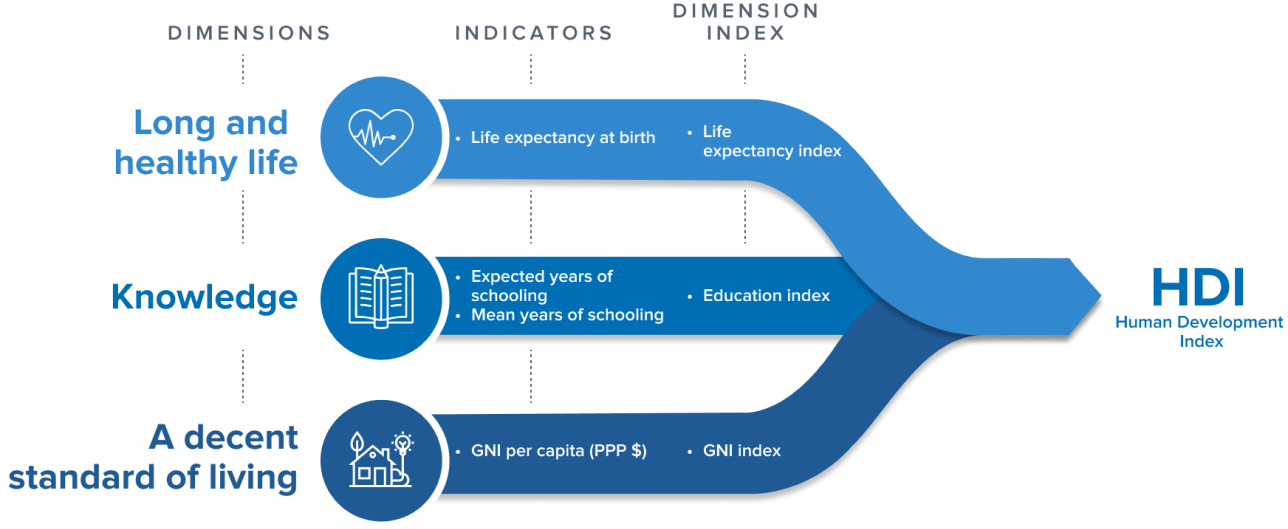
- Health measured by life expectancy.
- Education measured by years of schooling.
- Income measured by GNI per capita at PPP.
HDI combines health + education + income indicators.
Importance of HDI:
- Provides a broader measure than GDP alone.
- Measures human well-being and capabilities.
- Allows international comparisons of development.
Limitations of HDI:
- Does not fully measure inequality.
- Ignores environmental sustainability.
- Does not include political freedom or happiness.
Gender Inequality Index (GII)
The Gender Inequality Index (GII) measures gender-based inequalities within a country.
It focuses on differences between males and females in areas such as health, empowerment, and labor market participation.
Main Components of GII: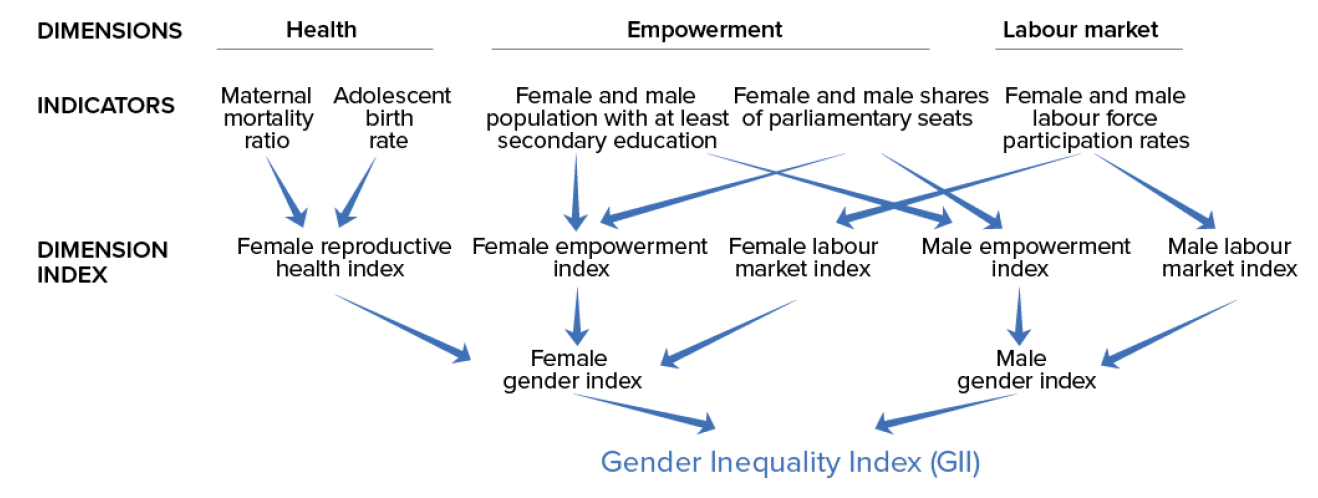
- Reproductive health.
- Educational attainment.
- Political representation.
- Labor force participation.
Importance of GII:
- Shows the extent of gender inequality.
- Highlights unequal opportunities and outcomes.
- Helps evaluate social development and inclusion.
Limitations of GII:
- Difficult to measure all forms of inequality.
- Some social and cultural differences may not be fully reflected.
- Data quality may vary between countries.
Inequality-adjusted Human Development Index (IHDI)
The Inequality-adjusted Human Development Index (IHDI) adjusts the HDI to account for inequality within a country.
While HDI measures average achievement, IHDI measures how evenly these achievements are distributed across the population.
Main Idea: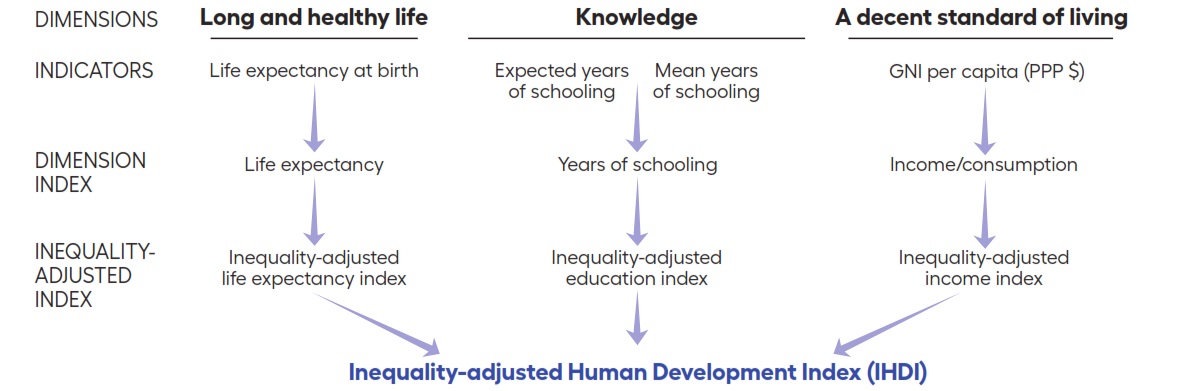
- If inequality is low, HDI and IHDI values are similar.
- If inequality is high, IHDI becomes significantly lower than HDI.
Importance of IHDI:
- Provides a more realistic measure of human development.
- Shows the impact of inequality on living standards.
- Highlights unequal access to health, education, and income.
Limitations of IHDI:
- Depends on accurate inequality data.
- Still does not include environmental sustainability fully.
- Complex to calculate and interpret.
Happy Planet Index (HPI)
The Happy Planet Index (HPI) measures sustainable well-being.
It combines measures of human well-being with environmental sustainability.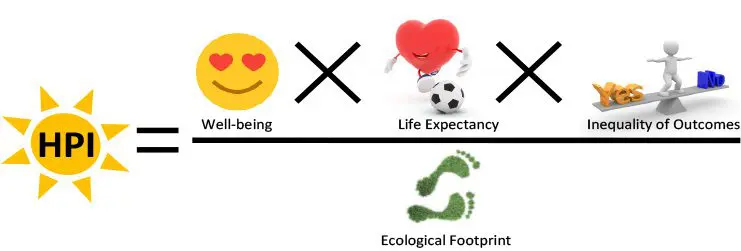
Main Components of HPI:
- Life expectancy.
- Subjective well-being (happiness).
- Ecological footprint.
The HPI focuses on how efficiently countries convert resources into long and happy lives.
Importance of HPI:
- Includes environmental sustainability.
- Measures quality of life beyond income.
- Encourages sustainable development.
Limitations of HPI:
- Happiness is subjective and difficult to measure.
- Comparisons between cultures may be difficult.
- Environmental data may vary in accuracy.
Comparison of Composite Indicators:
| Indicator | Main Focus | Main Components |
|---|---|---|
| HDI | Human development | Health, education, income |
| GII | Gender inequality | Health, empowerment, labor participation |
| IHDI | Development adjusted for inequality | HDI adjusted for unequal distribution |
| HPI | Sustainable well-being | Happiness, life expectancy, ecological footprint |
Importance of Composite Indicators
- Provide broader understanding of development.
- Recognize that development is multidimensional.
- Help governments identify development challenges.
- Allow better international comparisons.
Composite indicators therefore improve measurement of human well-being and sustainability.
Evaluation
- Composite indicators provide more complete measures than GDP alone.
- However, no single composite indicator captures every aspect of development.
- Different indicators emphasize different priorities such as inequality or sustainability.
- Economists often use several indicators together for more accurate analysis.
Example 1
Explain why the HDI is considered a better measure of development than GDP per capita alone.
▶️ Answer / Explanation
GDP per capita measures average income or output per person, but it does not show health or education conditions.
The HDI includes life expectancy, education, and income indicators.
This provides a broader understanding of human well-being and living standards.
For example, two countries with similar GDP per capita may have very different healthcare and education systems.
Therefore, the HDI is a more comprehensive measure of development than income alone.
Example 2
Using an example, explain how the IHDI differs from the HDI.
▶️ Answer / Explanation
The HDI measures average achievements in health, education, and income.
However, it does not consider how equally these achievements are distributed among the population.
The IHDI adjusts the HDI to account for inequality.
For example, a country with high average income but severe inequality may have a much lower IHDI than HDI.
Therefore, the IHDI provides a more realistic measure of actual human development.