
Consequences of Changes in the Exchange Rate on Economic Indicators
In a floating exchange rate system, the value of a currency changes according to demand and supply in the foreign exchange market.
Changes in the exchange rate affect many important economic indicators such as inflation, economic growth, unemployment, the current account balance, and living standards.
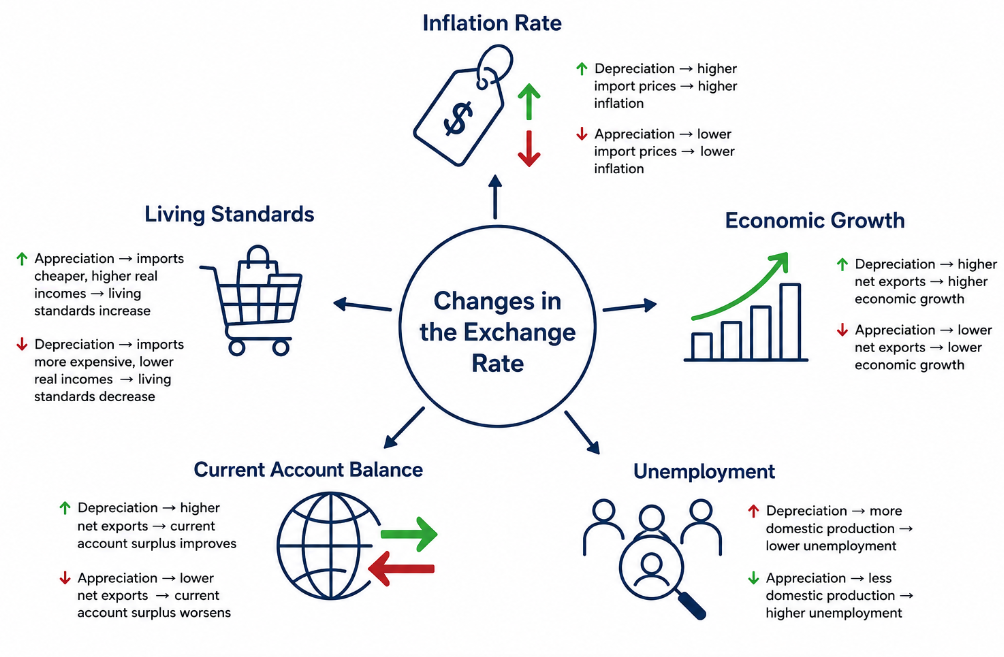
An appreciation means the currency increases in value, while a depreciation means the currency decreases in value.
- Exchange rate changes affect export and import prices.
- Changes in trade competitiveness influence economic performance.
- Appreciation and depreciation create different effects on the economy.
- The overall impact depends on the structure of the economy.
Effect on the Inflation Rate
Appreciation and Inflation
When a currency appreciates, imports become cheaper.
- Imported goods and raw materials cost less.
- Production costs may decrease.
- Inflationary pressure may fall.
Appreciation may therefore help reduce inflation.
Depreciation and Inflation
When a currency depreciates, imports become more expensive.
- Imported consumer goods become more expensive.
- Production costs may rise if firms use imported inputs.
- Cost-push inflation may increase.
Depreciation may therefore increase the inflation rate.
Effect on Economic Growth
Appreciation and Economic Growth
Appreciation makes exports more expensive and imports cheaper.
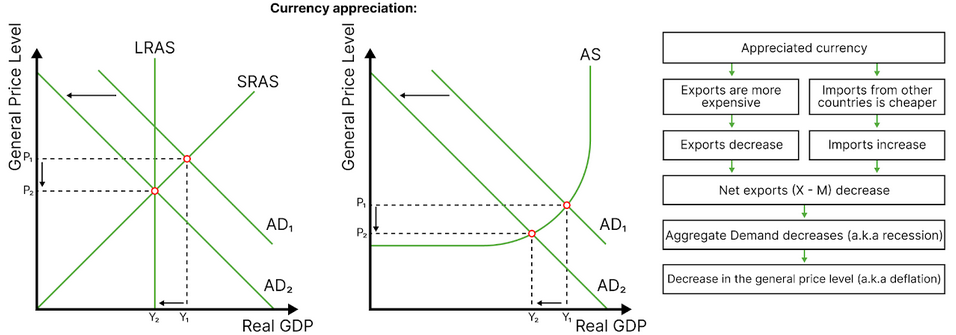
- Export demand may decrease.
- Net exports may fall.
- Aggregate demand may decrease.
This may slow economic growth.
Depreciation and Economic Growth
Depreciation makes exports cheaper and imports more expensive.
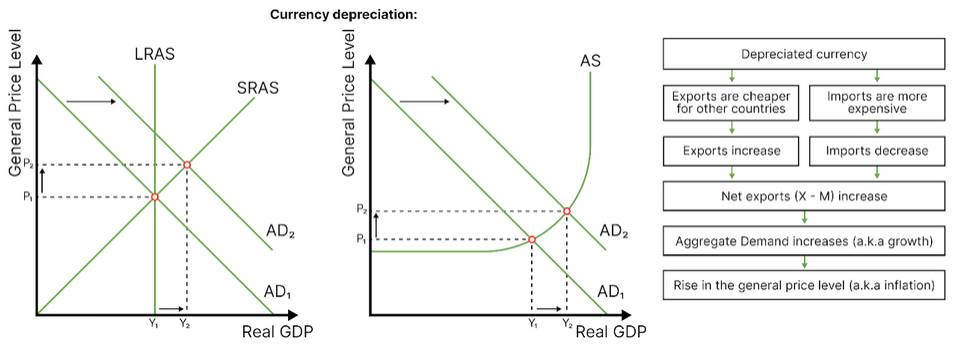
- Export demand may increase.
- Domestic consumers may switch from imports to local goods.
- Net exports and aggregate demand may increase.
This may stimulate economic growth.
Effect on Unemployment
Appreciation and Unemployment
Reduced export competitiveness may lower production in export industries.
- Firms may reduce output.
- Employment in export sectors may decrease.
- Unemployment may rise.
Appreciation may therefore negatively affect employment.
Depreciation and Unemployment
Cheaper exports may increase demand for domestic production.
- Firms may expand production.
- Employment opportunities may increase.
- Unemployment may decrease.
Depreciation may therefore improve employment levels.
Effect on the Current Account Balance
Appreciation and the Current Account
Appreciation reduces export competitiveness and encourages imports.
- Exports may decrease.
- Imports may increase.
- The current account balance may worsen.
This may increase a current account deficit.
Depreciation and the Current Account
Depreciation improves export competitiveness and discourages imports.
- Exports may increase.
- Imports may decrease.
- The current account balance may improve.
Depreciation may therefore reduce a current account deficit.
Effect on Living Standards
Appreciation and Living Standards
Cheaper imports may increase consumers’ purchasing power.
- Imported goods become more affordable.
- Consumers gain access to cheaper products.
- Inflation may decrease.
Living standards may improve in the short run.
Depreciation and Living Standards
More expensive imports may reduce purchasing power.
- Imported goods become more expensive.
- Inflation may rise.
- Real incomes may fall.
Living standards may decrease if inflation rises significantly.
Summary of Effects of Exchange Rate Changes:
| Economic Indicator | Appreciation | Depreciation |
|---|---|---|
| Inflation | May decrease | May increase |
| Economic Growth | May slow | May increase |
| Unemployment | May rise | May fall |
| Current Account Balance | May worsen | May improve |
| Living Standards | May improve | May decrease |
Evaluation
- The effects of exchange rate changes depend on the elasticity of demand for exports and imports.
- Depreciation may improve the current account only if export and import demand are sufficiently elastic.
- Appreciation benefits consumers through cheaper imports but may harm exporters.
- Exchange rate changes create both short-run and long-run effects on the economy.
Example 1
Explain how depreciation of a currency may affect inflation and unemployment.
▶️ Answer / Explanation
Depreciation makes imports more expensive, increasing the prices of imported consumer goods and raw materials.
This may increase cost-push inflation in the economy.
However, depreciation also makes exports cheaper and more competitive internationally.
Export industries may increase production and hire more workers.
Therefore, depreciation may increase inflation while reducing unemployment.
Example 2
Using an example, explain how appreciation may affect the current account balance and living standards.
▶️ Answer / Explanation
When a currency appreciates, imports become cheaper and exports become more expensive.
Consumers benefit because imported goods such as electronics and fuel become more affordable, improving purchasing power and living standards.
However, exports may decrease because foreign buyers face higher prices.
At the same time, imports may increase due to lower prices.
As a result, the current account balance may worsen despite higher living standards.