
Effectiveness of Measures to Correct a Persistent Current Account Deficit (HL only)
Governments and central banks use different policies to correct a persistent current account deficit.
However, the effectiveness of these measures varies depending on: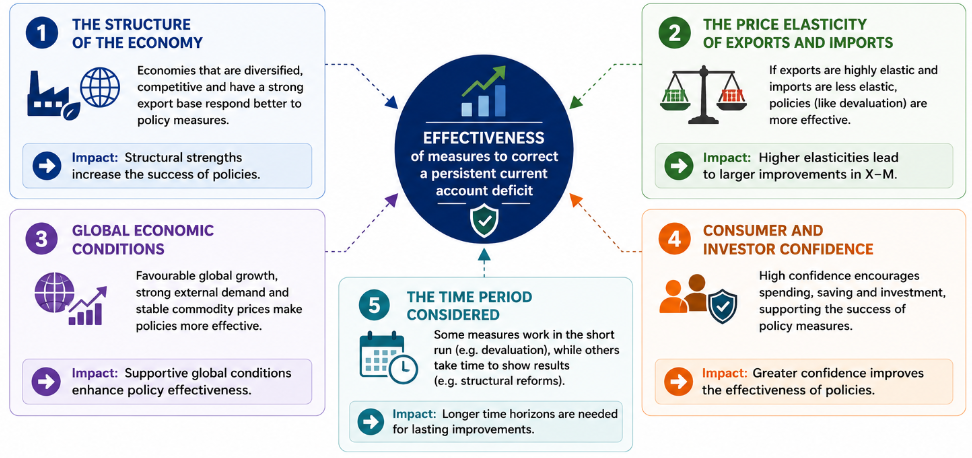
- The structure of the economy.
- The price elasticity of exports and imports.
- Global economic conditions.
- Consumer and investor confidence.
- The time period considered.
No policy guarantees success, and many measures involve trade-offs between economic growth, inflation, employment, and external stability.
- Some policies work better in the short run, while others are more effective in the long run.
- The success of policies depends on economic conditions and implementation.
- Policies may improve the current account but create other macroeconomic problems.
- Most countries use a combination of policies.
Effectiveness of Expenditure Switching Policies
Expenditure switching policies aim to shift spending away from imports toward domestic goods and services.
Currency Depreciation
Potential Effectiveness:
- Exports become cheaper and more competitive internationally.
- Imports become more expensive, reducing import demand.
- Net exports may increase.
Factors Affecting Effectiveness:
Marshall-Lerner Condition
A depreciation improves the current account only if demand for exports and imports is sufficiently price elastic.
If elastic:
- Export volumes rise significantly.
- Import volumes fall significantly.
- Current account improves.
If inelastic:
- Import spending may still remain high.
- Current account improvement may be limited.
The J-Curve Effect
In the short run, depreciation may initially worsen the current account.
Reason:
- Import prices rise immediately.
- Export and import quantities adjust slowly.
Over time, export demand may rise and import demand may fall.
Therefore:
- Short-run effectiveness may be limited.
- Long-run effectiveness may be greater.
Global Economic Conditions
If world demand is weak, exports may not increase significantly even after depreciation.
Therefore, external economic conditions influence effectiveness.
Protectionist Policies
Tariffs, quotas, and administrative barriers may reduce imports.
Potential Effectiveness:
- Import spending decreases.
- Domestic industries may expand.
Limitations:
- Retaliation from trading partners may reduce exports.
- Consumers may face higher prices and less choice.
- Domestic firms may become less efficient.
Therefore, protectionism may improve the current account in the short run but create long-term inefficiencies.
Effectiveness of Expenditure Reducing Policies
Expenditure reducing policies lower aggregate demand to reduce import spending.
Contractionary Fiscal Policy
Potential Effectiveness:
- Lower consumer spending reduces import demand.
- Inflationary pressure may decrease.
Limitations:
- Economic growth may slow.
- Unemployment may increase.
- Tax revenues may fall during recessions.
Therefore, contractionary fiscal policy may improve the current account but create recessionary effects.
Contractionary Monetary Policy
Higher interest rates reduce borrowing and spending.
Potential Effectiveness:
- Import demand may decrease.
- Inflationary pressure may fall.
- Capital inflows may increase.
Limitations:
- Higher interest rates may appreciate the currency.
- Exports may become less competitive.
- Investment and growth may decrease.
Therefore, monetary policy may have conflicting effects on the current account.
Effectiveness of Supply-Side Policies
Supply-side policies aim to improve productivity, efficiency, and international competitiveness.
Potential Effectiveness:
- Higher productivity lowers production costs.
- Exports become more competitive.
- Domestic industries may replace imports.
- Long-term export growth may increase.
Examples:
- Education and training.
- Infrastructure development.
- Technological investment.
- Labor market reforms.
Limitations of Supply-Side Policies
- Effects may take many years to occur.
- Large financial investment may be required.
- Political resistance to reforms may occur.
- Success depends on effective implementation.
However, supply-side policies are often considered the most sustainable long-term solution.
Importance of Financing the Deficit
The seriousness of a persistent current account deficit depends partly on how it is financed.
More Sustainable Financing
- Foreign direct investment (FDI).
- Long-term productive investment.
These may increase future productive capacity and exports.
Less Sustainable Financing
- Short-term borrowing.
- Volatile portfolio investment.
- Large external debt accumulation.
These may increase financial instability and vulnerability.
Comparison of Effectiveness of Different Policies:
| Policy | Main Strength | Main Limitation |
|---|---|---|
| Currency Depreciation | Improves export competitiveness | May increase inflation |
| Protectionism | Reduces imports quickly | Retaliation and inefficiency |
| Fiscal Contraction | Reduces import demand | Slower growth and higher unemployment |
| Monetary Contraction | Reduces spending and inflation | May appreciate the currency |
| Supply-Side Policies | Improves long-term competitiveness | Slow and costly to implement |
Short Run versus Long Run Effectiveness:
| Policy Type | More Effective In |
|---|---|
| Expenditure Switching | Short to medium run |
| Expenditure Reducing | Short run |
| Supply-Side Policies | Long run |
Evaluation
- No policy is perfectly effective in all situations.
- Currency depreciation may fail if demand for exports and imports is price inelastic.
- Protectionism may reduce imports but damage international trade relationships.
- Expenditure reducing policies may improve the current account but reduce economic growth and employment.
- Supply-side policies are often the most sustainable long-term solution because they improve competitiveness and productivity.
- Successful correction of persistent deficits often requires a combination of policies.
Example 1
Explain why a depreciation may not always improve a persistent current account deficit.
▶️ Answer / Explanation
A depreciation makes exports cheaper and imports more expensive.
However, the current account improves only if demand for exports and imports is sufficiently price elastic.
If import demand is price inelastic, consumers may continue buying imports despite higher prices.
Import spending may therefore remain high.
In the short run, the J-curve effect may also cause the current account to worsen initially.
Therefore, depreciation does not always successfully correct a current account deficit.
Example 2
Using an example, explain why supply-side policies may be considered an effective long-run solution to persistent current account deficits.
▶️ Answer / Explanation
Supply-side policies improve productivity and international competitiveness.
For example, investment in education and transport infrastructure may reduce production costs and improve product quality.
Domestic firms may become more competitive in international markets.
This may increase exports and reduce dependence on imports.
Unlike short-run demand-management policies, supply-side policies improve the productive capacity of the economy.
Therefore, they are often considered a more sustainable long-run solution to persistent current account deficits.