
Economic Barriers to Economic Development
Many developing countries face economic barriers that slow economic growth and limit improvements in living standards.
These barriers reduce productivity, investment, and economic opportunities, making it difficult for countries to achieve sustainable economic development. Economic barriers are often interconnected and may contribute to poverty traps and long-term underdevelopment.
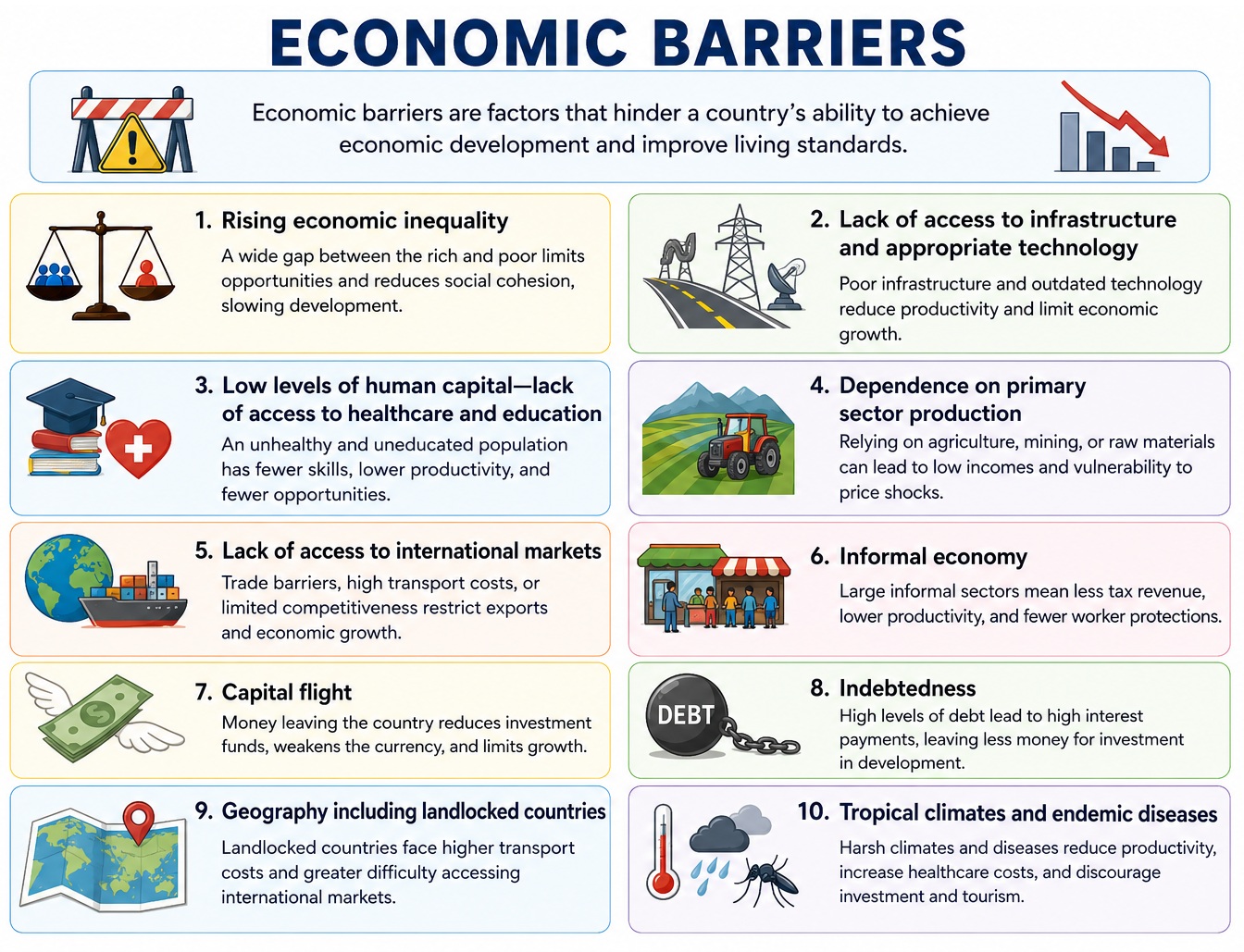
- Economic barriers reduce productivity and investment.
- Limited access to resources and opportunities slows development.
- Barriers may reinforce poverty and inequality.
- Different countries face different development challenges.
Rising Economic Inequality
Economic inequality refers to unequal distribution of income and wealth within a country.
How It Limits Development:
- Poor households may lack access to education and healthcare.
- Large inequalities may reduce social mobility.
- Poverty may persist despite economic growth.
- Social and political instability may increase.
High inequality may therefore weaken long-term development and social cohesion.
Lack of Access to Infrastructure and Appropriate Technology
Infrastructure includes transport, electricity, communication systems, and water supply.
How It Limits Development:
- Poor infrastructure increases production and transport costs.
- Firms may face unreliable electricity and weak communication networks.
- Limited technology reduces productivity and efficiency.
- Investment and industrialization may be discouraged.
Without infrastructure and technology, economic activity remains less efficient.
Low Levels of Human Capital
Human capital refers to the skills, knowledge, education, and health of the workforce.
How Low Human Capital Limits Development:
- Poor healthcare reduces labor productivity.
- Limited education lowers skill levels.
- Low productivity reduces income and growth.
- Innovation and technological progress remain limited.
Countries with weak human capital often struggle to industrialize and compete internationally.
Dependence on Primary Sector Production
Many developing countries depend heavily on agriculture or raw material exports.
How It Limits Development:
- Primary products often experience unstable prices.
- Export earnings may fluctuate significantly.
- Low value-added production limits income growth.
- Economies may remain undiversified.
Dependence on primary production therefore increases economic vulnerability.
Lack of Access to International Markets
Some countries face barriers to participating in global trade.
How It Limits Development:
- Trade barriers reduce export opportunities.
- Countries may struggle to attract foreign investment.
- Limited market access reduces economies of scale.
- Economic growth opportunities decrease.
International trade is important for growth, technology transfer, and development.
Informal Economy
The informal economy includes economic activities that are not officially recorded or regulated by the government.
How It Limits Development:
- Workers may lack legal protection and benefits.
- Governments collect less tax revenue.
- Productivity and access to finance may remain low.
- Investment and business growth may be limited.
Large informal sectors may therefore weaken economic development.
Capital Flight
Capital flight occurs when money and financial assets leave a country.
How It Limits Development:
- Domestic investment decreases.
- Economic growth slows.
- Currency depreciation may occur.
- Confidence in the economy weakens.
Capital flight reduces funds available for development and investment.
Indebtedness
Many developing countries face high levels of debt.
How It Limits Development:
- Large debt repayments reduce government spending on development.
- Interest payments may consume national income.
- Governments may need austerity policies.
- Investment in healthcare and education may decrease.
Heavy debt burdens may therefore slow economic development.
Geography Including Landlocked Countries
Geographical factors may affect economic opportunities.
Challenges Faced by Landlocked Countries:
- No direct access to sea trade routes.
- Higher transportation costs.
- Dependence on neighboring countries for trade access.
- Reduced competitiveness in international markets.
Geography can therefore increase trade and production costs.
Tropical Climates and Endemic Diseases
Some tropical regions experience environmental and health challenges.
How They Limit Development:
- Diseases such as malaria reduce labor productivity.
- Healthcare costs may increase.
- Agricultural productivity may be affected by climate conditions.
- Foreign investment may be discouraged.
Health and climate challenges therefore create additional barriers to development.
Summary of Economic Barriers to Development:
| Economic Barrier | Main Effect on Development |
|---|---|
| Economic Inequality | Limits opportunities and social mobility |
| Poor Infrastructure and Technology | Reduces productivity and investment |
| Low Human Capital | Weak labor productivity and skills |
| Primary Sector Dependence | Economic instability and low diversification |
| Limited Market Access | Reduced trade and growth opportunities |
| Informal Economy | Low tax revenue and weak regulation |
| Capital Flight | Lower domestic investment |
| Indebtedness | Reduced public spending capacity |
| Geographical Challenges | Higher transport and trade costs |
| Tropical Diseases | Lower productivity and higher health costs |
Evaluation
- Economic barriers are often interconnected and self-reinforcing.
- Some barriers can be reduced through investment, education, and infrastructure development.
- International trade and foreign investment may support development if managed effectively.
- Long-term development requires addressing both economic and social barriers simultaneously.
Example 1
Explain how dependence on primary sector production may limit economic development.
▶️ Answer / Explanation
Primary products such as agricultural goods and raw materials often experience unstable world prices.
This causes export earnings and national income to fluctuate.
Primary industries also usually create lower value-added output compared to manufacturing or services.
As a result, countries may struggle to diversify their economies and increase incomes.
Therefore, dependence on primary sector production may slow long-term economic development.
Example 2
Using an example, explain how poor infrastructure may create a barrier to development.
▶️ Answer / Explanation
Poor infrastructure increases production and transportation costs for firms.
For example, weak road networks may make it difficult for farmers to transport goods to markets.
This reduces efficiency, lowers incomes, and discourages investment.
Businesses may also face unreliable electricity and communication systems.
Therefore, poor infrastructure limits productivity and slows economic development.