
Fixed Exchange Rate
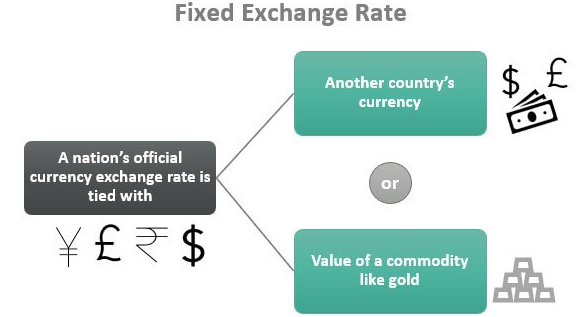
A fixed exchange rate system is a system in which a government or central bank maintains the value of its currency at a fixed level against another currency or a basket of currencies.

Unlike a floating exchange rate system, exchange rates do not change freely according to market forces. Instead, the central bank intervenes in the foreign exchange market to maintain the target exchange rate.
Key Point:
- The exchange rate is officially maintained at a fixed value.
- Central banks use foreign exchange reserves to maintain stability.
- Government intervention is necessary to keep the exchange rate fixed.
- Changes in the official exchange rate are called devaluation or revaluation.
Devaluation of a Currency
Devaluation is an official decrease in the value of a currency in a fixed exchange rate system.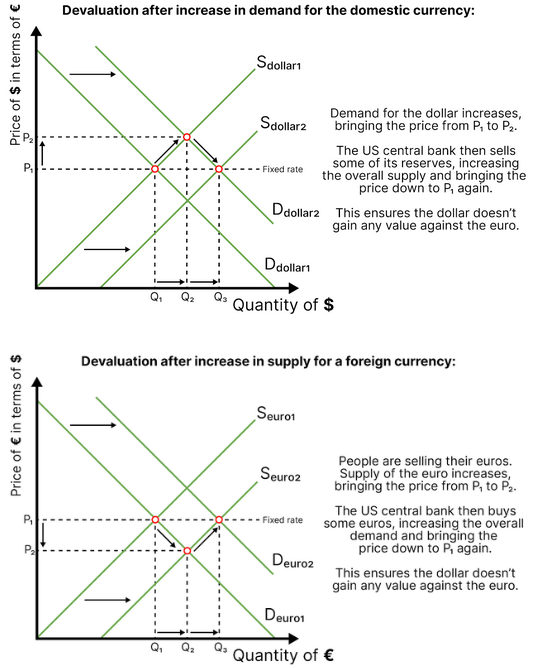
The government or central bank deliberately lowers the exchange rate relative to other currencies.
Main Reasons for Devaluation:
- Improve export competitiveness.
- Reduce imports.
- Correct a current account deficit.
- Stimulate economic growth and employment.
Effects of Devaluation:
- Exports become cheaper internationally.
- Imports become more expensive.
- Export demand may increase.
- Inflationary pressure may rise.
Devaluation → Official decrease in currency value
Revaluation of a Currency
Revaluation is an official increase in the value of a currency in a fixed exchange rate system.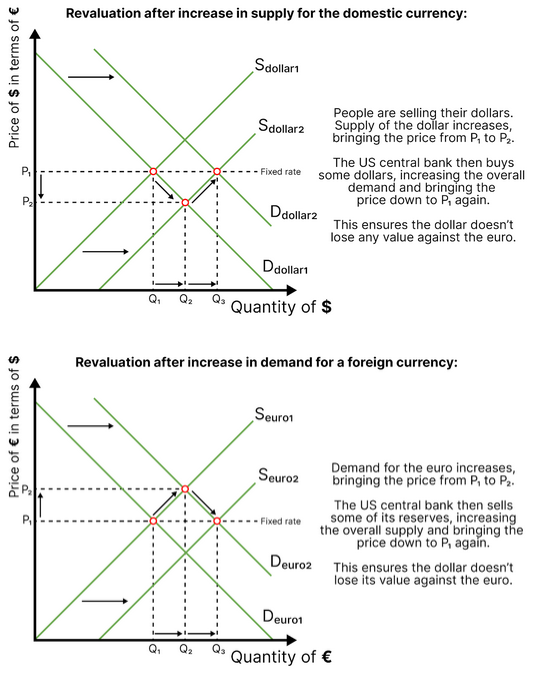
The government or central bank raises the exchange rate relative to other currencies.
Main Reasons for Revaluation:
- Reduce inflationary pressure.
- Lower import prices.
- Reduce large current account surpluses.
- Increase purchasing power.
Effects of Revaluation:
- Imports become cheaper.
- Exports become more expensive.
- Inflation may decrease.
- Export competitiveness may fall.
Revaluation → Official increase in currency value
How Fixed Exchange Rates Are Maintained
Under a fixed exchange rate system, the central bank intervenes in the foreign exchange market to maintain the target exchange rate.
Maintaining the Exchange Rate During Excess Demand
If demand for the domestic currency increases, the currency tends to appreciate.
To prevent appreciation above the fixed rate:
- The central bank sells domestic currency.
- It buys foreign currency using newly supplied domestic currency.
- This increases supply of the domestic currency.
The exchange rate is therefore pushed back toward the fixed level.
Maintaining the Exchange Rate During Excess Supply
If supply of the domestic currency increases, the currency tends to depreciate.
To prevent depreciation below the fixed rate:
- The central bank buys domestic currency.
- It sells foreign exchange reserves.
- This reduces supply of the domestic currency.
The exchange rate is therefore supported at the fixed level.
Use of Foreign Exchange Reserves
Central banks use foreign exchange reserves to maintain fixed exchange rates.
- Reserves include foreign currencies such as USD or EUR.
- These reserves are used to buy or sell domestic currency.
- Large reserves improve the ability to defend the exchange rate.
Insufficient reserves may make the fixed exchange rate difficult to maintain.
Interest Rate Changes
Governments or central banks may also adjust interest rates to influence demand for the currency.
- Higher interest rates attract foreign investment.
- Demand for the currency increases.
- This helps support the fixed exchange rate.
However, higher interest rates may slow economic growth.
Summary of Fixed Exchange Rate Concepts:
| Concept | Main Meaning |
|---|---|
| Fixed Exchange Rate | Currency value maintained at target level |
| Devaluation | Official decrease in currency value |
| Revaluation | Official increase in currency value |
| Central Bank Intervention | Buying or selling currencies to maintain rate |
| Foreign Exchange Reserves | Used to support the exchange rate |
Advantages and Disadvantages of Fixed Exchange Rates:
| Advantages | Disadvantages |
|---|---|
| Exchange rate stability | Requires large foreign exchange reserves |
| Greater certainty for trade and investment | Loss of monetary policy flexibility |
| Reduced exchange rate volatility | Difficult to maintain during crises |
| May reduce speculation | May create balance of payments problems |
Evaluation
- Fixed exchange rates provide stability and predictability for international trade.
- However, maintaining a fixed rate may require large foreign exchange reserves and continuous intervention.
- Governments may lose flexibility in monetary policy.
- Persistent pressure on the currency may eventually force devaluation or abandonment of the fixed rate.
Example 1
Explain how devaluation may help reduce a current account deficit.
▶️ Answer / Explanation
Devaluation lowers the official value of the currency in a fixed exchange rate system.
This makes exports cheaper for foreign buyers and imports more expensive for domestic consumers.
As export demand increases and imports decrease, net exports may improve.
This may help reduce a current account deficit.
Therefore, governments may use devaluation to improve trade competitiveness and the balance of payments.
Example 2
Using an example, explain how a central bank maintains a fixed exchange rate during depreciation pressure.
▶️ Answer / Explanation
If the domestic currency faces excess supply in the foreign exchange market, it tends to depreciate below the fixed exchange rate.
To maintain the fixed rate, the central bank buys domestic currency using foreign exchange reserves such as US dollars.
This reduces supply of the domestic currency and supports its value.
For example, a central bank may sell USD reserves to purchase its own currency in the market.
Therefore, central bank intervention is necessary to maintain a fixed exchange rate system.