
Fixed versus Floating Exchange Rate Systems (HL Only)
Exchange rate systems determine how the value of a currency is established relative to other currencies.
The two main exchange rate systems are:
- Fixed exchange rate system
- Floating exchange rate system
Each system has different methods of determining exchange rates and different economic advantages and disadvantages.
Key Point:
- Fixed exchange rates prioritize stability.
- Floating exchange rates prioritize market flexibility.
- Governments intervene heavily in fixed systems.
- Floating systems allow automatic market adjustment.
Fixed Exchange Rate System
In a fixed exchange rate system, the government or central bank maintains the value of the currency at a fixed level against another currency or basket of currencies.
The central bank intervenes in the foreign exchange market to maintain the target exchange rate. 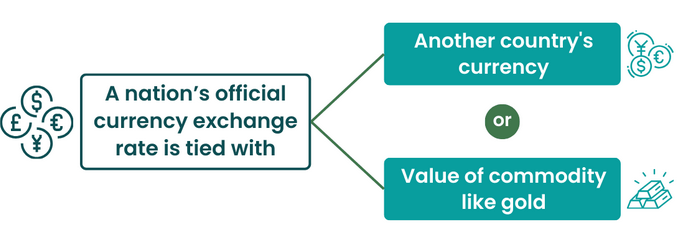
Fixed exchange rate = Officially maintained exchange rate
Main Features:
- Exchange rate stability.
- Requires government or central bank intervention.
- Uses foreign exchange reserves.
- Limited exchange rate fluctuations.
Floating Exchange Rate System
In a floating exchange rate system, the value of the currency is determined by demand and supply in the foreign exchange market.
The exchange rate changes automatically according to market conditions.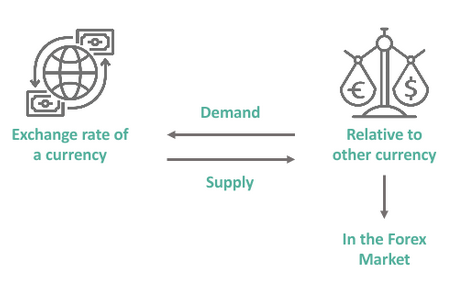
Floating exchange rate = Market-determined exchange rate
Main Features:
- Exchange rate determined by market forces.
- Minimal government intervention.
- Exchange rates fluctuate continuously.
- Automatic adjustment to economic conditions.
Comparison Between Fixed and Floating Exchange Rate Systems:
| Aspect | Fixed Exchange Rate | Floating Exchange Rate |
|---|---|---|
| Determination of Exchange Rate | Set by government or central bank | Determined by demand and supply |
| Government Intervention | High | Low |
| Exchange Rate Stability | More stable | More volatile |
| Foreign Exchange Reserves Needed | Large reserves required | Not usually required |
| Monetary Policy Flexibility | Limited | Greater flexibility |
| Automatic Balance of Payments Adjustment | Limited | Automatic through exchange rate changes |
| Business Certainty | Higher certainty | Greater uncertainty |
Advantages of Fixed Exchange Rate Systems
- Greater exchange rate stability.
- Encourages international trade and investment.
- Reduces exchange rate uncertainty.
- May reduce speculation.
Stable exchange rates improve business confidence and predictability.
Disadvantages of Fixed Exchange Rate Systems
- Requires large foreign exchange reserves.
- Loss of monetary policy independence.
- Difficult to maintain during economic crises.
- May create persistent balance of payments problems.
Governments may struggle to defend the fixed exchange rate under strong market pressure.
Advantages of Floating Exchange Rate Systems
- Automatic adjustment of exchange rates.
- Greater monetary policy flexibility.
- No need for large foreign exchange reserves.
- Can help correct current account imbalances.
Floating systems allow governments to focus more on domestic economic objectives.
Disadvantages of Floating Exchange Rate Systems
- Exchange rates may become highly volatile.
- Greater uncertainty for businesses and investors.
- Speculation may cause instability.
- Rapid exchange rate changes may affect inflation and trade.
Volatility may discourage trade and investment.
Effect on Economic Objectives
| Economic Objective | Fixed Exchange Rate | Floating Exchange Rate |
|---|---|---|
| Exchange Rate Stability | Higher | Lower |
| Monetary Policy Independence | Lower | Higher |
| Automatic Current Account Adjustment | Weaker | Stronger |
| Control of Inflation | May improve stability | Depends on exchange rate movements |
| Economic Flexibility | Lower | Higher |
Evaluation
- Fixed exchange rates provide greater stability but reduce policy flexibility.
- Floating exchange rates allow automatic adjustment but may create volatility.
- The most suitable system depends on the structure and objectives of the economy.
- Many countries use managed exchange rate systems that combine features of both systems.
Example 1
Explain why fixed exchange rate systems may require large foreign exchange reserves.
▶️ Answer / Explanation
In a fixed exchange rate system, the central bank must maintain the currency at a target exchange rate.
If the currency faces depreciation pressure, the central bank buys domestic currency using foreign exchange reserves.
This reduces supply of the domestic currency and supports its value.
Large reserves are therefore necessary to maintain confidence and defend the fixed exchange rate.
Without sufficient reserves, the fixed exchange rate may become unsustainable.
Example 2
Using an example, explain why floating exchange rates provide greater monetary policy flexibility.
▶️ Answer / Explanation
Under a floating exchange rate system, the exchange rate adjusts automatically according to market forces.
This means the central bank does not need to continuously intervene to maintain a target exchange rate.
For example, a central bank can lower interest rates during a recession to stimulate economic growth without defending a fixed exchange rate.
Although the currency may depreciate, the government retains greater control over domestic monetary policy.
Therefore, floating exchange rates provide greater policy flexibility than fixed exchange rate systems.