
Floating Exchange Rates
A floating exchange rate system is a system in which the value of a currency is determined by the forces of demand and supply in the foreign exchange market without direct government control.
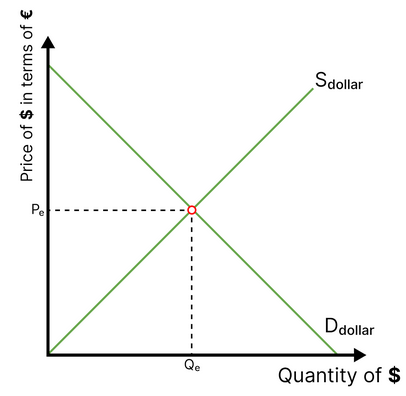
Under a floating exchange rate system, exchange rates change continuously according to market conditions.
The exchange rate may rise (appreciation) or fall (depreciation) depending on changes in demand and supply for the currency.
Floating exchange rate = Exchange rate determined by market forces
- Exchange rates are determined by demand and supply.
- No fixed official exchange rate exists.
- Currency values fluctuate continuously.
- Changes in economic conditions affect exchange rates.
Determination of Floating Exchange Rates
In a floating exchange rate system, the exchange rate is determined where the demand for a currency equals the supply of that currency in the foreign exchange market.
Demand for a Currency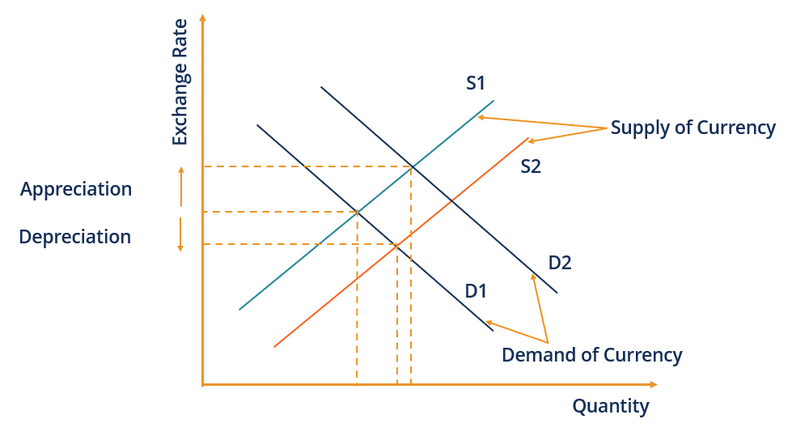
Demand for a currency comes from foreigners who wish to buy goods, services, or financial assets from a country.
Main Sources of Currency Demand:
- Exports of goods and services.
- Foreign direct investment (FDI).
- Tourism inflows.
- Demand for domestic financial assets.
When demand for a currency increases, its value tends to rise.
Supply of a Currency
Supply of a currency comes from domestic residents who wish to buy foreign goods, services, or financial assets.
Main Sources of Currency Supply:
- Imports of goods and services.
- Investment abroad.
- Tourism outflows.
- Demand for foreign financial assets.
When supply of a currency increases, its value tends to fall.
Equilibrium Exchange Rate
The equilibrium exchange rate occurs where the demand for a currency equals its supply.
If market conditions change, demand or supply shifts, causing the exchange rate to change.
Appreciation of a Currency
Appreciation occurs when the value of a currency increases relative to another currency in a floating exchange rate system.
This usually happens when demand for the currency increases or supply decreases.
Causes of Appreciation:
- Increase in exports.
- Higher interest rates attracting foreign investment.
- Economic growth and confidence.
- Increase in demand for domestic assets.
Effects of Appreciation:
- Imports become cheaper.
- Exports become more expensive.
- Inflationary pressure may decrease.
- Export competitiveness may fall.
Higher demand for currency → Appreciation
Depreciation of a Currency
Depreciation occurs when the value of a currency decreases relative to another currency in a floating exchange rate system.
This usually happens when demand for the currency decreases or supply increases.
Causes of Depreciation:
- Increase in imports.
- Lower interest rates causing capital outflows.
- Economic instability.
- Reduced foreign investment.
Effects of Depreciation:
- Exports become cheaper.
- Imports become more expensive.
- Export competitiveness may improve.
- Inflationary pressure may increase.
Higher supply of currency → Depreciation
Summary of Appreciation and Depreciation:
| Aspect | Appreciation | Depreciation |
|---|---|---|
| Meaning | Increase in currency value | Decrease in currency value |
| Main Cause | Higher demand / lower supply | Lower demand / higher supply |
| Effect on Exports | Exports become more expensive | Exports become cheaper |
| Effect on Imports | Imports become cheaper | Imports become more expensive |
| Effect on Inflation | May reduce inflation | May increase inflation |
Evaluation
- Floating exchange rates automatically adjust to changes in demand and supply.
- Exchange rate flexibility may help correct balance of payments imbalances.
- However, exchange rates may become unstable and unpredictable.
- Large fluctuations may create uncertainty for businesses and investors.
Example 1
Explain how an increase in exports may cause appreciation of a currency.
▶️ Answer / Explanation
When exports increase, foreign buyers need the domestic currency to purchase goods and services from the country.
This increases demand for the currency in the foreign exchange market.
If demand rises while supply remains unchanged, the value of the currency increases.
This increase in currency value is called appreciation.
Therefore, higher exports may lead to appreciation of a floating exchange rate.
Example 2
Using an example, explain how depreciation may affect exports and imports.
▶️ Answer / Explanation
If a currency depreciates, foreign buyers need less of their own currency to purchase exports from the country.
As a result, exports become cheaper and more competitive internationally.
At the same time, imports become more expensive for domestic consumers because more domestic currency is needed to buy foreign goods.
For example, after depreciation, imported electronics may become more expensive while domestic exports become more attractive abroad.
Therefore, depreciation may increase exports and reduce imports.
Example 3
A smartphone costs USD 800 in the United States.
The exchange rate is:
\( \mathrm{1\ USD = 83\ INR} \)
Calculate the price of the smartphone in Indian rupees (INR).
▶️ Answer / Explanation
Step 1: Write the exchange rate.
\( \mathrm{1\ USD = 83\ INR} \)
Step 2: Multiply the price in USD by the exchange rate.
\( \mathrm{800 \times 83 = 66{,}400} \)
Step 3: State the final answer.
Price of smartphone \( \mathrm{= 66{,}400\ INR} \)
Conclusion: The smartphone costs ₹66,400 in Indian currency.