
Implications of a Persistent Current Account Surplus (HL only)
A persistent current account surplus occurs when a country continuously earns more from exports and external inflows than it spends on imports and external outflows over a long period of time.
This means that the country is a net lender to the rest of the world.
A persistent surplus may reflect strong international competitiveness and high export demand, but it may also create economic imbalances.
- Persistent surpluses increase inflows of foreign currency.
- Strong export performance may increase growth and employment.
- Large surpluses may lead to currency appreciation.
- Persistent surpluses may also indicate weak domestic consumption.
Effects on Domestic Consumption and Investment
A persistent current account surplus often means that a country saves more than it spends domestically.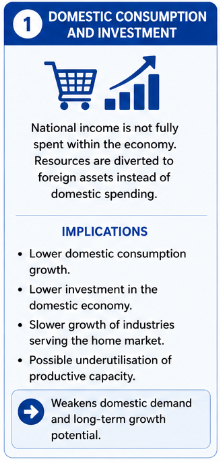
Lower Domestic Consumption
Countries with persistent surpluses may rely heavily on exports rather than domestic demand.
Possible Reasons:
- High household savings.
- Low consumer spending.
- Government policies encouraging exports.
Possible Consequences:
- Living standards may rise more slowly.
- The economy may become overly dependent on external demand.
- Domestic demand may remain weak.
Higher Overseas Investment
Countries with surpluses often invest excess savings abroad.
Possible Effects:
- Foreign assets owned by domestic residents increase.
- Future income from overseas investments may rise.
- The country becomes a net international lender.
However, domestic investment opportunities may be underutilized.
Effects on Exchange Rates
A persistent current account surplus increases demand for the domestic currency.
How It Happens:
- Foreign buyers demand domestic currency to purchase exports.
- Export earnings increase currency demand in foreign exchange markets.
Possible Result:
The currency may appreciate.
Persistent current account surplus → Currency appreciation pressure
Possible Consequences:
- Imports become cheaper.
- Export prices rise for foreign buyers.
- Export competitiveness may decrease over time.
Effects on Inflation
The effect on inflation depends on economic conditions.
Possible Inflationary Pressure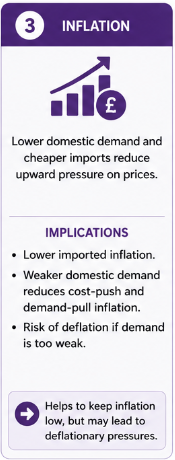
Strong export demand may increase aggregate demand and economic activity.
Possible Effects:
- Higher incomes and employment.
- Increased spending and demand-pull inflation.
Possible Reduction in Inflation
Currency appreciation may reduce inflationary pressure.
How:
- Imports become cheaper.
- Imported raw materials and consumer goods cost less.
This may reduce cost-push inflation.
Therefore, the overall effect on inflation depends on the balance between higher demand and cheaper imports.
Effects on Employment
A persistent current account surplus often reflects strong export industries.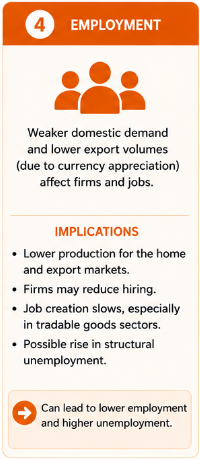
Possible Positive Effects:
- Export industries expand.
- Employment and incomes increase.
- Economic growth may rise.
Possible Negative Effects:
- Overdependence on exports may create vulnerability to global downturns.
- Employment may fall if world demand weakens.
Therefore, employment gains may depend on global economic conditions.
Effects on Export Competitiveness
A persistent current account surplus may eventually reduce export competitiveness.
Main Reason: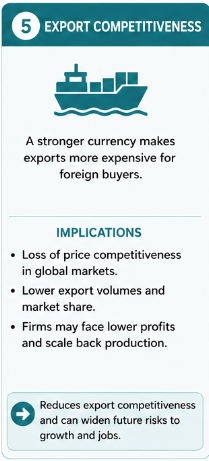
Currency appreciation makes exports more expensive for foreign buyers.
Possible Consequences:
- Export demand may decrease.
- Export growth may slow.
- Trade surplus may shrink over time.
However, countries with highly productive and high-quality industries may maintain competitiveness despite appreciation.
Importance of Productivity and Quality
Some countries remain internationally competitive despite strong currencies because of:
- High productivity.
- Strong innovation.
- Advanced technology.
- High-quality products.
Therefore, exchange rate appreciation does not always eliminate export competitiveness.
Summary of Implications of a Persistent Current Account Surplus:
| Area | Possible Implication |
|---|---|
| Domestic Consumption | May remain relatively low |
| Investment | Greater foreign investment and asset accumulation |
| Exchange Rates | Currency appreciation pressure |
| Inflation | Demand-pull inflation or lower imported inflation |
| Employment | Higher employment in export industries |
| Export Competitiveness | May weaken if currency appreciates |
Advantages and Disadvantages of a Persistent Current Account Surplus:
| Advantages | Disadvantages |
|---|---|
| Strong export earnings | Currency appreciation pressure |
| Higher employment and growth | Dependence on external demand |
| Increase in foreign assets | Lower domestic consumption |
| Greater financial stability | Possible loss of export competitiveness |
Evaluation
- A persistent current account surplus may reflect strong international competitiveness and economic strength.
- However, very large surpluses may indicate imbalances such as excessive saving and weak domestic demand.
- Currency appreciation may reduce export competitiveness over time.
- Countries highly dependent on exports may become vulnerable to global recessions.
- The impact of a surplus depends on productivity, exchange rates, and economic structure.
Example 1
Explain why a persistent current account surplus may cause currency appreciation.
▶️ Answer / Explanation
A persistent current account surplus means export earnings exceed import spending.
Foreign buyers must demand the domestic currency to purchase exports.
This increases demand for the domestic currency in foreign exchange markets.
As demand rises, the currency may appreciate.
Therefore, persistent current account surpluses create upward pressure on the exchange rate.
Example 2
Using an example, explain how a persistent current account surplus may affect export competitiveness.
▶️ Answer / Explanation
Suppose a country continuously exports more goods than it imports.
This increases demand for the country’s currency and may cause appreciation.
As the currency appreciates, exports become more expensive for foreign consumers.
Foreign demand for exports may decrease over time.
As a result, export competitiveness may weaken.
However, highly productive industries producing high-quality goods may remain competitive despite appreciation.