
Interdependence Between the Accounts in the Balance of Payments
The different accounts in the balance of payments (BOP) are closely connected and interdependent. The balance of payments records all international economic transactions between residents of a country and the rest of the world.
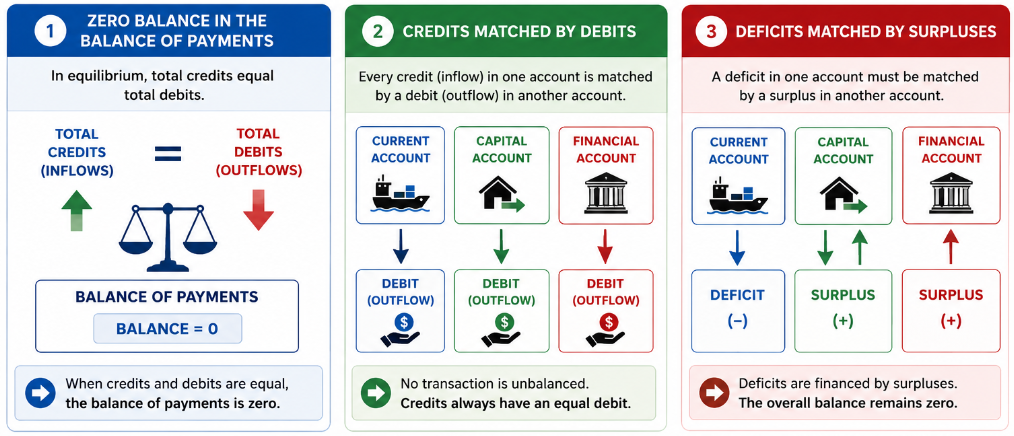
Because every transaction has two sides, the balance of payments must theoretically balance overall.
Total balance of payments = 0
- Every international transaction creates both a credit and a debit entry.
- The current, capital, and financial accounts are interconnected.
- Deficits in one account are matched by surpluses in another account.
- The balance of payments therefore balances overall in accounting terms.
Zero Balance in the Balance of Payments
The balance of payments uses a double-entry accounting system.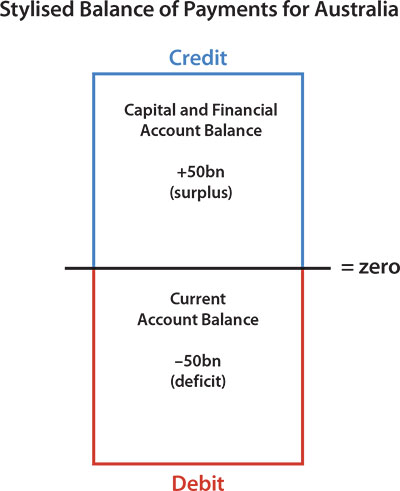
This means that every transaction is recorded twice:
- Once as a credit item.
- Once as a debit item.
As a result, the total value of credits equals the total value of debits.
Total credits = Total debits
Overall BOP balance = 0
This is why the balance of payments must theoretically balance overall.
Credits Matched by Debits
Every international transaction creates both an inflow and an outflow.
Example: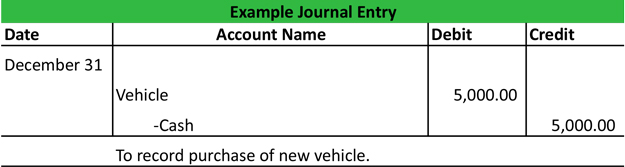
If a country exports cars worth $10 million:
- The export is recorded as a credit in the current account.
- The payment received may appear as a debit in another account, such as increased foreign assets or reserve changes.
Therefore, credits are always matched by corresponding debits.
How the Accounts Are Interdependent
The three main accounts are:
- Current account
- Capital account
- Financial account
If one account has a deficit, another account must have a surplus to balance the BOP.
Current Account Deficit and Financial Account Surplus
A country with a current account deficit spends more on imports and outflows than it earns from exports and inflows.
This deficit must be financed through financial inflows.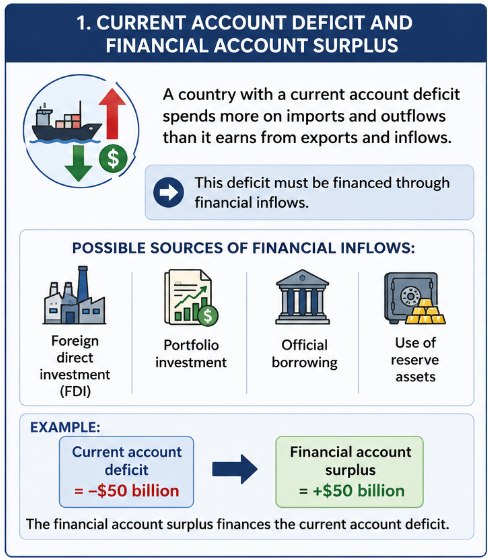
Possible Sources of Financial Inflows:
- Foreign direct investment (FDI).
- Portfolio investment.
- Official borrowing.
- Use of reserve assets.
Example:
Current account deficit = −$50 billion
Financial account surplus = +$50 billion
The financial account surplus finances the current account deficit.
Current Account Surplus and Financial Account Deficit
A country with a current account surplus earns more from exports and inflows than it spends on imports and outflows.
The surplus may be used to invest abroad or increase reserve assets.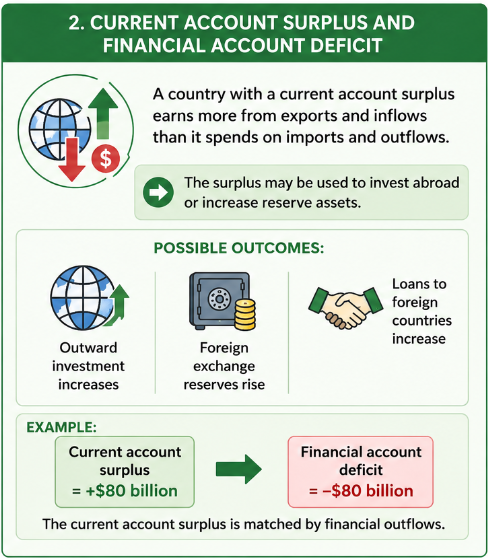
Possible Outcomes:
- Outward investment increases.
- Foreign exchange reserves rise.
- Loans to foreign countries increase.
Example:
Current account surplus = +$80 billion
Financial account deficit = −$80 billion
The current account surplus is matched by financial outflows.
Role of the Capital Account
The capital account is usually smaller than the current and financial accounts.
However, it still contributes to balancing the BOP.
Examples:
- Debt forgiveness.
- Transfer of non-produced assets.
Capital account balances help offset imbalances in the other accounts.
Importance of Interdependence Between Accounts
- Shows how trade imbalances are financed.
- Helps explain changes in exchange rates and foreign reserves.
- Reflects international confidence and investment flows.
- Shows connections between domestic and global economies.
The accounts therefore provide important information about economic stability and international competitiveness.
Summary of Interdependence Between Accounts:
| Situation | Matching Account Effect |
|---|---|
| Current Account Deficit | Financial/Capital Account Surplus |
| Current Account Surplus | Financial/Capital Account Deficit |
| Credit Entry | Matched by a Debit Entry |
| Overall BOP | Total Balance = 0 |
Example of Interdependence:
| Account | Balance |
|---|---|
| Current Account | −$30 billion |
| Capital Account | +$5 billion |
| Financial Account | +$25 billion |
| Total | $0 |
The deficit in the current account is financed by surpluses in the capital and financial accounts.
Evaluation
- Current account deficits are not always harmful if financed through productive investment inflows.
- Reliance on borrowing or volatile financial flows may create financial instability.
- Persistent surpluses or deficits may affect exchange rates and international relations.
- The balance of payments helps governments monitor economic performance and external stability.
Example 1
Explain why the balance of payments must theoretically balance overall.
▶️ Answer / Explanation
The balance of payments uses a double-entry accounting system.
Every international transaction is recorded twice: once as a credit and once as a debit.
For example, an export creates a current account credit, while the payment received creates a matching debit elsewhere in the accounts.
As a result, total credits equal total debits.
Therefore, the overall balance of payments must theoretically equal zero.
Example 2
Using an example, explain how a current account deficit may be financed.
▶️ Answer / Explanation
If a country imports more goods and services than it exports, it experiences a current account deficit.
For example, suppose the current account deficit is $40 billion.
This deficit may be financed by financial account inflows such as foreign direct investment or portfolio investment.
If foreign firms invest $40 billion in factories and businesses, the financial account records a surplus of $40 billion.
Therefore, the financial account surplus offsets the current account deficit, helping the balance of payments balance overall.