
Limitations of the Theory of Comparative Advantage (HL Only)
The theory of comparative advantage explains that countries should specialize in producing goods with lower opportunity costs and trade with others to achieve gains from trade. Although the theory provides an important basis for international trade, it has several limitations when applied to the real world.
The assumptions of the theory are often unrealistic, and actual trade patterns are influenced by many economic, political, and social factors.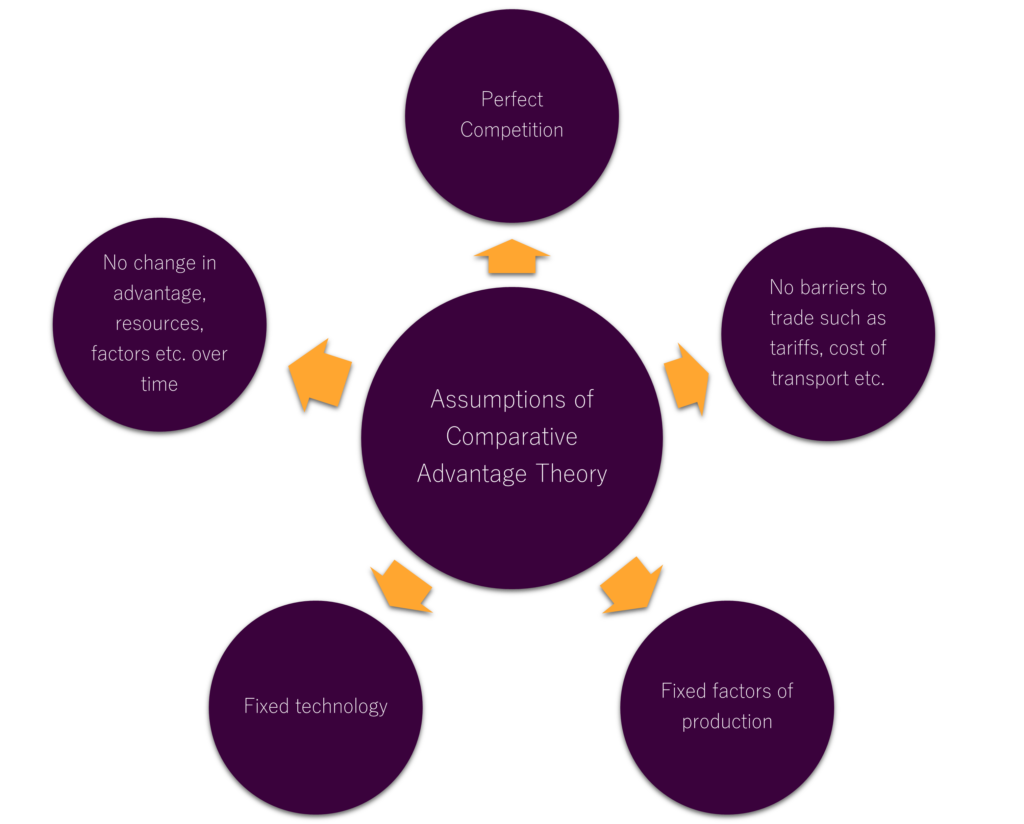
- The theory is based on simplified assumptions that may not reflect real economies.
- Specialization may create economic risks and dependency.
- Transport costs and trade barriers reduce gains from trade.
- Comparative advantage can change over time.
Unrealistic Assumptions
The theory assumes conditions that rarely exist in reality.
- Assumes only two countries and two goods.
- Assumes no transport costs.
- Assumes perfect mobility of resources within countries.
- Assumes constant opportunity costs and full employment.
In reality, economies are much more complex, making the theory less accurate in practical situations.
Transport Costs
International trade often involves significant transportation and shipping costs.
- High transport costs may eliminate cost advantages.
- Countries located far from markets may lose competitiveness.
- Perishable goods may be difficult or expensive to trade internationally.
As a result, trade may not always be beneficial even when comparative advantage exists.
Trade Protection
Governments often impose tariffs, quotas, and other trade barriers to protect domestic industries.
- Protection reduces free trade.
- Limits specialization based on comparative advantage.
- Can distort global resource allocation.
Political decisions therefore affect trade patterns beyond comparative advantage.
Changing Comparative Advantage
Comparative advantage is not fixed and may change over time.
- Technology and education can improve productivity.
- Resource availability may change.
- Economic development can shift production patterns.
A country specializing in one product today may lose its advantage in the future.
Over-specialization
Excessive specialization may create economic dependence on a narrow range of exports.
- Countries become vulnerable to price fluctuations.
- Demand shocks can severely affect export revenues.
- Economic diversification may be reduced.
For example, countries heavily dependent on oil exports face risks when oil prices fall.
Unequal Distribution of Gains
The gains from trade may not be distributed equally between countries or within societies.
- Developed countries may gain more than developing countries.
- Some industries and workers may lose jobs due to imports.
- Income inequality may increase.
Therefore, trade may create winners and losers.
Environmental Costs
The theory does not consider environmental consequences of specialization and increased production.
- Specialization may increase pollution and resource depletion.
- Transport contributes to carbon emissions.
- Long-term sustainability may be ignored.
This may reduce overall economic well-being despite gains from trade.
Summary of Limitations:
| Limitation | Main Problem |
|---|---|
| Unrealistic Assumptions | Theory oversimplifies real economies. |
| Transport Costs | Trade may become expensive. |
| Trade Protection | Tariffs and quotas restrict trade. |
| Changing Comparative Advantage | Advantages may not remain permanent. |
| Over-specialization | Creates dependence on limited exports. |
| Unequal Gains | Benefits may not be shared equally. |
| Environmental Costs | Ignores sustainability issues. |
Example 1
Explain why transport costs may limit the benefits of comparative advantage.
▶️ Answer / Explanation
The theory of comparative advantage assumes that transport costs do not exist. However, in reality, transporting goods internationally can be expensive.
For example, a country may produce agricultural products at lower opportunity cost, but high shipping costs may make exports more expensive than domestically produced alternatives.
This reduces the gains from trade and may make specialization less beneficial.
Therefore, transport costs can limit the practical application of comparative advantage.
Example 2
Using an example, explain how over-specialization can create economic risks.
▶️ Answer / Explanation
Comparative advantage encourages countries to specialize in goods with lower opportunity costs. However, excessive specialization can make economies dependent on a narrow range of exports.
For example, an economy heavily dependent on oil exports may experience severe economic problems if global oil prices fall.
Lower export revenues may reduce government income, increase unemployment, and slow economic growth.
This demonstrates that over-specialization can increase economic vulnerability and instability.