
Managed Exchange Rates
A managed exchange rate system is an exchange rate system in which the value of a currency is mainly determined by market forces, but the government or central bank occasionally intervenes to influence or stabilize the exchange rate.
This system combines features of both floating and fixed exchange rate systems.
Exchange rates are allowed to fluctuate within the foreign exchange market, but authorities may buy or sell currencies to prevent excessive appreciation or depreciation.
Managed exchange rate = Market-determined exchange rate with government intervention
Why Governments Manage Exchange Rates
- Reduce excessive exchange rate volatility.
- Protect export competitiveness.
- Control inflationary pressure.
- Improve balance of payments performance.
- Increase confidence in the economy.
Central banks usually intervene using foreign exchange reserves or interest rate adjustments.
Overvalued Currencies
An overvalued currency exists when the exchange rate is maintained at a value higher than its market equilibrium level.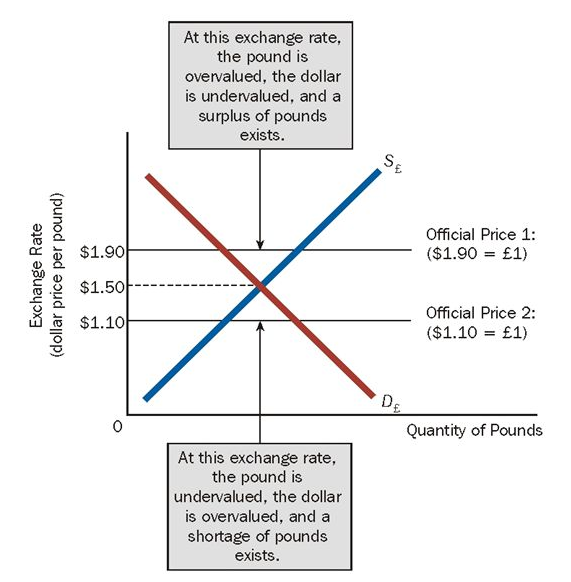
In other words, the currency is artificially too strong relative to demand and supply conditions.
Causes of Overvaluation:
- Government or central bank intervention supporting the currency.
- High interest rates attracting foreign capital.
- Policies aimed at controlling inflation.
Effects of an Overvalued Currency
Effects on Exports and Imports
- Exports become more expensive internationally.
- Export competitiveness decreases.
- Imports become cheaper.
- Import demand increases.
Effects on the Economy
- Current account deficits may increase.
- Domestic industries may struggle against cheaper imports.
- Unemployment in export industries may rise.
- Inflationary pressure may decrease due to cheaper imports.
Overvalued currency → Stronger currency than market equilibrium
Undervalued Currencies
An undervalued currency exists when the exchange rate is maintained below its market equilibrium value.
The currency is therefore artificially weaker than it would be under free market conditions.
Causes of Undervaluation:
- Central bank intervention to weaken the currency.
- Policies aimed at increasing exports.
- Accumulation of foreign exchange reserves.
Effects of an Undervalued Currency
Effects on Exports and Imports
- Exports become cheaper internationally.
- Export competitiveness increases.
- Imports become more expensive.
- Import demand decreases.
Effects on the Economy
- Current account balance may improve.
- Economic growth and employment may increase.
- Inflationary pressure may rise due to expensive imports.
- Consumers face higher prices for imported goods.
Undervalued currency → Weaker currency than market equilibrium
How Managed Exchange Rates Are Maintained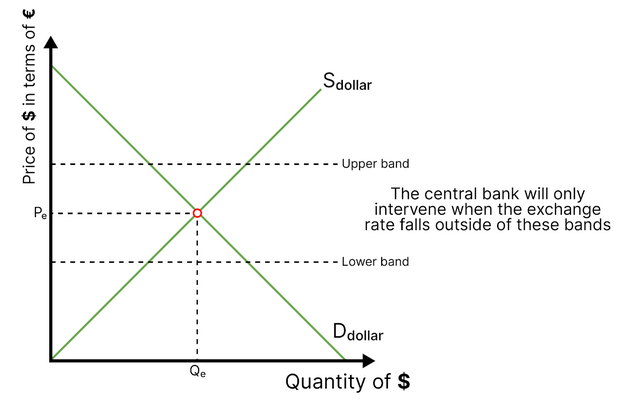
Central banks manage exchange rates through intervention in foreign exchange markets.
- Buying domestic currency increases demand and supports appreciation.
- Selling domestic currency increases supply and encourages depreciation.
- Interest rate changes may influence capital flows and exchange rates.
- Foreign exchange reserves are often used for intervention.
Governments may intervene to maintain economic stability or improve competitiveness.
Summary of Overvalued and Undervalued Currencies:
| Aspect | Overvalued Currency | Undervalued Currency |
|---|---|---|
| Currency Value | Above market equilibrium | Below market equilibrium |
| Exports | More expensive | Cheaper |
| Imports | Cheaper | More expensive |
| Current Account | May worsen | May improve |
| Inflation | May decrease | May increase |
| Employment | May decrease in export industries | May increase in export industries |
Advantages and Disadvantages of Managed Exchange Rates:
| Advantages | Disadvantages |
|---|---|
| Reduces excessive volatility | Requires foreign exchange reserves |
| Allows some policy flexibility | Government intervention may distort markets |
| May improve competitiveness | Can create trade tensions |
| Supports economic stability | Difficult to maintain long term |
Evaluation
- Managed exchange rates provide greater flexibility than fixed exchange rates.
- Governments can intervene to reduce excessive fluctuations and support economic goals.
- Persistent overvaluation or undervaluation may distort trade and investment decisions.
- Long-term intervention may become costly and difficult to sustain.
Example 1
Explain how an undervalued currency may improve economic growth.
▶️ Answer / Explanation
An undervalued currency makes exports cheaper and more competitive internationally.
Foreign demand for exports may therefore increase.
Domestic firms may increase production to meet higher export demand.
This may create more employment and increase national income.
Therefore, an undervalued currency may stimulate economic growth through higher net exports.
Example 2
Using an example, explain one disadvantage of an overvalued currency.
▶️ Answer / Explanation
An overvalued currency makes exports more expensive for foreign buyers.
For example, domestic car exports may become less competitive compared to foreign producers.
Export demand may decrease, reducing production and employment in export industries.
At the same time, cheaper imports may increase competition for domestic firms.
Therefore, an overvalued currency may worsen the current account balance and increase unemployment.