
Monetary Union
A monetary union is a form of economic integration in which member countries share a common currency or permanently fix their exchange rates under a unified monetary system.
Member countries in a monetary union usually share a common central bank that controls monetary policy, including interest rates and money supply.
A monetary union represents a deeper level of economic integration than a common market.
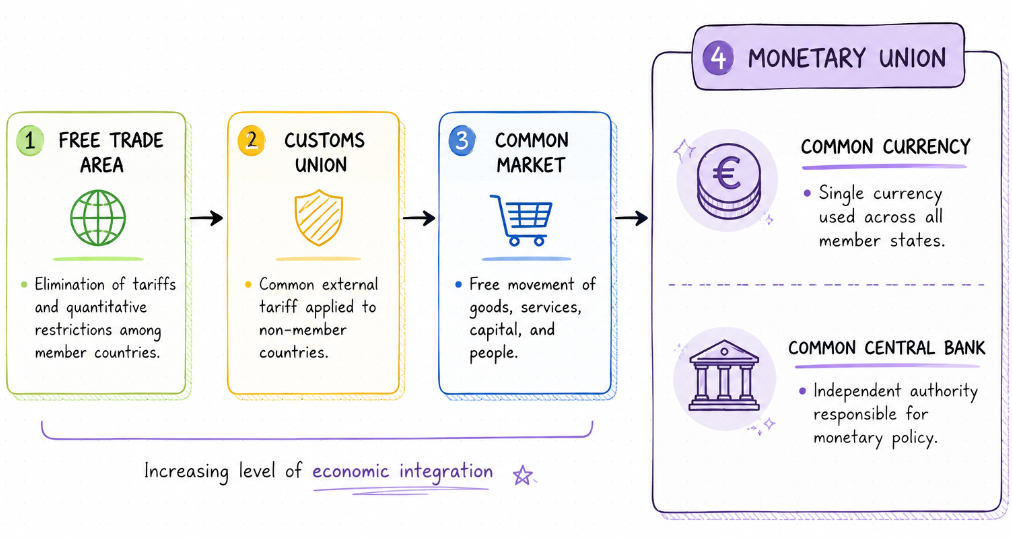
Main Features of a Monetary Union:
- Use of a common currency or permanently fixed exchange rates.
- Shared monetary policy.
- Common central banking authority.
- Closer economic and financial integration.
Monetary Union = Shared currency + Shared monetary policy
Example:
- Eurozone (European Monetary Union): 20 of 27 EU member states use the euro as their common currency, managed by a central bank.
- Eastern Caribbean Currency Union (ECCU): A group of Caribbean nations (e.g., Saint Lucia, Antigua) that share the Eastern Caribbean dollar.
Key Point:
- Monetary unions reduce exchange rate uncertainty.
- Member countries lose control over independent monetary policy.
- Economic integration and interdependence increase.
- Economic shocks may affect all members more strongly.
Evaluation
- The success of a monetary union depends on how similar member economies are.
- Countries with similar inflation, growth, and unemployment rates may benefit more.
- Labor mobility and fiscal coordination are important for stability.
- Monetary unions create both economic opportunities and policy challenges.
Example 1
Explain how a monetary union may increase trade between member countries.
▶️ Answer / Explanation
In a monetary union, member countries use a common currency or fixed exchange rates.
This removes exchange rate uncertainty and reduces currency conversion costs.
Businesses can trade more easily because prices and revenues become more predictable.
Consumers can also compare prices more easily across countries.
Therefore, monetary unions may increase trade and economic integration between member countries.
Example 2
Using an example, explain why countries in a monetary union may face difficulties during economic crises.
▶️ Answer / Explanation
Countries in a monetary union cannot independently control interest rates or exchange rates.
For example, if one country experiences recession while others experience inflation, the common central bank may set policies that do not suit all members equally.
The country in recession cannot devalue its currency or independently lower interest rates to stimulate the economy.
This limits policy flexibility and may worsen economic difficulties.
Therefore, monetary unions may create challenges when member economies face different economic conditions.
Advantages and Disadvantages of Monetary Union (HL Only)
A monetary union is a form of economic integration in which member countries share a common currency or permanently fix exchange rates under a unified monetary system.
Member countries usually share a common central bank responsible for monetary policy, including interest rates and money supply. Monetary unions can increase trade and economic integration, but they also reduce national policy independence and may create economic challenges during crises.
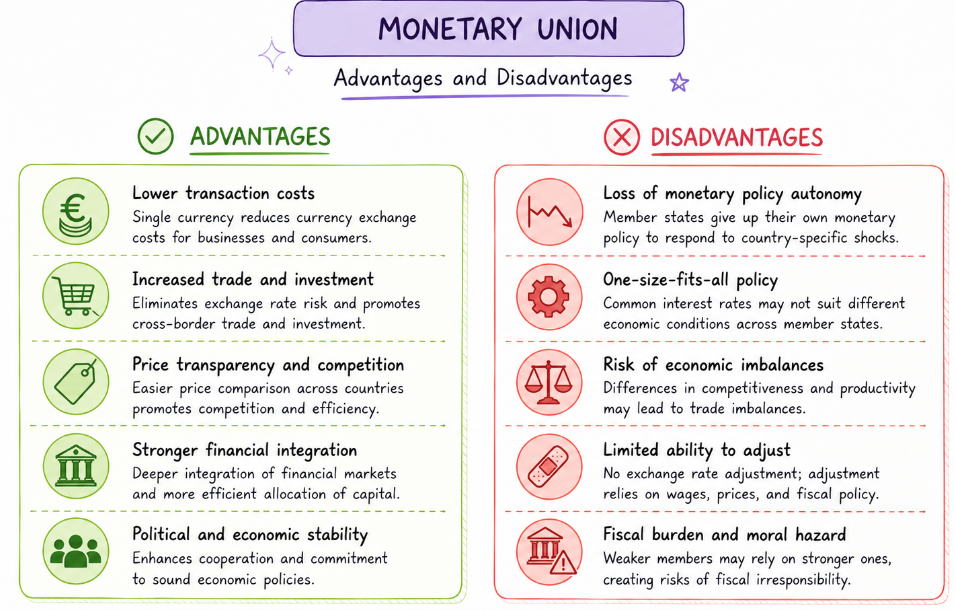
Advantages of Monetary Union
Reduced Exchange Rate Uncertainty
Member countries no longer face fluctuations in exchange rates when trading with each other.
- Trade and investment become more predictable.
- Businesses face lower currency risk.
- Long-term planning becomes easier.
This encourages international trade and economic stability within the union.
Lower Transaction Costs
A common currency removes the need for currency conversion between member countries.
- Businesses and tourists save money on exchange fees.
- Cross-border trade becomes easier and cheaper.
- Financial transactions become more efficient.
Lower costs encourage greater economic activity.
Greater Price Transparency
Using the same currency makes price comparisons easier across member countries.
- Consumers can compare prices directly.
- Competition between firms increases.
- Firms face pressure to remain competitive.
This may help lower prices and improve allocative efficiency.
Increased Trade and Investment
Stable monetary conditions encourage trade and investment within the union.
- Investors face lower uncertainty.
- Cross-border investment increases.
- Trade volumes may expand.
- Economic growth may improve.
Monetary integration strengthens economic interdependence between countries.
Stronger Economic and Political Cooperation
Monetary unions encourage member countries to coordinate economic policies more closely.
- Regional cooperation may increase.
- Political relationships may strengthen.
- Economic stability may improve over time.
Deeper integration may reduce political conflict between member states.
Disadvantages of Monetary Union
Loss of Independent Monetary Policy
Member countries cannot independently control interest rates or money supply.
- Countries lose monetary policy flexibility.
- Policies may not suit all economies equally.
- Governments cannot independently respond to domestic economic conditions.
This is one of the most important disadvantages of monetary unions.
Difficulty Responding to Asymmetric Economic Shocks
An asymmetric shock occurs when one member country experiences different economic conditions from others.
- One monetary policy may not suit all countries.
- Countries cannot devalue their currency to restore competitiveness.
- Unemployment and recession may worsen in weaker economies.
Economic adjustment may therefore become slower and more difficult.
Loss of Sovereignty
Member countries transfer monetary authority to a common central institution.
- National governments lose policy independence.
- Economic decisions may be influenced by stronger economies.
- Political tensions may arise over policy decisions.
Some countries may view this as a reduction in national control.
Risk of Economic Contagion
Economic problems in one member country may spread to other countries within the union.
- Financial crises may affect the entire union.
- Weak economies may create instability.
- Member countries may need to support weaker economies financially.
Greater economic integration increases shared economic risks.
Fiscal Constraints
Monetary unions often require countries to follow strict fiscal rules.
- Governments may face limits on budget deficits and borrowing.
- Fiscal policy flexibility may decrease.
- Public spending decisions may become restricted.
This may limit governments’ ability to stimulate the economy during recessions.
Summary of Advantages and Disadvantages:
| Advantages | Disadvantages |
|---|---|
| Reduced exchange rate uncertainty | Loss of independent monetary policy |
| Lower transaction costs | Difficulty responding to asymmetric shocks |
| Greater price transparency | Loss of sovereignty |
| Increased trade and investment | Risk of economic contagion |
| Greater political cooperation | Fiscal constraints |
Evaluation
- The success of a monetary union depends on how similar member economies are.
- Countries with similar inflation, unemployment, and growth rates may benefit more.
- Labor mobility and fiscal coordination improve stability within the union.
- Monetary unions increase integration but reduce policy flexibility.
Example 1
Explain how a monetary union may increase economic efficiency.
▶️ Answer / Explanation
In a monetary union, countries share a common currency, eliminating exchange rate fluctuations between member states.
This reduces transaction costs and exchange rate uncertainty for firms and consumers.
Businesses can therefore trade and invest more confidently across member countries.
Greater competition and larger integrated markets may improve allocative efficiency and economic growth.
Therefore, monetary unions may increase economic efficiency through deeper economic integration.
Example 2
Using an example, explain why asymmetric shocks create problems in a monetary union.
▶️ Answer / Explanation
An asymmetric shock occurs when one member country experiences economic conditions different from the rest of the monetary union.
For example, one country may experience recession while others experience economic growth and inflation.
The common central bank sets one interest rate for all members, which may not suit every country equally.
The country in recession cannot independently lower interest rates or devalue its currency to stimulate the economy.
Therefore, asymmetric shocks make economic adjustment more difficult within a monetary union.