
Political and Social Barriers to Economic Development
In addition to economic barriers, many countries face political and social barriers that limit economic development and improvements in living standards.
Weak institutions, corruption, inequality, and poor governance can reduce investment, lower productivity, and weaken confidence in the economy. Political and social barriers often reinforce poverty and slow long-term development.
- Strong institutions are important for economic development.
- Corruption and poor governance reduce efficiency and investment.
- Social inequality may limit opportunities and productivity.
- Political instability and unequal power weaken development outcomes.
Weak Institutional Framework
An institutional framework refers to the legal, financial, and administrative systems that support economic activity.
Strong institutions encourage investment, trade, and economic stability, while weak institutions create uncertainty and inefficiency.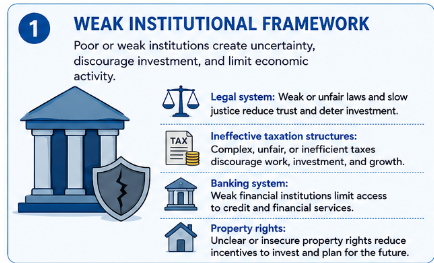
Weak Legal System
A weak legal system may fail to enforce laws and contracts effectively.
How It Limits Development:
- Businesses may lack confidence to invest.
- Contract disputes may be difficult to resolve.
- Corruption and crime may increase.
- Economic uncertainty discourages entrepreneurship.
A reliable legal system is important for stable economic activity.
Ineffective Taxation Structures
Some countries have weak or inefficient taxation systems.
How It Limits Development:
- Governments collect insufficient tax revenue.
- Public services such as healthcare and education remain underfunded.
- Tax evasion and informality may increase.
- Infrastructure investment may remain low.
Weak taxation systems reduce the government’s ability to support development.
Weak Banking System
A weak banking and financial system limits access to finance.
How It Limits Development:
- Firms may struggle to obtain loans for investment.
- Savings may not be efficiently allocated.
- Entrepreneurship and business expansion may slow.
- Financial instability may increase.
Efficient financial systems are important for investment and economic growth.
Weak Property Rights
Property rights refer to legal protection of ownership of land, businesses, and assets.
How Weak Property Rights Limit Development:
- Investors may fear losing assets or profits.
- Entrepreneurship and investment may decrease.
- Access to credit may become difficult if assets cannot be used as collateral.
- Economic uncertainty may increase.
Secure property rights encourage long-term investment and economic activity.
Gender Inequality
Gender inequality occurs when women and men have unequal access to opportunities, resources, education, employment, and political power.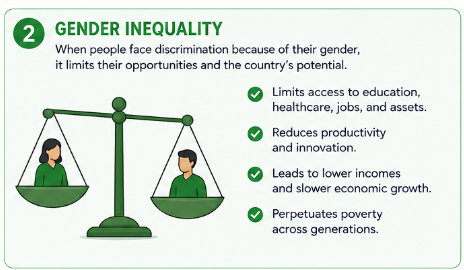
How It Limits Development:
- Human capital remains underutilized.
- Female labor force participation may remain low.
- Educational opportunities for women may be limited.
- Poverty and inequality may increase.
Reducing gender inequality improves productivity and economic development.
Lack of Good Governance and Corruption
Good governance refers to effective, transparent, and accountable government institutions.
Corruption occurs when public power is used for private gain.
How Corruption Limits Development: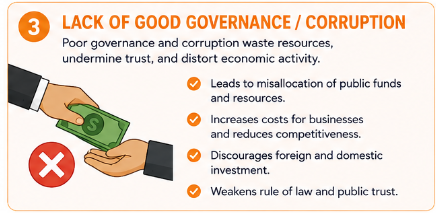
- Public funds may be misused or stolen.
- Investment and business confidence may decrease.
- Resources may be allocated inefficiently.
- Public services may remain poor.
Corruption therefore weakens economic efficiency and trust in institutions.
Unequal Political Power and Status
In some countries, political power may be concentrated among small elite groups.
How It Limits Development:
- Policies may favor powerful groups rather than the general population.
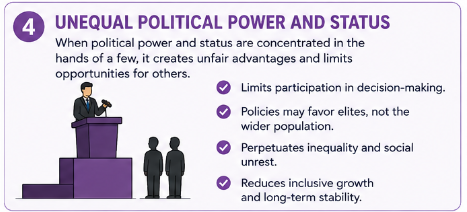
- Poverty and inequality may persist.
- Social mobility may remain limited.
- Political instability and conflict may increase.
Inclusive political systems are important for broad-based development.
Consequences of Political and Social Barriers
- Reduced domestic and foreign investment.
- Lower economic growth and productivity.
- Persistent poverty and inequality.
- Weak public services and infrastructure.
- Social instability and conflict.
Political and social barriers therefore weaken long-term development prospects.
Policies to Reduce Political and Social Barriers
- Strengthening legal and political institutions.
- Improving transparency and reducing corruption.
- Expanding access to education and healthcare.
- Promoting gender equality and social inclusion.
- Developing effective financial and taxation systems.
Institutional reform is often necessary for sustainable economic development.
Summary of Political and Social Barriers:
| Barrier | Main Effect on Development |
|---|---|
| Weak Legal System | Low investment and economic uncertainty |
| Ineffective Taxation | Low government revenue and poor services |
| Weak Banking System | Limited investment and access to finance |
| Weak Property Rights | Reduced investment incentives |
| Gender Inequality | Underused human capital |
| Corruption | Inefficient resource allocation |
| Unequal Political Power | Persistent inequality and exclusion |
Evaluation
- Strong institutions and good governance are essential for sustainable development.
- Political and social barriers often interact with economic barriers.
- Reducing corruption and inequality may improve investment and productivity.
- Inclusive political and social systems support long-term economic growth and development.
Example 1
Explain how corruption may limit economic development.
▶️ Answer / Explanation
Corruption occurs when public officials misuse power for personal benefit.
Government funds intended for healthcare, education, or infrastructure may be stolen or used inefficiently.
This reduces the quality of public services and weakens development outcomes.
Corruption may also discourage domestic and foreign investment because businesses face uncertainty and unfair practices.
Therefore, corruption reduces efficiency, investment, and long-term economic development.
Example 2
Using an example, explain why gender inequality may create a barrier to development.
▶️ Answer / Explanation
If women have limited access to education and employment opportunities, a large part of the population cannot fully contribute to economic activity.
For example, low female school enrollment may reduce the number of skilled workers in the economy.
This lowers productivity and slows economic growth.
Gender inequality may also increase poverty and reduce household incomes.
Therefore, reducing gender inequality can improve human capital and support economic development.