
Preferential Trade Agreements
Preferential trade agreements (PTAs) are agreements between countries that reduce or remove trade barriers such as tariffs, quotas, and other restrictions among participating members.
The purpose of these agreements is to encourage international trade, improve economic cooperation, and increase economic growth among member countries. Preferential trade agreements may exist at different levels depending on the number of participating countries and the geographic scope.

Main Types of Preferential Trade Agreements:
- Bilateral agreements
- Regional agreements
- Multilateral agreements
Preferential Trade Agreement = Reduced trade barriers between member countries
Bilateral Trade Agreements
Bilateral trade agreements are trade agreements between two countries. The participating countries agree to reduce or eliminate trade barriers between each other.
These agreements are usually easier to negotiate because only two countries are involved.
Main Features:
- Involves only two countries.
- Reduces tariffs and trade restrictions between members.
- Encourages trade and investment flows.
- Can be tailored to the specific needs of both countries.
Advantages:
- Simpler and faster negotiations.
- Improved access to foreign markets.
- Strengthens political and economic relations.
Disadvantages:
- Benefits are limited to only two countries.
- May create trade diversion.
- Smaller economies may have weaker bargaining power.
Example: Free trade agreement between two neighboring countries.
Regional Trade Agreements
Regional trade agreements (RTAs) involve a group of countries, usually located within the same geographic region, that agree to reduce or eliminate trade barriers among themselves.
Regional agreements encourage economic integration and cooperation between neighboring economies.
Main Features:
- Involves multiple countries within a region.
- Promotes regional economic integration.
- Reduces tariffs and trade restrictions among members.
- May involve deeper integration such as common markets or customs unions.
Advantages:
- Larger markets for firms.
- Greater economies of scale.
- Improved political and economic cooperation.
- Encourages regional development.
Disadvantages:
- May discriminate against non-member countries.
- Trade diversion may occur.
- Economic benefits may not be shared equally among members.
Examples:
- USMCA (North America), the European Union (EU)
Multilateral Trade Agreements
Multilateral trade agreements involve many countries participating in global trade agreements under common international rules.
The most important multilateral organization is the : (WTO).
The WTO promotes free trade by reducing trade barriers, resolving trade disputes, and establishing international trade rules.
Main Functions of the WTO: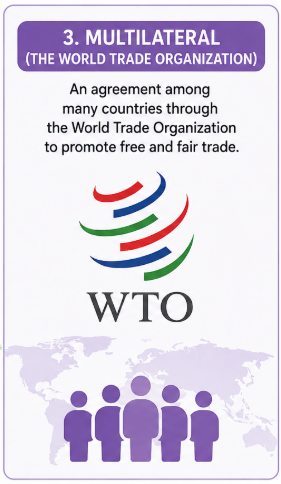
- Promotes freer international trade.
- Provides a framework for trade negotiations.
- Resolves trade disputes between countries.
- Encourages transparency and fair trade practices.
Advantages:
- Creates global trade rules and stability.
- Reduces uncertainty in international trade.
- Encourages global economic growth.
- Provides dispute settlement mechanisms.
Disadvantages:
- Negotiations are complex and time-consuming.
- Developing countries may have weaker bargaining power.
- Global agreements may be difficult to enforce equally.
Example: WTO agreements involving member countries worldwide.
Comparison of Preferential Trade Agreements:
| Type | Scope | Main Feature | Example |
|---|---|---|---|
| Bilateral | Two countries | Trade agreement between two nations | Country-to-country FTA |
| Regional | Group of countries in one region | Regional economic integration | European Union |
| Multilateral | Many countries globally | Global trade rules and cooperation | World Trade Organization |
Evaluation
- Preferential trade agreements generally increase trade and economic cooperation.
- Regional and multilateral agreements may create larger economic benefits through bigger markets.
- Trade agreements may also create trade diversion by favoring members over non-members.
- The effectiveness of agreements depends on economic cooperation and enforcement of rules.
Example 1
Explain the difference between bilateral and regional trade agreements.
▶️ Answer / Explanation
A bilateral trade agreement involves only two countries that agree to reduce trade barriers between themselves.
In contrast, a regional trade agreement involves multiple countries within a geographic region that cooperate to increase trade integration.
For example, a free trade agreement between two countries is bilateral, while the European Union is a regional trade agreement involving many member states.
Regional agreements generally create larger markets and deeper economic integration than bilateral agreements.
Example 2
Using an example, explain the role of the World Trade Organization in international trade.
▶️ Answer / Explanation
The World Trade Organization (WTO) promotes freer and fairer international trade among member countries.
It establishes trade rules, encourages trade negotiations, and helps resolve disputes between countries.
For example, if one country imposes unfair trade restrictions, another country may bring the issue before the WTO dispute settlement system.
The WTO therefore helps maintain stability and cooperation in the global trading system.